South Korea Pt. 2: The Simple Joys of Slow Travel
10 min readOn navigating the day-to-day in South Korea
안녕하세요 (annyeonghaseyo)!
That means hello in Korean. We’d like to also say 감사합니다 (kamsahamnida), or thank you, for opening up and reading our newsletter today. We’ve had some readers reach out to us and share their thoughts on our writings and adventures, and it’s sparked really lovely discussion. So, we want to invite you to share any commentary/favorite parts of our adventure/etc. either in the comments below or in a private message. It helps motivate us and we’d love to foster more discussion on food and travel!
In our last newsletter, we left off after a busy two days exploring Seoul’s metropolitan. Unfortunately, we woke up on our third day feeling pretty sick. Our sleep deprivation from our overnight flight from Singapore combined with our non-stop itinerary of the last few weeks had finally caught up with us. Our bodies were telling us we needed a rest! This ended up working out because our original flight out of Korea back to the US was for tomorrow. We’d already decided not to board it and extend our travels in Asia indefinitely, so a few days of rest gave us some time to do mental planning of where to go. We did lose out on the money spent for our original flight home, sadly.
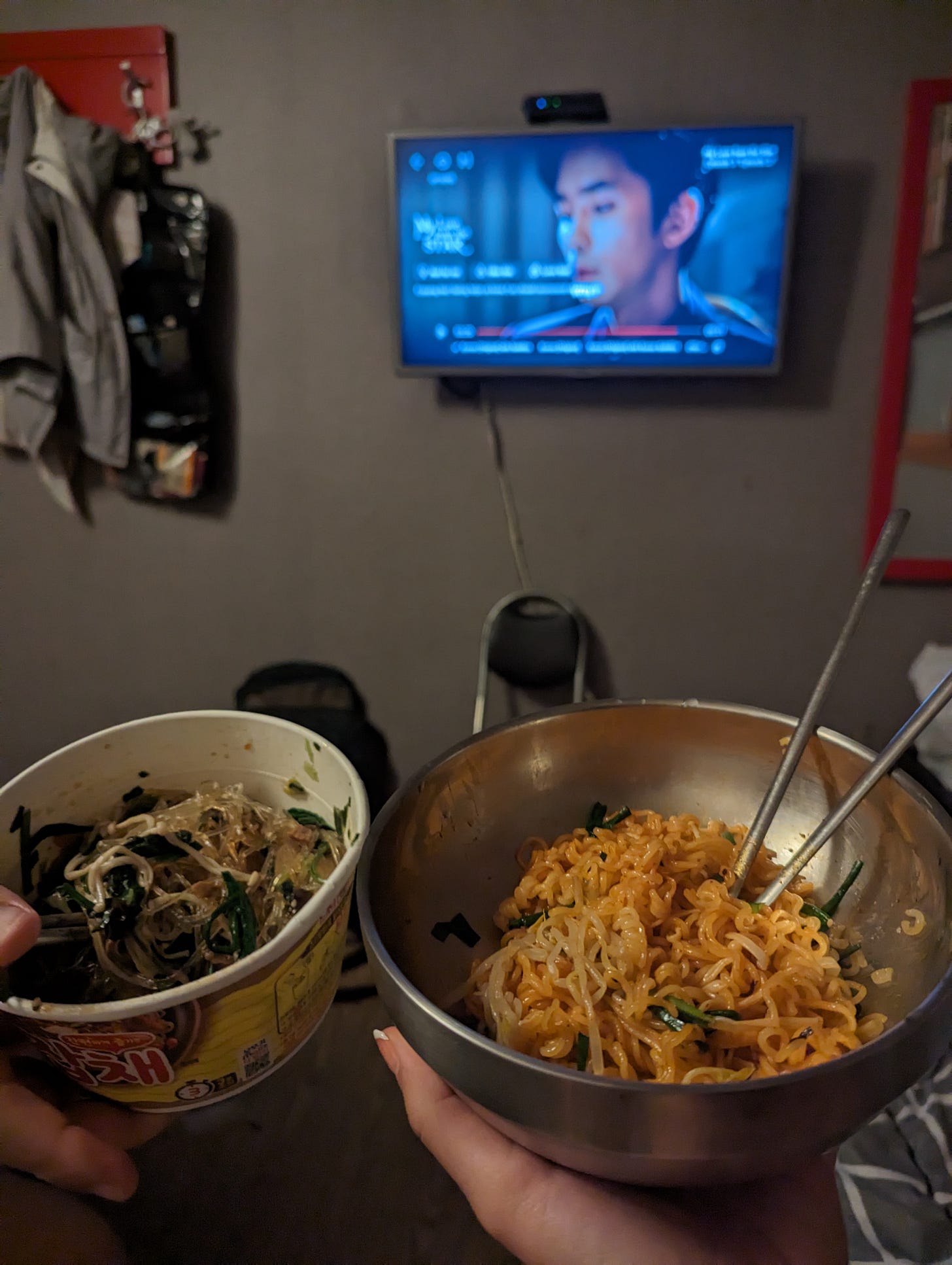
Thankfully, Sol travels with a full first aid kit that includes cold medicine, and we’d brought groceries. Snuggled up on two twin beds, we turned on one of Sol’s favorite k-dramas, My Love from the Stars, and relished the extra joy that comes with watching a K-drama in Korea while eating Korean food.
Carrot and Chickpea Travel Guide: Korea Edition
We thought it would be helpful to give a concise guide on phrases, money exchange, and generally what to expect when in South Korea! These are all things that we often used and/or experienced, so we can attest to their usefulness though we recognize that grammatically they might not be the most accurate.
Basic Phrases
Hangul, the written form of the Korean language, was created by King Sejong the Great in the Joseon Dynasty. He wanted to increase literacy of Koreans and thus devised hangul as writing system whose logical structure would make it easier to learn. The character shapes reflect the position of one’s tongue or lips while forming that sound – so cool! This logical structure is still beneficial to this day. In fact, by the time we’d left Korea, Dang-Huy could read the written alphabet (very slowly)!
We won’t go into all the hangul basics but if you’re interested, we recommended checking out this link. The Korean language has different speech levels. In the most basic way, this means you can speak formally or casually. In general, it’s best to learn the formal phrases while traveling to be as polite and appropriate as possible.
-
Hello = 안녕하세요 (ann-yeong-ha-se-yo)
-
Thank you = 감사합니다 (kam-sa-ham-ni-da)
-
고마워요 (go-ma-wo-yo) is a more informal way of saying thank you, one that you might use with friends or someone close in age.
-
-
Yes = 예 (ye)
-
No = 아니요 (a-ni-yo)
-
I don’t know Korean = 나는 한국말 몰라요 (na-neun han-guk-mal mul-la-yo)
-
Please give me ____ = ____주세요 (ju-se-yo)
-
This phrase might be one of the most helpful ones! You can use it for ordering or asking for items. When paired with 이거 (i-geo) or “this”, the phrase becomes 이거 주세요 (i-geo ju-se-yo). Just point to whatever item you’re asking for when using this phrase and you should be all set!
-
-
One = 하나 (ha-na)
-
There are two numbering systems in Korean – native Korean and Sino-Korean. 하나 (ha-na) belongs to the native Korean system and is what you’d use to order an item.
-
To pair it with the phrase above to order one unit of an item, you’d say 이거 하나 주세요 (i-geo ha-na ju-se-yo). The sentence structure is item-amount-verb.
-
-
Two = 둘 (dul)
-
Note that any number above one in native Korean requires a particle at the end when referring to two units of an item. It would become 두 개 (du-gae)
-
-
Where is ___? = ___어디에요 (o-di-e-yo)
-
Bathroom = 화장실 (hwa-jang-shil)
-
How much is ___? = 얼마예요 (or-ma-ye-yo)
-
Can you do takeaway? = 포장할 수 있어요 (po-jang-hal su i-sseo-yo)
-
This is used specifically for asking to take leftovers home. Not every restaurant offers boxes/allows taking any leftover foods, so we found this to be a key phrase.
-
Getting Around
In terms of traveling throughout the country, we were primarily reliant on buses. They were pretty easy to navigate in terms of buying tickets (the kiosk had an English option) and were very punctual. We found that we never had to buy bus tickets in advance and instead could show up at the bus station an hour before we wanted to leave and select the bus time that worked best for us. We could get from city to city for about ~$12-25 USD / person. Korea does have a train system and multiple airports, though these are more expensive.
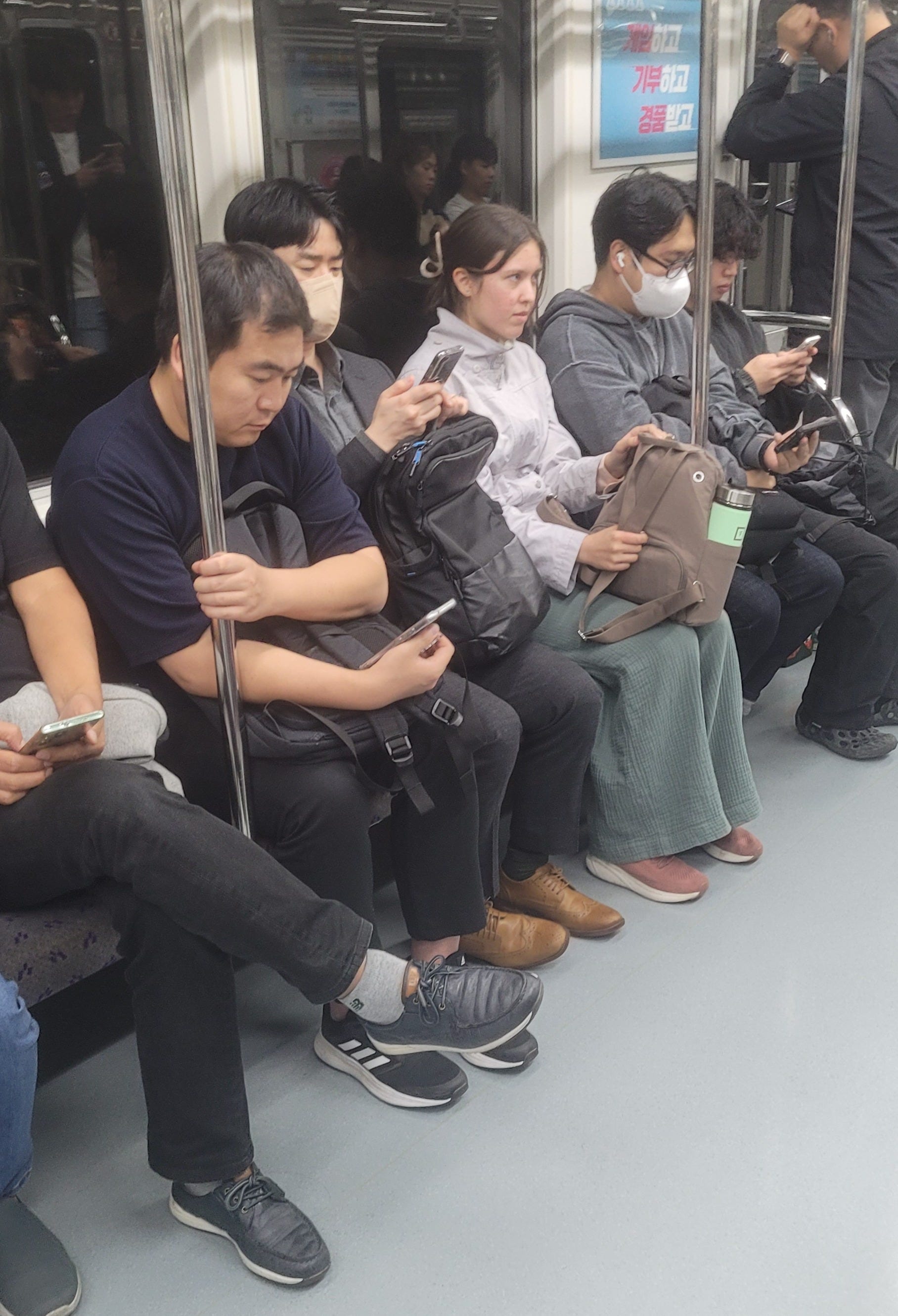
We navigated most cities in Korea on foot or via the city’s metro. With both of these options, be prepared for a lot of stairs! The subway system is deep below the surface and can require many flights of stairs to finally ascend back into the bustling city. Our legs got super strong after doing this multiple times a day. Check out our video below to see what a typical subway station looks like during mid-day. Notice how quiet and clean it is!
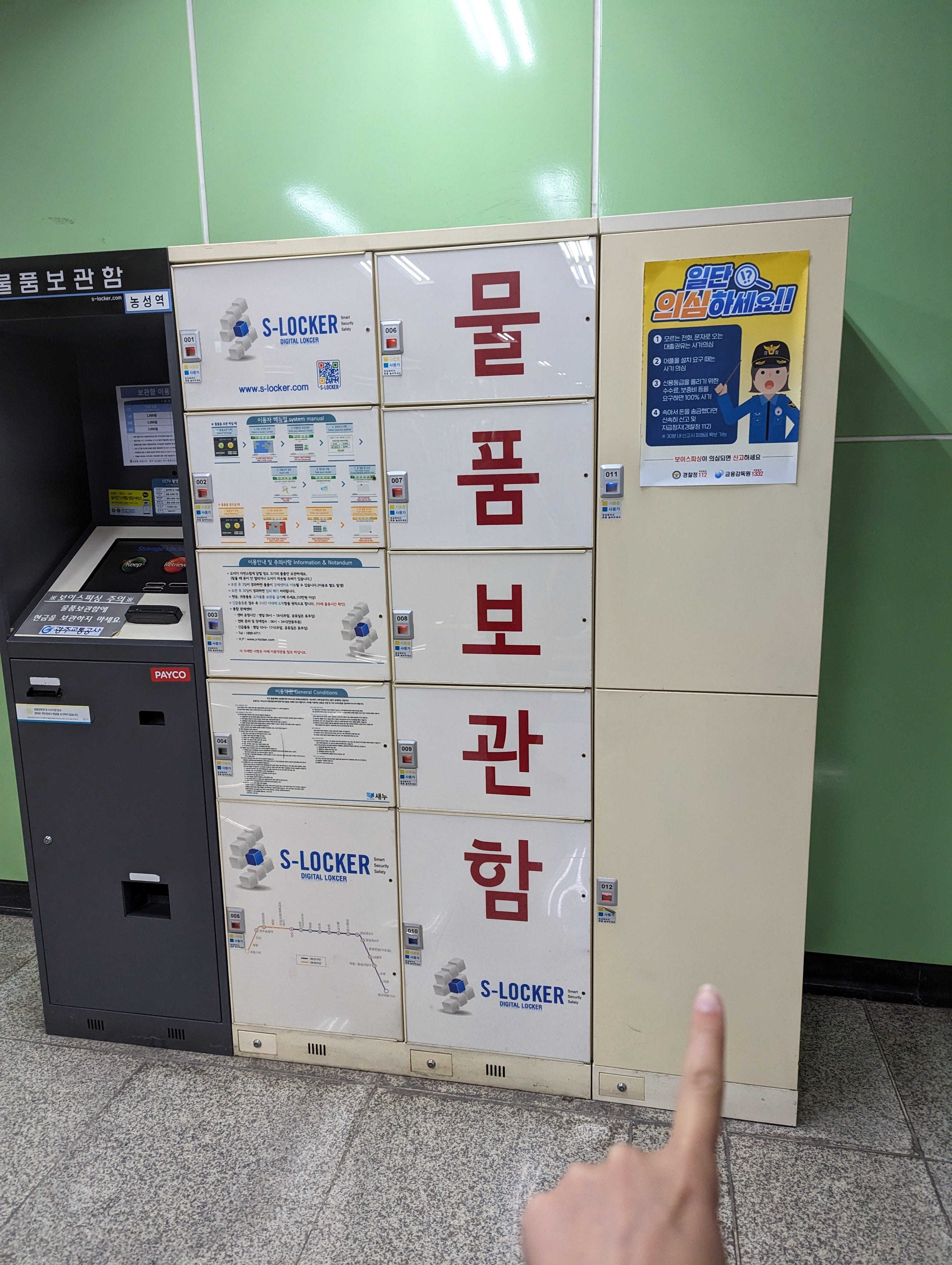
It’s worthwhile to get a metro card if you’ll be in Korea for multiple days. They’re relatively easy to acquire – we got ours at a vending machine in the airport. However, they can only be loaded using cash. This might seem a little inconvenient if you live in a primarily cashless society but with ATMs present everywhere, it’s not too big of a deal. Plus, as travelers on a budget, using cash is a great way to track your spending in our experience. Cards can be loaded at subway stations or at a convenience store.
✨The Convenience Store ✨
It would be remiss to talk about day-to-day travel encounters without mentioning Korea’s convenience stores. Every traveler we’ve met in East Asia adores them. Japan, Taiwan, and Korea all have famous convenience stores and while they vary from country to country, their most unifying trait is that they fully live up to their name of being “convenient”. In Korea, convenience stores are located on every block within the cities. CU, GS25, and e-mart are ones we frequented the most. They have pretty much anything you could need. Instant noodles? Pre-made food to-go? Vegan ice cream? Yup, they have all that and more. From using an ATM to grabbing emergency underwear, these stores are gems for travelers and locals alike. One of our main takeaways from Korea as travelers was that it was a very comfortable country to be in. We believe convenience stores make this comfort more possible because it enabled us to have basic items always available to us.
Recovering from Sickness
Now that you have a better understanding of how we navigated the day-to-day in Korea, we’ll jump back to our storytelling. After spending over day resting inside, we finally mustered up the strength to walk over to a pasta restaurant. We were nearly out of groceries and desperate to see more of Seoul.
We entered a nondescript building, climbed a few levels and entered through a doorway. Once inside, we were greeted by an empty yet cozy room filled with local art. We had arrived right at opening time, and the workers were quietly moving through their preparations for the night.
The menu was small – just a few types of pasta and wine to order – so we quickly ordered and hungrily watched the kitchen like hawks. Even though we probably only waited for 5-10 minutes, it felt much longer as our growling tummies prodded us for food.
When the food arrived, we were pleasantly surprised!
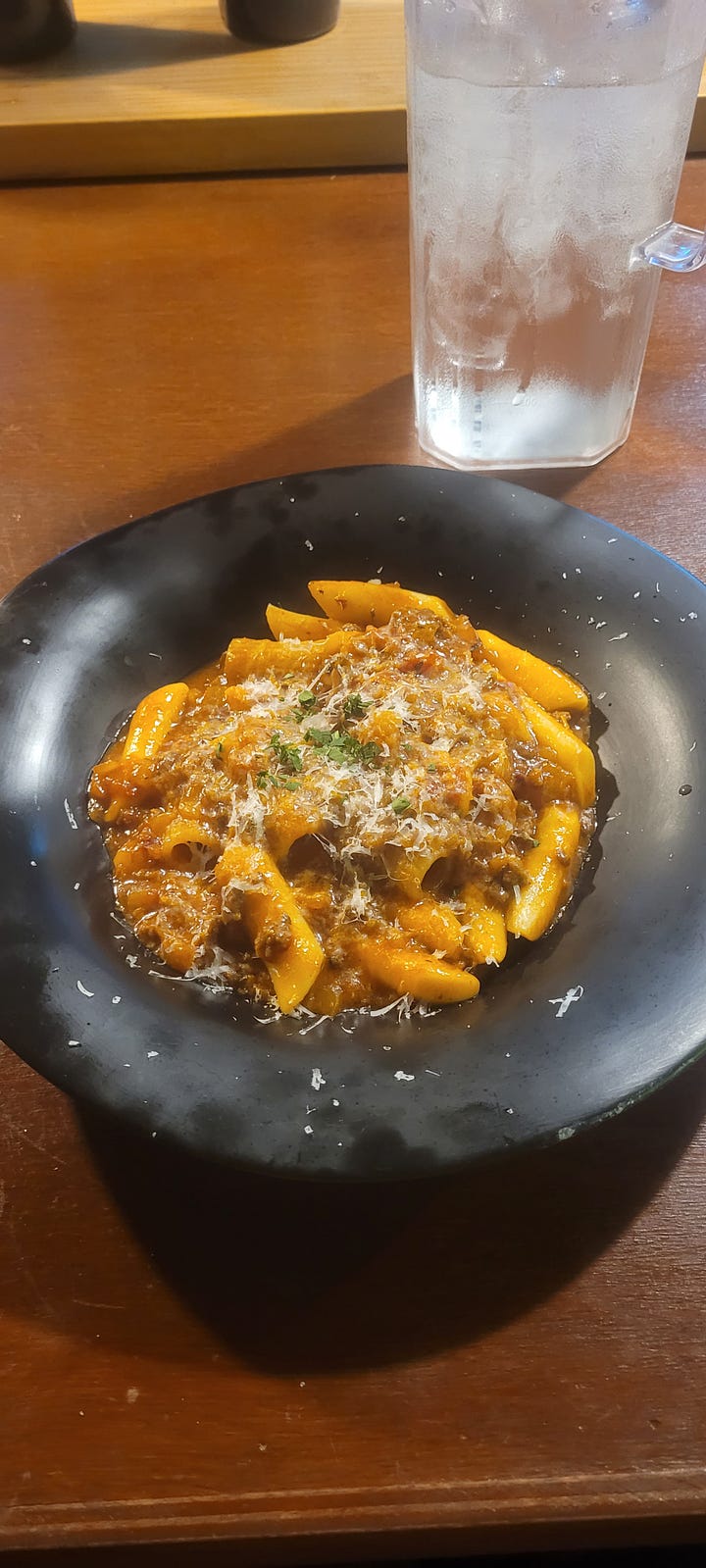
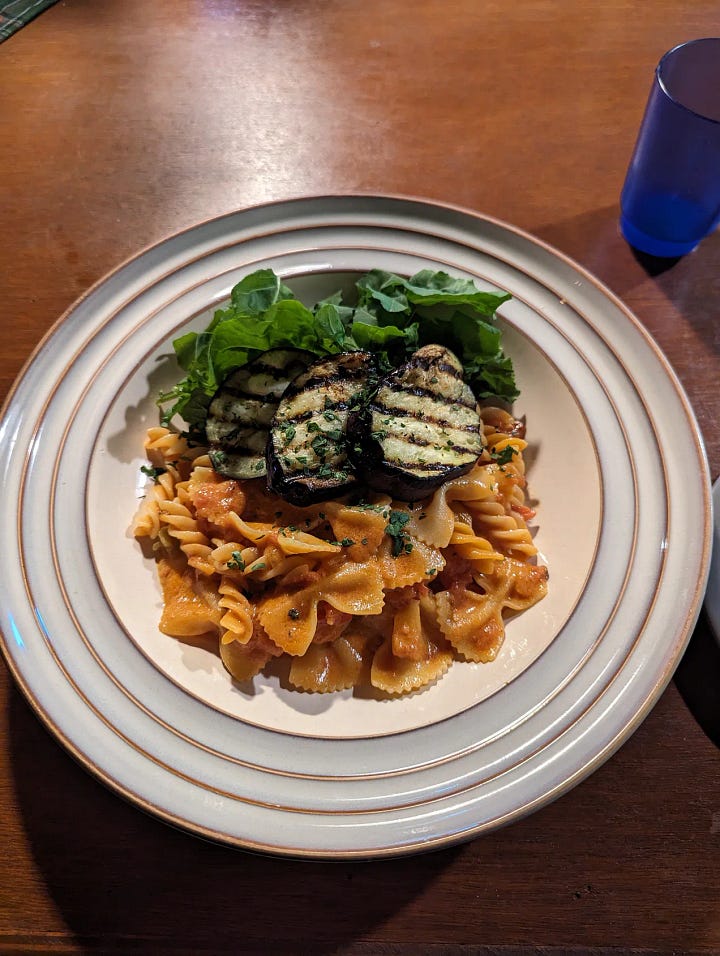
Dang-Huy ordered a Tteokbboki (chewy rice cake) ragu and Sol ordered a vegan grilled eggplant and tomato sauce pasta. The standout for us was having different pastas mixed together – probably blasphemous in Italy, but the textural contrasts were delightful.
Sol: I was happy that we were able to have something comforting like pasta while recovering from being sick. While I love Korean food, when I’m not feeling good I want something to remind me of home. This pasta did the trick of comforting my sick self while appealing to the travel-hungry part of me that’s eager for new experiences.
A Slower Pace and Everyday Living Abroad
If you’ve been following our posts since the beginning, you’ll know that we’d been traveling at a pretty quick pace throughout Indonesia, Malaysia, and Singapore. Everyday was jampacked and we felt heavily fatigued each nightfall. Once we decided to cancel our return flight to the US and stay in Asia for longer, we knew that Korea was the country to finally slow down in.
Instead of planning multiple events per day and bussing from edge to edge of each city to check off all the popular tourist sights, we wanted to focus on the seemingly mundane: walking around, shopping at the groceries, cooking with new ingredients, and structuring our days around only one or two things to do. Doing as such would match our physicality and budget, and being unemployed, we had the luxury of time to stay in each city as long as we pleased. To our pleasant surprise, we discovered we were never bored when travelling slowly. When you slow down to examine the minutia, those mundane routines are an excellent filter lens that highlight the biggest cultural differences between people.
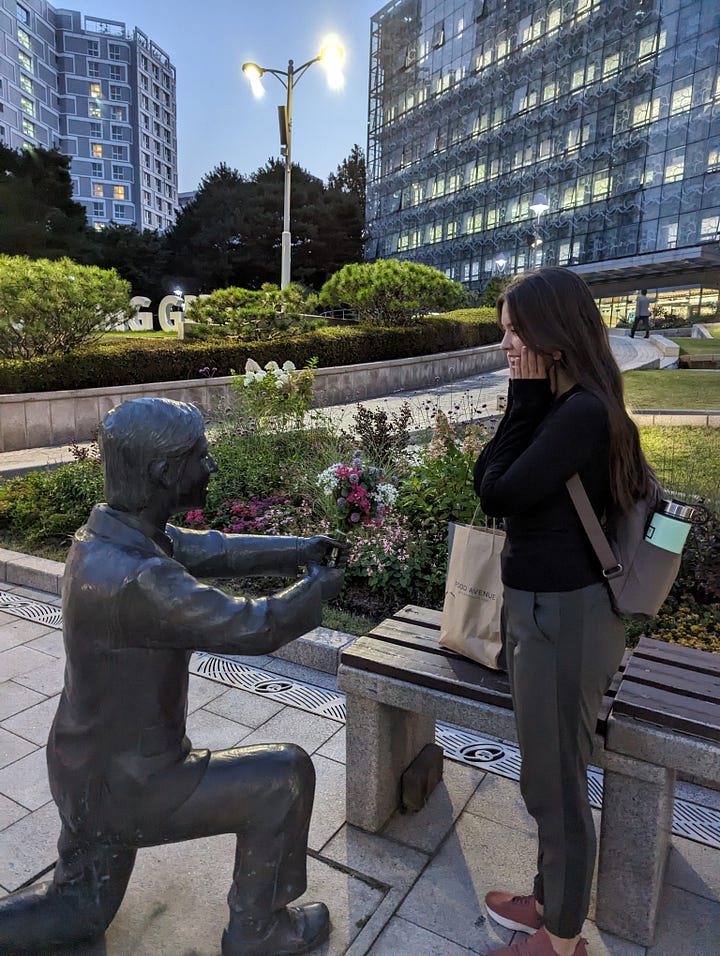
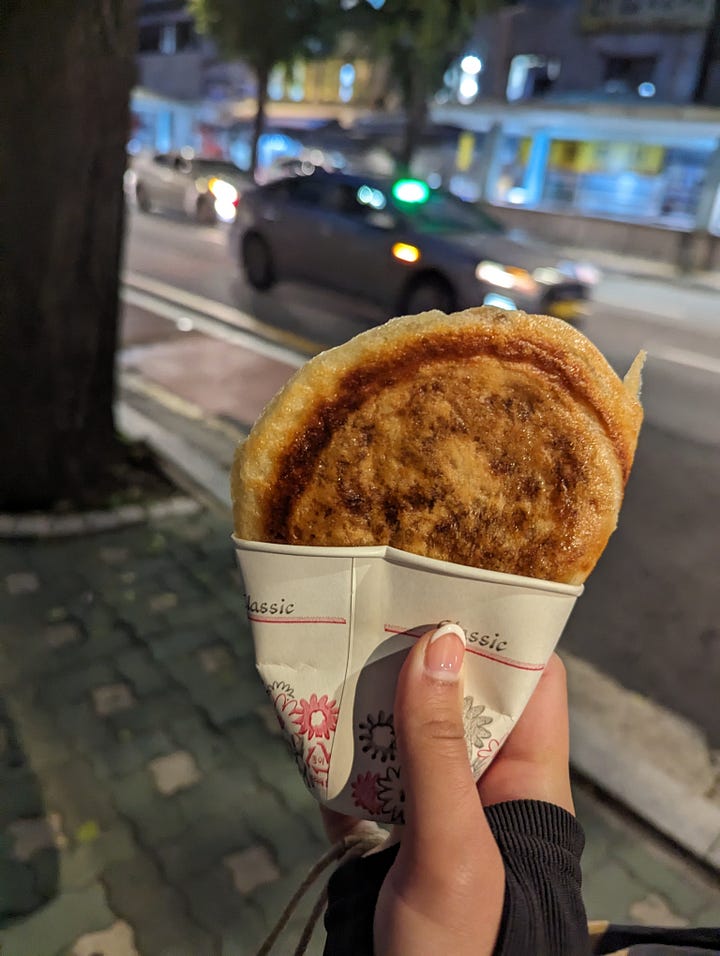
On our walks throughout Seoul we discovered cool statues like the one above and would stumble upon a few street food vendors occasionally. While Korea’s street food culture isn’t as prevalent as in South East Asia, we did get to try a few snacks. For example, hotteok is a sweet and chewy Korean pancake that is filled with sugar, cinnamon, and peanuts. It’s only available in the wintertime and since the weather was cooling down, we were lucky enough to stumble upon an elderly woman selling them. She was so sweet and gave us two for the price of one without us asking.
Dang-Huy: I can’t eat peanuts, so Sol got to have two haha. It was also a surprising experience because the grandma was just set up in a makeshift tarp, and sanitation standards were lower than what we normally saw in Korea. Sol said she saw a cockroach scuttling around on the ground. I felt a little bad for the grandma and wished I could have given her a more comfy life.
Sol: The hotteok wasn’t as good as others I had, but I have no regrets that we stopped there. I loved getting to interact with the vendor and speak with her in Korean!
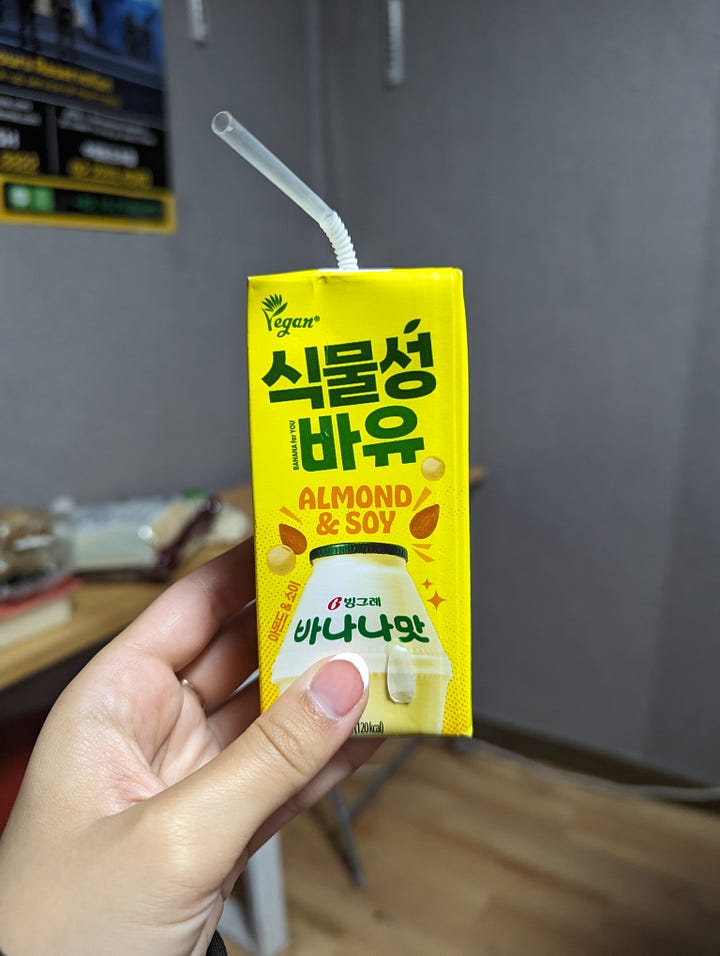
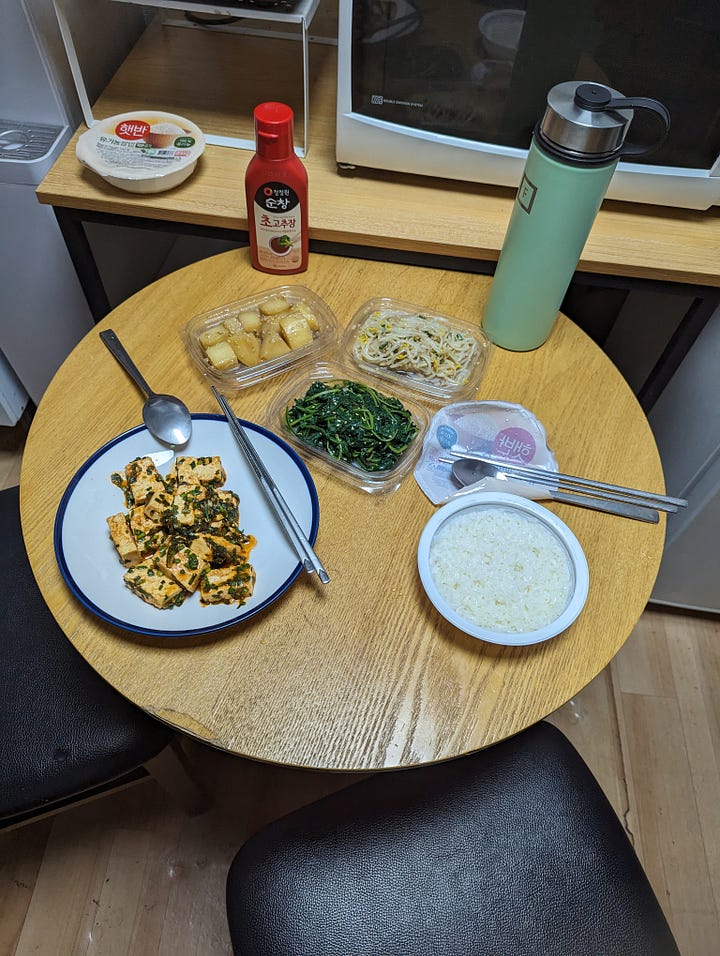
Many nights, Dang-Huy would cook up a simple meal using grocery store ingredients: tofu with a vinegary-gochujang cocktail sauce and garlic chives served with microwaveable rice, sweet soy sauce potatoes, blanched spinach, and blanched bean sprouts. We’d gotten the spinach, potatoes, and bean sprouts as premade banchan (Korean side dishes) at the grocery. That was its own unique experience, as the aunties there bagged and weight our produce for us and advised we get three banchan minimum!
Dang-Huy: A note about Korean microwaveable rice: It’s a totally different story from American parboiled rice. Not saying there’s anything wrong with parboiled rice – it has its place – but Korean microwaveable rice tastes just like rice you’d make in a pot or rice cooker. The convenience to taste ratio is on another level, especially when you’re travelling or have a small kitchen.
Sol: There is nothing better than Dang-Huy’s home-cooking! Home-cooked meals are nearly always delicious and healing in their own ways, but when it’s made from your loved ones, it’s got that special quality. Plus, Dang-Huy is an amazing chef. If you haven’t tried his cooking yet, you are missing out!
Cooking with humble local ingredients after walking around is the perfect example of a simple slow travel joy. You’ll find this quiet happiness becomes a common theme throughout our travels going forward. Indeed, holding these moments tenderly makes us wonder how many other simple joys we might be missing out on due to life’s busy nature.
Next time in our newsletter: join us as we explore the Itaewon neighborhood, the international-friendly area where the misfits of Korean society often find belonging. Here we will connect with a friend of Sol’s and check out one of Korea’s many bakeries before exploring Seoul’s district of traditional Korean homes!
Grateful to be feeling better,
Dang-Huy and Sol


