Tbilisi in Autumn: 15 Magical Things to Do in the Golden Season
14 min readDiscover all the best things to do in Tbilisi in autumn, including special events and celebrations, the best spots for fall foliage in the city centre, seasonal food and wine, and autumn day trips.
While there’s no ‘wrong’ time to visit Tbilisi, I have to admit that summer is my least favourite time of year in the city. The heat is searing, the air is thick, and the light is far too harsh for photography.
As soon as September rolls around, the mercury starts to slide and the air clears. That’s my queue to lace up my shoes and grab my camera. By the middle of the month, Tbilisi is absolute paradise!

Autumn in Tbilisi is long, lingering, and pronounced. The trees along the riverside and in the city’s parks turn shades of bronze and chestnut, while the hills take on a honey-coloured glow. This is the perfect time to get out and explore on foot.
In early fall, there are outdoor events – street markets, live music performances and the like – happening almost every weekend. Add to that special festivals, seasonal produce and the Rtveli wine harvest, and there’s no doubt in my mind that these are Tbilisi’s golden days.

Please note: This post contains affiliate links, meaning I may earn a commission if you make a purchase by clicking a link (at no extra cost to you). Learn more.
Tbilisi in autumn: Quick monthly overview
Tbilisi in September
September is often called the ‘fourth month of summer’ because in Tbilisi and the lowlands, it remains warm and balmy for much of the month. Generally speaking, temperatures only start to drop into the mid-20s from the second week of September onwards.
The end of the month brings breezy nights – perfect for sitting outside with a blanket over your shoulders and a glass of wine in hand. There can be intense evening storms, but generally speaking the days are dry.
Hiking trails around Tbilisi remain relatively busy, and you get a nice mix of summer greens and autumn yellows on the trees. There are lots of outdoor festivals and celebrations held in the city during this month.


Tbilisi in October
October can be one of the nicest times of year in Tbilisi weather-wise, with temperatures around 15-20 degrees during the day, dropping below 10 degrees at night. It’s still quite dry, but slightly more humid.
The colours really start to pop this month, and the light mellows out into beautiful golden tones. This makes October my favourite month of the year in Tbilisi!


Tbilisi in November
Tbilisi dries out in November and the hills around the city start to turn grey. The sky clouds over towards the end of the month as winter starts to creep in.
Temperatures hover around 8-10 degrees (5 degrees overnight), so it’s still quite pleasant outdoors. November brings some of the shortest days of the year, so wake up early to make the most of it.
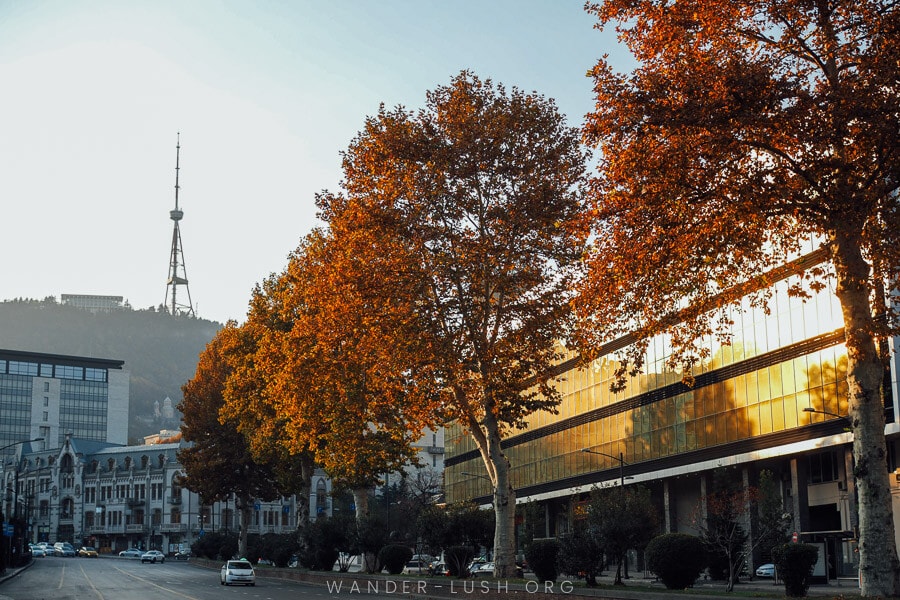
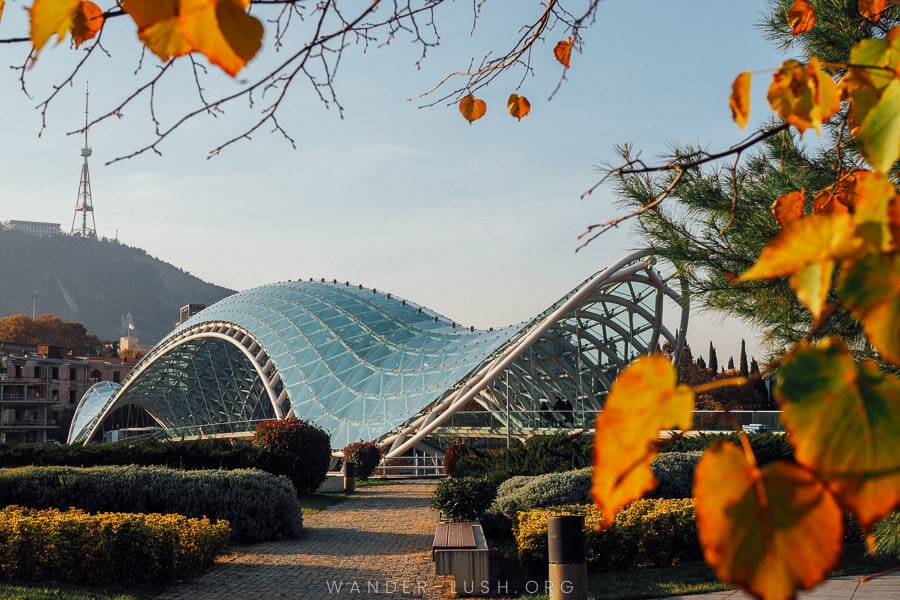
If you visit Tbilisi in spring or summer, you’ll no doubt be struck by how green the city is. Come autumn, those same parks, boulevards and hillsides transform into a blaze of colour, offering the chance to enjoy fall foliage right in the centre. You don’t need to leave the capital to see the seasons change.
Where to see fall colours in Tbilisi:
- Rike Park (pictured above)
- State Botanical Garden
- Lisi Lake
- Kojori (near Tbilisi)
- Vake Park (more below)
Even a simple stroll through the Old City feels special at this time of year. Many of the main avenues are lined with deciduous trees that turn gold and crimson from late October into November, while on the outskirts of Tbilisi, the forested hills begin to show their colours as early as late September. Peak colours usually arrive in late November and last until mid December.


One of the best spots for leaf-peeping is along the Mtkvari River. Both banks have pedestrian footpaths that are fine for strolling (just take care when crossing the busy highway – I recommend going in the early morning when there’s fewer cars on the road).
The stretch along the Left Bank, between Marjanishvili Bridge and Saarbrücken Bridge, delivers postcard views of the Public Services Hall, the gold-topped Sameba Cathedral, and the Bridge of Peace framed by autumn trees.

Tbilisi feels a lot calmer in the shoulder season compared to August and July. Families return to the capital from their summer holidays to ‘claim back’ their city, resuming work and school from mid-September onwards.
Popular tourist landmarks such as the Dry Bridge Market and Narikala Castle are far less crowded than in summer, and you can often wander into a quiet backstreet and not see another soul.

Shrivelled grapes still hang from vines, golden creepers climb the facades, and blue balconies stand out perfectly against cascades of red and amber leaves.
2. Walk beneath the autumn canopy in Vake Park
Vake Park, Tbilisi’s largest public park, spans 200 hectares at the top of Chavchavadze Avenue, in the foothills of the Trialeti Mountains. First opened in 1946 and recently renovated, its old-growth trees and shady sitting areas make it one of the city’s most beloved green spaces.
In autumn, the park is especially beautiful – the wide avenues and towering trees form golden canopies from October to November, turning it into one of the best spots in the capital for an afternoon walk.
The centrepiece of the park is a grand staircase and fountain topped with the 28-metre-tall People’s Monument, designed by Giorgi Ochiauri and Zurab Tsereteli in 1985 as a memorial to the Great Patriotic War (WWII).
From Vake Park, you can either climb the monumental steps or ride the Turtle Lake Cable Car – one of the last Soviet-era gondolas still in operation – to reach the Open Air Museum of Ethnography and Turtle Lake above. The museum, founded by ethnographer Giorgi Chitaia, is a living showcase of traditional dwellings and cultural heritage from across Georgia.
While you’re up there, be sure to grab some hearty mountain fare at Rachis Urbani, a hilltop restaurant with a panoramic view of the city.
3. Watch a perfect autumn sunset from King Parnavaz Garden


As someone who loves photography, I can’t get enough of Tbilisi’s soft autumn light. One of the best places to capture the mood is King Parnavaz Garden in Avlabari. A small square perched above a bend in the Mtkvari River, it is dedicated to the first ruler of the Kingdom of Iberia.
This is one of my favourite viewpoints in Tbilisi and the best sunset spot in the city – and in autumn, it’s just that much better. From here, you can get a beautiful photo of Metekhi Church, Narikala Fortress, and the Old Town glowing in the evening sun.
4. Admire the autumn produce at the Dezerter Bazaar

Pumpkins, potatoes, pomegranates, persimmons – and plenty of other produce that doesn’t start with the letter P – all come into season in Georgia in autumn. Head to the Dezerter Bazaar, the city’s lively agricultural market, to see elegant strings of dried persimmons hanging above stalls, and marigold flowers the colour of sunbeams adding splashes of gold between the crates of fruit and vegetables.
If you know anything about Georgian cuisine, you’ll know it’s hearty and wholesome – made for munching on brisk autumn eves. Restaurants in Tbilisi take full advantage of nature’s fall bounty, often adding special seasonal meals to their menus. Look out for pumpkin pkhali and fresh mushroom dishes.
The ultimate autumn delicacy is the Caesar’s mushroom, foraged in Western Georgia (especially Upper Imereti) from late August through September. These large amber-coloured beauties were prized by the Ancient Romans and are still much sought-after today.
Chanterelles are another wild variety that thrive in Georgia. If you want to try your hand at mushrooming, popular foraging spots near Tbilisi include Sabaduri Forest and the Gombori Pass near Telavi.
5. Browse the pop-up markets on Rustaveli Avenue

Tbilisi’s main boulevard, Rustaveli Avenue, takes on a special charm in autumn. The tall leafy trees that line both sides of the street begin to shed in October, their golden leaves carpeting the wide pavements.
If you go out early in the morning, before the street sweepers with their straw brooms have passed through, you’ll find the sidewalks completely blanketed in syrup-coloured foliage – a magical sight to start the day.

A walk down Rustaveli is as much about the architecture as the atmosphere. As you crunch along, you’ll pass some of Tbilisi’s most impressive buildings – theatres, galleries and museums – all set under gorgeous dappled light.
Weekends in early autumn often bring outdoor events to the avenue, from concerts and food stalls to regular maker’s fairs organised by STALL. These lively markets are ideal for browsing handmade souvenirs, sampling treats, or simply people-watching with an ice cream in hand.
6. Join a street art tour


Tbilisi has exploded with street art over the past decade. From large-scale murals to stencils and graffiti, the city’s walls carry everything from playful designs to sharp political messages. Autumn is an ideal time to canvas the street art – the soft light is perfect for photography, there are fewer leafy trees to get in the way, and the cooler weather makes it comfortable to spend hours outdoors.
My favourite place to start is Chugureti neighbourhood, especially around Fabrika – the birthplace of Tbilisi’s street art movement.
If you want to go deeper, join a 3-4 hour guided street art tour with Tbilisi Free Walking Tours, which begins at Fabrika and then continues by minivan to the vast concrete jungle of Varketili – a place that few travellers venture. The massive grey apartment blocks on the city’s edge have been transformed by local and international artists into some of the largest and most impressive street art pieces in Georgia.
The tour not only introduces you to the city’s most striking artworks, it also gives insight into Tbilisi’s contemporary counterculture and its Soviet architectural legacy.
7. Celebrate Tbilisoba, Georgia’s biggest street festival
Taking place in early October (normally the first weekend of the month), Tbilisoba is the biggest event on Georgia’s cultural calendar. The capital’s ‘day of’ festival celebrates all things Tbilisi while also shining a light on the regions. If you’re lucky enough to be in town while it’s on, you can experience the whole of Georgia in one afternoon.
In 2025, Tbilisoba will be held earlier than usual on September 20-21. The reason for the change is the upcoming elections, scheduled for October.
The cornerstone of the festival is food. Farmers and producers from around the country descend on Orbeliani Square and Dedaena Park for a huge Gastronomic Fare, which showcases the cream of autumn crops, wine, and regional food specialties including artisanal cheese.
Outdoor stages dispersed around the Old Town host folk dance, orchestra, big band and theatre performances, giving the whole city an outdoor music festival vibe (peak levels of public chacha consumption guaranteed).
Tbilisoba is free to attend. Dates are typically announced a month out, with a full program made available a few days in advance.
8. See Sukhishvili at Takara
Autumn is one of the best times for live music and cultural performances in Tbilisi, as many touring ensembles return home after the European summer. Alongside ballet and opera on Rustaveli Avenue, adults-only puppet shows at the Gabriadze Theatre, and the Autumn Tbilisi International Music Festival, the city often hosts performances by the legendary Sukhishvili National Ballet.
Founded in 1945 by Iliko Sukhishvili and Nino Ramishvili, Sukhishvili is more than just a dance troupe – it has become one of the country’s greatest cultural exports. The company has performed in over 90 countries – at venues including the Royal Albert Hall and Madison Square Garden – and is renowned for blending centuries-old folk traditions with spectacular choreography, acrobatics, and dramatic live music.
In autumn, Sukhishvili performs at Takara, their open-air amphitheatre tucked into the hills above the city. Just 15 kilometres (about a 25-minute drive) from Freedom Square, it is a magical setting where dance unfolds beneath the stars.
Tickets sell out fast, so be sure to keep an eye on the Sukhishvili website for announcements. In 2025, the troupe will perform at Takara from September 11-20.
I use the TKT.ge website to search for events and to buy tickets for sporting matches, festivals and concerts in Georgia.
9. Head to the hills for a view

Because Tbilisi is set in a valley, you can literally watch autumn gradually sweep in as the surrounding mountains start to change colour. In winter, the first traces of snow in the city always appear at higher altitudes.
Mtatsminda and Narikala both offer panoramic views, while lesser-known spots such as Betlemi Rise provide a quieter alternative. Mtatsminda is also home to the Pantheon of Writers and Public Figures, one of Georgia’s oldest cemeteries, where cultural icons and national treasures are commemorated with elaborate sculptures and tombstones.


A short hike is the perfect way to while away an autumn afternoon in Tbilisi, treating yourself to sweeping vistas of the city in a warm palette of fall colours. For safety, I recommend hiking with a friend.
Alternatively, use the city’s network of cable cars and funiculars to get high.
10. Soak in the sulfur baths

Any local will tell you the best time to visit the sulfur baths is when the air outside is cool and crisp. Brisk autumn evenings are ideal for sinking into the steaming pools, and a traditional kisi scrub is the perfect way to refresh body and soul after a long, sweaty summer.
The heart of Tbilisi’s bathing tradition is Abanotubani, where a dozen or so bathhouses sit beneath their domed brick roofs. Among the most popular are Chreli-Abano, with its colourful Persian-style facade, and Gulo’s, beloved for its authenticity and old-world feel.
Beyond Abanotubani, there are more bathhouses scattered across the city that each offer something different – from modern spas to banya-style steam rooms. For my recommended venues, plus tips on etiquette and how to make the most of your soak, see my full guide here.
11. Go cafe-hopping

Tbilisi’s cafe culture is getting better every year. While pumpkin spice lattes aren’t a big trend here (they are served at Chiti and Baho, with a vegan version available at Coffee Place), you will find excellent specialty coffee and locally grown tea that fit the season just as well.
Cafe Leila is an autumn classic – its pumpkin-coloured facade and snug interior set the mood, and in the season they serve a mean pumpkin soup. For coffee or a leisurely breakfast, Chaduna in Sololaki is a favourite, while Aristaeus Tea House does waffles and steaming cups of chai.
12. Do a Georgian wine tasting at 8000 Vintages

To enhance your experience in Kakheti, I highly recommend brushing up on your Georgian wine knowledge with a degustation in Tbilisi. Even if you know nothing about wine (hello, that’s me), you’ll find it an incredibly rewarding task.
In Georgia, wine isn’t just wine – it’s a pathway to learning about history and culture. And in autumn, when a new batch of grapes is placed in the qvevri, there’s something especially fitting about sipping a full-bodied amber, its rich golden hue mirroring the colours of the season.
For a more formal introduction, a guided tasting with a sommelier is the best way to dive in. 8000 Vintages is my favourite wine shop-bar in Tbilisi: the selection is vast, the grazing plates are excellent, and the staff really know their stuff. Don’t be intimidated – tastings here are beginner-friendly, and prices are extremely fair. (You can read all about my wine tasting experience here.)
If you’d prefer something more laid back, the city’s bars serve local vintages by the glass or bottle. And if wine isn’t your style, you can always find craft beer, apple cider and even Saperavi Georgian grape juice on the menu.
13. Take a day trip to Kakheti for the Rtveli


If you’re a wine-lover, September/October – AKA the Fifth Season – is the ultimate time to visit Tbilisi and Georgia. In Kakheti and all across the country, people start harvesting and processing grapes for winemaking. Known as Rtveli, the harvest season is a joyous occasion deeply tied to Georgian identity.
If your trip coincides with the harvest, then Kakheti is simply a must. Ideally you should spend a few nights in the region: Use this transport guide to get there, this accommodation guide for tips on where to stay, and my Kakheti itinerary for things to do.
Not all vineyards are open to visitors during Rtveli, so you have to plan ahead if you want to see the harvest in action. See here for a list of Rtveli venues for this year.
For an authentic harvest experience with a supra meal, I highly recommend going as part of an organised tour. Book a Real Rtveli experience Kakheti or an alternative wine region near Tbilisi with my preferred tour company, Eat This! Tours. Use wanderlush to get 5% off your booking.
14. Hike in the Rkoni Valley

An easy day trip from Tbilisi, the Rkoni Valley is a great spot for late-season hiking and fall colours. Located near Gori, 90 minutes’ drive from the capital, the valley glows with golden hues from mid October into early November.
The hiking trail starts in picturesque Rkoni village and winds through woodland to the 7th-century Rkoni Monastery, before continuing to the elegant Tamar Bridge, a 12th-century stone arch linked to Georgia’s golden age. Fallen leaves and acorns decorate the path for a true autumn-wonderland feel.
The hike takes a few hours to complete over fairly even terrain, and the way is clearly sign-posted. On weekends, you will likely encounter other hikers and groups of Georgian visitors from Tbilisi. A vehicle with high clearance is required to access the trailhead – transfers are available on GoTrip.
15. Take a scenic drive through Tianeti (best autumn colours near Tbilisi)

The ultimate leaf-peeping destination near Tbilisi is the town of Tianeti, less than two hours’ drive from the capital. The road unfurls in long, straight stretches lined with tall trees blazing gold in October, then winds into the mountains with views of rolling hills painted in rich hues.
This route also works as an alternative connection between Kakheti and Kazbegi, making it a scenic way to travel between the two regions without having to pass back through the city. Along the way, don’t miss Kvetera Fortress Church – its distinctive turquoise-glazed roof gleams against a backdrop of fiery foliage.
The humble but delicious Super Khinkali in Tianeti is a great place to stop and try the area’s signature dumplings and dambalkhacho cheese.


Peak colours in Tianeti arrive from mid to late October. Shared transport in this area is limited, so it’s best to go with your own car or book a private driver for the day on GoTrip.
You can easily combine it with a visit to Mtskheta on your way back to the city.
What to wear in Tbilisi in autumn + things to pack
The start of September is still warm enough for summer attire, but by the end of the month, you’ll need a jacket or scarf for the evenings. My jeans usually come out at the start of October and by November, I’m wearing at least two layers.
If you feel the cold, I would recommend bringing a warm outer layer for travel in October or November. Autumn can be quite windy as the seasons change, which adds to the chill factor – especially at night. Rain is not uncommon in the first part of autumn so definitely pack a travel umbrella and a rain jacket.
→ Essential reading: My Georgia packing guide for all seasons.


