13 Things to Do in Chiatura: New Cable Cars, Restored Ropeways, Mosaics & More
34 min readA comprehensive guide to visiting Chiatura, Georgia. Includes the best things to do – from the old Soviet-era cable cars to the modern ropeways – a tourist map of Chiatura, and practical tips for planning a visit from Kutaisi or elsewhere.
Chiatura is a mining town perched in the hills of Imereti Region, around 75 kilometres (47 miles) or 1.5 hours by road from Kutaisi. Known for its extensive network of Soviet-era cable cars built from the 1950s-70s, it has long been a favourite destination in Georgia for urbexers and photographers.
Things changed forever in Chiatura around 2018, when the old cable cars were shut down for safety reasons. For the next three years, the city was free of the signature gondolas that had plied its skies for generations. Then, in September 2021, a brand new set of French-built ropeways opened in Chiatura, and ‘Air Venice’ (as one local described it to me) finally got her wings back.
In late 2024, the Sashevardno Cable Car from 1966 – the first of several retro ropeways to undergo restoration – relaunched.

I have been lucky enough to visit Chiatura at different stages of its modern history, including in 2017 when the old cable cars were still running, in autumn 2021 when the new lines launched, and in 2024 as the Sashevardno line started running again. Living in Kutaisi, I regularly travel up to see new what’s new. This guide draws on all my different experiences across the years.
While it’s true that Chiatura has changed dramatically and will never be exactly the same again, for me it hasn’t lost its appeal.
I think it’s wonderful to see new infrastructure making life a lot easier (and safer) for the people who rely on the cable cars to get around. In addition, a lot of work has been done to the town itself – new squares, sidewalks and greenspaces have been created, a leisure park with a Ferris wheel has been built, and many of the buildings in the downtown area have been refaced.
But still, mixed in with the new and shiny, there are enough relics from the past – Brutalist cable car station buildings, rusting gondolas, beautiful mosaics – to make a trip here interesting. It is still absolutely worth including 1-2 days in Chiatura in your Georgia itinerary, especially if you are interested in Soviet history and architecture.


Updated for 2025/2026, this Chiatura travel guide is the most comprehensive resource currently available online. It covers the new cable cars, the old ropeways and stations, plus all the best things to do in Chiatura and nearby (including Katskhi Column).
At the end, you will find detailed transport instructions for getting to Chiatura from Kutaisi or Tbilisi, food and hotel recommendations, and everything else you need to plan a trip.
Are the Chiatura cable cars closed?
After being suspended for several years, in September 2021 the aerial tramways started running again in Chiatura.
But these are not the old Chiatura cable cars: This is a brand new, modern transportation network with four two-way lines, new gondolas, and new upper and lower station buildings.
The old cable car network is classed as an endangered heritage site and parts of it are now being restored. In late 2024, the Chiatura-Upper Rgani line (Sashevardno Cable Car) was the first to reopen to the public. The nearby Chiatura-Perevisa line is currently under rehabilitation and is scheduled to relaunch in 2026. Restoration of its lower station building is almost complete.
I will update this guide as more of the restored cable cars come back online. In the meantime, you can read about my experience riding the original cable cars back in 2017 at the end of this guide.
Please note: This post contains affiliate links, meaning I may earn a commission if you make a purchase by clicking a link (at no extra cost to you). Learn more.
Looking for a Chiatura day trip or a private transfer?
While it is possible to get to Chiatura from Kutaisi using shared transport, if you only have a day, it might be more convenient to hire a driver to take you to the abandoned stations and other points of interest further from the centre of town. I recommend using GoTrip. Prices start from $50, including as many stops along the way as you like.
→ Build your own GoTrip itinerary here.
If you are coming from Tbilisi, I recommend joining a tour for ease and efficiency. Friendly.ge, my preferred day trip provider in Georgia, runs a full-day guided tour that covers all the highlights (including Katskhi Pillar). Guides are enthusiastic and extremely knowledgeable.
→ Book a day trip to Chiatura with Friendly.ge via Get Your Guide.
About Chiatura
The story of Chiatura starts with manganese, a mineral used to manufacture iron and steel. If not for the discovery of manganese in the hills around Chiatura, the town probably wouldn’t exist.
Chiatura was founded when Georgian poet Akaki Tsereteli unearthed the first manganese and iron ore deposits in the area during a 1879 expedition. Heavy investment followed, and by 1905, Chiatura’s mines accounted for an unbelievable 60% of global output.


In 1954-56 – apparently spearheaded by Joseph Stalin, who favoured Chiatura (one of the few Bolshevik strongholds in Georgia) – construction of a kanatnaya doroga (rope road) began with the aim of shortening the miners’ daily commute and boosting productivity.
Up to 20 passenger ropeways and two cargo lines totalling more than 6,000 metres in length plied Chiatura’s skyline. This included the first heavy reversible bi-cable cable car in the Soviet Union (with the first simple reversible mono-cable having been built down the road in Zestafoni a decade earlier in 1946).
The cable cars ferried miners and commuters alike up and down the steep hills, and was vital for connecting the mines with the city centre and Chiatura’s upper neighbourhoods, now dominated by Soviet-style apartment blocks.

When the Soviet Union collapsed, some of Chiatura’s mines were decommissioned. Many families lost their source of livelihood and moved away as a result. Now owned by Georgian Manganese, the mines that remained in operation are a continuing point of tension and uncertainty. In late 2024, a temporary shutdown led to massive protests, and the issue remains unresolved today. I encourage everyone to read more about it in this news article.
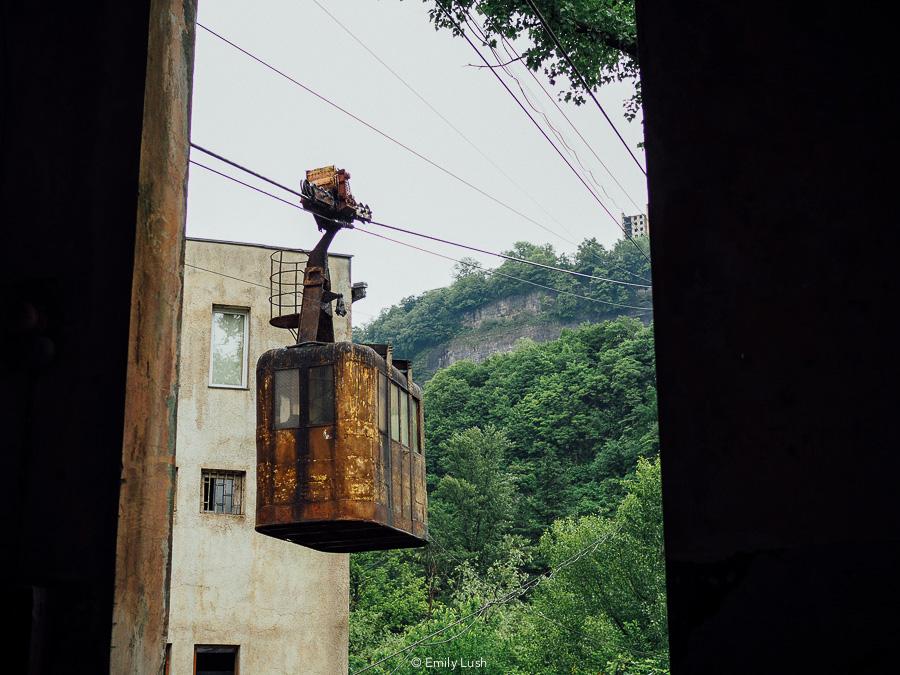
As for the cable cars: at the time of my first visit to Chiatura in 2017, only a handful of the precariously strung, rusted cable cars remained operational. There were rumours that all of Chiatura’s ‘iron coffins’ would be retired by the end of the year, and that’s exactly what ended up happening.
Now that the new cable cars are running, Chiatura feels like a different city…
Tourist map of Chiatura
Click to open my Chiatura map and see the exact locations for the old cable car stations plus the other points of interest covered in this guide.

Best things to do in Chiatura: Old rope roads, new cable cars & more
Aside from the famous ropeways, Chiatura is a cornucopia of Soviet throwbacks, stunning architecture, mosaics, and abandoned buildings. There are several notable monasteries and churches in the vicinity of the city, and the landscape around Chiatura – all expansive cliffs and green valleys – is breathtakingly beautiful, especially on a misty day.
Here are my recommendations for what to do in Chiatura. One full day is plenty of time to cover the highlights, but you might consider spending the night to explore further afield and fully soak up the atmosphere.
1. Ride the restored Soviet-era cable car

Built in 1966 to link downtown Chiatura with Upper Rgani, the Sashevardno Ropeway is one of the steepest cable cars in the world. The line is strung at a 48-degree angle along the hillside, with a gain of 186 metres between the lower and upper stations.
It only takes a few minutes to travel the 249-metre-long line. It’s a thrilling ride as you pass directly over the treetops. At times, it feels more like a funicular, with the gondola almost rolling along the rocky cliff face.


I first rode this particular cable car in 2017. After being closed for the better part of a decade, it relaunched in late 2024. I took my dad to Chiatura in October and we got a chance to ride the new line together!
Sashevardno has two shiny new gondolas – one blue, one red – and (mercifully) an all-new cable line and machinery. Below is a before (left) and after (right).


When you reach the top station in Zeda Rgani (location here), walk out across the vacant block and you will see the original cable car mechanism lying in the mud. There are some pieces of old mining equipment in the area, too, including a big, rusty dragline excavator.
From there, you have the option to walk 10-15 minutes to reach a marked viewpoint with a newly built piazza square and a big Georgian flag. When you’re ready to go back down, simply return to the upper station.


The gondolas lift off from a small open-air station area at the end of the bridge near City Hall. Unlike the other cable cars in Chiatura, this one is completely free. It operates on demand between 10am and 6pm every day.
The adjacent station building (with the Stalin and Lenin insignia – see another before and after below) is now being renovated, along with a second Soviet-era cable car that departs from inside and travels the opposite way across the river. The Chiatura-Perevisa Cable Car will hopefully relaunch in early 2026.


Once lemon-coloured, the station has been repainted purple-grey, and the plasterwork detailing and stone mosaic on the facade have been restored. On my last visit, the door was open and I was able to peek inside. The station interior has been whitewashed, and unfortunately the Dr. Love mural (pictured in my photos from 2017) has been erased.
2. Ride the new modern Chiatura cable cars

There are four new cableways in Chiatura with a total length of almost 3,500 metres. All of them depart from a new, modern lower station building called Central Cable Car Station. It is located on the southern side of the Kvirila River, next to the Cultural Centre.

Built by French company Poma, these are reversible cable cars with fully enclosed twin gondolas that seat 8-10 people comfortably. One of the biggest contrasts to the old cable cars (apart from the obvious) is the addition of supporting poles: each line has 2-4.
These cable cars are ticketed. The fare is 50 tetri per person one-way. Children under 6 years old ride for free.
Paper tickets are no longer sold (I’m glad I kept some of mine from 2021 as a souvenir) – to ride the cable cars, you can either tap-on with a white Tbilisi MetroMoney card or with a debit card. MetroMoney cards can be purchased and topped-up at the ticket desk located underneath the Central Station building.
The cable cars run every day from 8am-10pm.

Here is a quick run-down of the four different lines: Sanatorium, Mukhadze, Lezhubani, and Naguti. Some of the upper stations are not on Google Maps – you can see the locations pinned on my Chiatura Map.
Sanatorium Cable Car
The Sanatorium line runs south-east and replaces the old cableway of the same name. It departs from the top floor of the Central Station building.
This line is 862 metres long, and it terminates at an upper station adjacent to the Former Pioneer Palace.

Mukhadze Cable Car
At 640 metres, this is the shortest of the new lines. It departs from a small annex station that is accessible by pedestrian bridge from the main Central Station building.
Sailing in a south-easterly direction, the gondola runs directly over the train station, giving you a great view of the tracks and rollingstock below.
After a few short minutes, you reach the upper station, located in a residential area close to Central Hospital and in the shadow of some impressive apartment blocks. Off to the east you can see the Sanatorium line upper station on a nearby hill.

Lezhubani Cable Car
Spanning 845 metres, the line is roughly the same duration as Sanatorium but runs in a north-westerly direction to the opposite side of the river valley.
The highlight is passing over the top of one of the old cable car stations near the market. You can see the cantilevered arms and the green sprigs emerging from cracks in the concrete roof.

Lezhubani upper station, a royal blue metal structure, is the most striking of the smaller station buildings.

Naguti Cable Car
Finally, this line runs almost directly west into upper Chiatura’s Naguti residential district. At 1,081 metres, it is the longest of the four. It also replaces an old line of the same name.
The upper station is close to the highway that brings you into town and the Chiatura Memorial. Walking distance from the upper station, there is an abandoned concrete tower building and an old hospital (see #9 below).

If you only have time to ride one of the cable cars, I recommend either Sanatorium or Naguti. Sanatorium is the highest station with nice views on the way up, a panorama at the top, and the Former Pioneer’s Palace within walking distance (see #7 below).
Naguti is fun because it’s the longest line. If you are travelling by marshrutka and you can’t stop on the way into town, it’s a good way to get back to the Chiatura Memorial (see #8 below).
3. Photograph the old & abandoned Chiatura cable car stations

Even though the new cable cars now reign supreme, you can still see and photograph some of Chiatura’s old and abandoned Soviet-era infrastructure.
At least one station building has been demolished – the old three-way cable car station (designed by Otar Turkia in 1973) that used to sit where Central Station is now located. You can see a photo of the station inside the Chiatura Museum (more info in section #4 below).

Other stations have been abandoned and shuttered, and are in various states of disrepair. Some still have their de-commissioned wagons floating mid-air; their operator booths and machine rooms have been emptied out.
There are half a dozen former stations that are worth seeking out for their interesting architecture and photo opportunities. In order of appearance on my Chiatura Map:
- Old station near the bus stop (centre of town)
- Old station near the market (centre of town)
- Old station on the way to the stadium (edge of town)
- Old station in Mgvimevi (past Mgvimevi Convent)
- Old station in Tsofi (past Mgvimevi Convent)
- Old station in Itkhvisi (between Chiatura & Sachkhere)
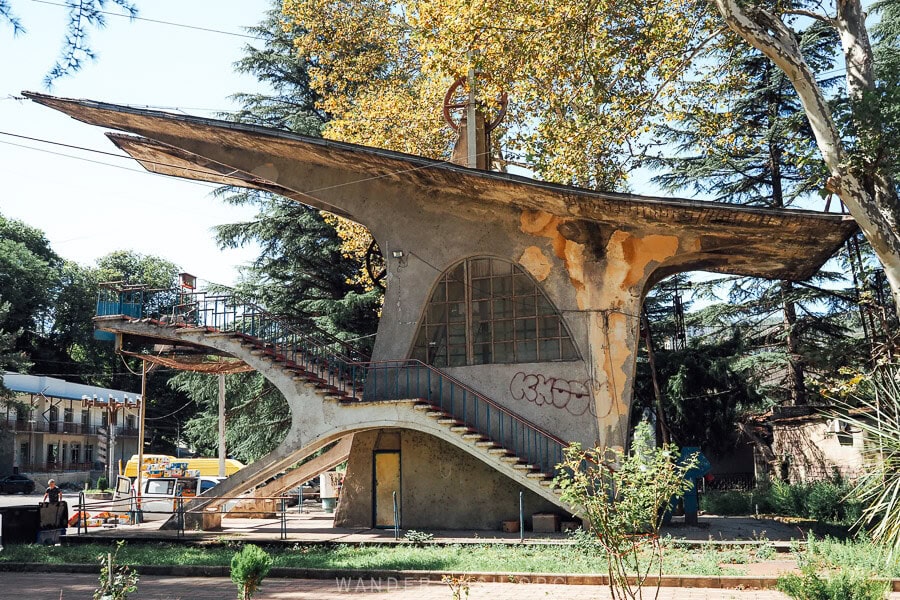
The first old station building in the centre of Chiatura (pictured below) is linked to the bus station by a pedestrian underpass. The architecture is magnificent, with a split cantilevered roof, arched windows on either side, and two sculptural staircases that almost look like the arched neck and legs of a galloping horse. The upward flair of the concrete arms and the repeated railings gives it a kind of kinetic energy – almost as if the station itself is leaping forward.
Its sole surviving red gondola hangs above the street in mid-air. This is a busy little intersection, with people often gathering in this spot to sell grapes and other produce from makeshift car-boot market stalls.
On the opposite side of the river, close to the First Public School, the second lower station building is labelled by some sources as ‘Giorgi Mumladze: Abashidze Cablecar Station’, and it was probably built in the 1960s.
It is much taller and larger, its bare, windowless concrete body towering high above the houses, and its arms outstretched to the skies.

Next on the list, there is a small abandoned lower station building hidden in the undergrowth on the side of the road as you drive out to the Temur Maghradze Stadium (see #5 below). I will stop for a photo on my next visit.
The three remaining stations of note are all located on the way out of Chiatura, along the main road that goes past Mgvimevi Convent to Sachkhere (also covered later on this list).
The first is a one-kilometre walk from the convent. It is a very interesting building – not just a cable car station, but a junction point where two lines from ridges on opposite sides of the valley meet. On street level, there is a covered bus stop. This must have been an all-in-one transport hub for residents of Mghvimevi village.
The bus station’s curved concrete wall is decorated with a bas-relief sculpture depicting musicians and dancers along with Georgian folk symbols. Inside the cable car station above, the attendant’s booth is still partially intact (although many of the objects I saw here a few years ago have sadly been looted).
A logbook on the desk bares entries from 2006 – a reminder that these ropeways were somehow still in service until quite recently.


Another 700 metres east along the same road, there is another abandoned station building on the side of the Kvirila River. This one appears to be more recent, with a modern tiled floor, big frosted glass windows, and a contemporary green-and-white paint job.
Positioned on either side of the covered ticket booth, two massive drive wheels are still strung with the heavy steel cables once used to guide and tension the dual cabins. Outside, a single gondola painted in the same signature green and with round portal windows dangles above the trees.


Finally, this upper cable car station is located in the village of Itkhvisi, around 4 kilometres or a 10-minute drive via a windy, scenic concrete road that passes right by one of the mines. Unlike the previous two, the doors of the triple-storey concrete building are locked. You can peer through the broken wooden door on the bottom level to see some of the old machinery – and if you’re brave, climb the exterior access ladder onto the roof (not recommended).
A red gondola – a typical Soviet design produced by the Tbilisi Aviation Factory, and also used in Khulo in Upper Adjara, in Kutaisi, and for Tbilisi’s Turtle Lake Ropeway – dangles above someone’s back fence and vegetable garden.


The most monumental of Chiatura’s former cable cars stations is a tower-like concrete construction on the upper western side of the city. I have covered it separately under #9 below.
There are more stations scattered in the villages and hills around Chiatura. If you have a car, you can try scouting out more of them. Let me know in the comments if you find anything of note!
4. Learn about Chiatura’s mining history at the Local Lore Museum


Established in 1962, Chiatura’s small regional museum used to be located inside the Cultural Centre (former Palace of Culture), the stately colonnaded building with the big fountain plaza next door to the Central Cable Car Station.
A couple of years ago, it moved to a new location on the opposite side of the river. You can now find it on the end of the long shopping arcade building, above the small Tourist Information Office that occupies the bottom floor.
This space used to be Chiatura’s Wedding Palace, a civil registry hall where couples formalised their union. One of the highlights of the two-room museum is the original details of the building: decorative bronze plates, elaborate chandeliers, and a carved wooden pillar, all decorated with folk symbols rendered in a Soviet modernist style.
The first room contains a variety of archaeological treasures displayed in glass cases, plus weapons, costumes, musical instruments, clay qvevri, and some impressive Chiatura-themed canvases by local artists.


The more interesting exhibition is in the second smaller room. Documenting the history of Chiatura’s manganese mines, it contains archival photographs from the 1920s, original oil lanterns, protective helmets and other equipment used in the shafts, and an old-school map showing the extent of Chiatura’s manganese exports around the Soviet Union.
The museum is open every day from 10am-6pm. Entrance costs 5 GEL per person (cash only). Purchase your ticket at the desk downstairs before heading up. Staff speak some English and are very warm and friendly.
5. Explore Temur Maghradze Stadium & see the swimming pool mosaic

Chiatura’s old sports stadium is located on the south-west side of town, around 5 minutes by car or 30 minutes on foot from the centre. Despite appearances, the complex is not fully abandoned – the adjacent gymnasium and swimming pool are still very much in use.
This the homeground of FC Chiatura, 1975 Georgian Soviet Champions and Liga finalists in 2020. As I later read, the club used to be known as Magaroeli (‘Miner’), a tribute to the town’s main industry.
The main gates are normally open, so you can stroll in and walk through the dramatic arched passageway that runs underneath the southern stands. The bleachers once held 11,650 spectators. You can still see the concrete VIP boxes.


To get onto the nicely clipped playing field, you need to go through the adjacent building. As we walked through we heard the sound of people running and jumping in the gymnasium above. The outlines of what I assume were a clock and a scoreboard can be seen on the front part of the building facing the field.
The next building houses an indoor pool. Having seen photos online, I was very eager to pop in for a peek. We sheepishly walked into the front office where four women were sitting behind desks signing kids in for their swimming lessons, and uttered the magic word, mosaika? Without a second thought, one of the friendly women led us through to the back room, smiling and laughing with us all the way.
There are Soviet-era mosaics at both ends of the indoor pool: the eastern side has a simple geometric design with a red sun, while the shallow end has an extremely detailed wall-to-wall panorama depicting two figures lounging in a fantastical subaquatic setting.

There isn’t much written about the mosaics online – author and dates sadly unknown – but judging by the 10-oared ship, I’m guessing it references Jason and the Argonauts.
Other swimming pool mosaics in Georgia – including the incredible ones in Zestafoni and in Rustavi – have similar imagery, but Chiatura’s has an unusual colour scheme.
6. Find the other Soviet-era mosaics in Chiatura


Speaking of mosaics: there are several more to be seen in the centre of Chiatura, all walking distance from each other and all rendered in cool blue tones.
The first decorates the front of the Metallurgy-Mining Institute, on the southern side of the river near Liberty Bank. It depicts three suited men with unfurled blueprints and set squares in hand (above left).
On the opposite side of the river at the next intersection, there is a beautiful Shota Rustaveli mosaic on the front of the First Public School. It shows the poet holding a copy of his epic, with a big cat lying at his feet (above right). It is somewhat damaged and quite faded.


The third mosaic is located uphill on the next street. The largest and most impressive of the trio, it decorates the front of a local kindergarten. (This is still a kindergarten, so be mindful when taking photos.)
Part of the mosaic is obscured by an overgrown tree, but you can still get a good look at the central figure and mothers pictured cradling their children.
7. Stop by the former Pioneer Palace

Set high on the southern side of the city, Chiatura’s Former Pioneer Palace is an abandoned landmark that once served as a children’s cultural and recreational centre. Purpose-built in the early 1960s by Georgian architect Konstantine Chkheidze, it echoes his other Pioneer Palaces in Tkibuli (another mining town in Imereti) and Tkvarcheli (a former industrial hub in Abkhazia).
The front facade – a surviving fragment of the once-monumental complex – is still distinguished by its ring of colonnades and sweeping staircase.


The Young Pioneers organisation is often described as the Soviet equivalent of the Boy Scouts and Girl Scouts, though with a stronger political and ideological dimension. Pioneer Palaces like this one hosted art classes, performances, lectures, sports clubs, and exhibitions.
Amazingly, it was still in use right up until 2007 when it was abandoned and left to ruin. Plans to demolish the building in 2014 were thwarted by local activists – and although there have been various schemes to restore it, no work has been done to the building itself.
The territory around the palace and nearby Sanatorium Cable Car upper station have been completely redeveloped into a small amusement park with rides and a Ferris Wheel. While the ruins of the Pioneer Palace are still standing, the area has been cordoned off with a high fence. This means it is no longer possible to get inside – probably a good thing, given that huge chunks of concrete were literally falling off when I first came here in 2022.
8. Photograph the Chiatura Memorial

This imposing statue is the first thing you see as you enter the ‘upper’ part of Chiatura from Kutaisi. It stands on a grassy knoll at the entrance to the city, in front of a set of seven-storey apartment blocks.
Officially the Memorial to the Great Patriotic War, this is a typical Soviet-style WWII memorial like many others you see around Georgia. What makes Chiatura’s special is the scale of the thing – it is absolutely huge.
The statue depicts a solitary soldier in his combat helmet and boots, wrapped up in an overcoat. A second figure with its arms raised overhead rises up behind him like a dark spirit. Her cloak billowing behind her in a wave of sculpted folds, she is likely a personification of the Motherland, invoking courage and sacrifice amongst her people.
Last year, I noticed that the sculpture had been painted jet black, which honestly made it look a bit strange. It has weathered and mellowed out and a bit now.
If you are driving into Chiatura, I recommend making this your first photo stop. If not, you can take the new Naguti Cable Car to the upper station and walk for around 15 minutes to reach it on foot.
9. Photograph the tower cable car station & urbex at the old hospital

Also walking distance from the Naguti upper cable car station, this five-storey concrete skeleton clings precariously to the cliffside above Chiatura. Either unfinished or long since stripped of its fittings – I am not completely sure – the structure is reduced to bare concrete and yawning window frames.
The only clue to its function is the skeletal framework of a cable car landing, still jutting from the facade with a set of rusting stairs attached. Had it been completed, this would have been one of the most monumental ropeway stations in the city.
A long gangway leads out to the tower – it is boarded off for safety, and there’s no way I would risk going inside. Next time I will take my drone to get a better shot of the structure from below.


Beside the tower lies the entrance to a huge abandoned hospital (or maybe a sanatorium). There is a gaping hole where the door once was – so we walked inside and explored the corridors. Shards of glass bricks scatter the floors, and doors hang open on broken hinges.
There is nothing much of note inside aside from some rusted signs and patient charts discarded on the floor. As we were leaving, a well-dressed man passed us in the corridor with a casual Gamarjoba. My heart definitely skipped a beat!
I would love to know more about this building and the cable car tower station – if you have any intel, please leave me a comment.
10. Explore downtown Chiatura: The Railway Station, Drama Theatre, Palace of Culture & apartment blocks

Downtown Chiatura is a fascinating mix of industrial history, Soviet architecture, and everyday urban life. Before you leave town, spend an hour or so exploring the centre and nearby Chavchavadze Street.
The story begins with the railway, built in 1895 as a narrow-gauge line connecting Chiatura with Shorapani in the lowlands near Zestafoni. Its primary purpose was to transport manganese ore to the processing plant in Zestafoni, which opened in 1933. Later converted to standard gauge, the line began carrying passengers as well.
In 1976, a new two-storey railway station was constructed in the heart of Chiatura to handle the growing flow of travellers. It has fallen into decline, and today only the Kutaisi-Sachkhere train still passes through (the front part of the station has been converted into a shop).

Opposite the station, the Akaki Tsereteli State Drama Theatre was built in 1949 and still active today. Its monumental facade, framed by tall arches and wrought ironwork, bears a statue of poet Akaki Tsereteli – the man credited with discovering Chiatura’s manganese deposits.
Look closely and you’ll see a stone frieze high on the building’s exterior: Stalin in profile, surrounded by workers and children. The inscription reads Didi Stalins Didebi (‘The Glory of Great Stalin’).

Back on the main street, the former Palace of Culture holds another Soviet-era treasure: two enormous Socialist Realist canvases by artist Koko Ignatov. It was easy to see the paintings when the museum was located here, but it has since moved (see #3 above). If the front door is open and Cultural Centre staff are around, you could try your luck by asking to go upstairs.

Beyond these landmarks, Chiatura’s streets are a showcase of eclectic architectural styles. Colourful apartment blocks, Empire-style civic buildings (including the stately corner building with the belvedere near the Brutalist City Hall), and Brutalist cable car stations share space with modernist facades.
I particularly love the long building where the Local Lore Museum is located – it follows the gentle curve of the cliff.

Spot the long row of riverside kiosks with their wave-like roofs, and the whitewashed Bauhaus-like shops near the bus stop.
Things to do near Chiatura
Here are three more places to visit in the area with directions on how to get there from Chiatura.
11. Katskhi Pillar & Monastery
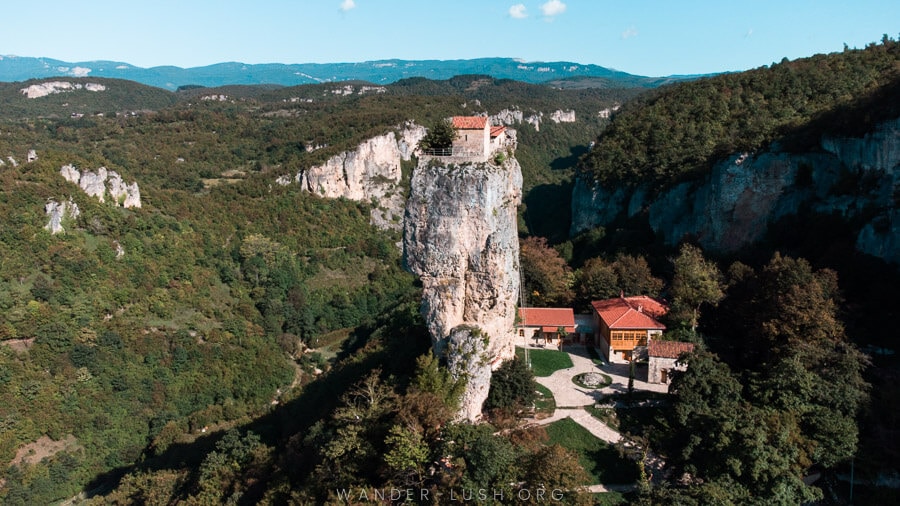
Katskhi Column (also called Katskhi Pillar) is a dramatic 40-metre-high limestone monolith crowned with a small Orthodox hermitage. Located just off the highway before you enter Chiatura, it makes an ideal stop on the way into the city if you’re travelling from Kutaisi.
Climbing the pillar is strictly prohibited, but you can walk all the way up to the base to see the Church of Simeon Stylites, along with the remains of an old wall and belfry. The resident monks run a small museum and gift shop here. The cloister complex is open daily between 9am and 8pm.
But to fully appreciate the column’s scale, it’s best to view it from afar. A designated viewpoint – linked to the highway by a sealed road – offers a photogenic angle. From here, a walking path continues to the base of the pillar.
There is also an off-road vehicle trail, and a marked hiking trail that you can use to travel further up the plateau and view the column from above.
A two-minute drive further along the road to Chiatura brings you to Katskhi Church, a unique cylindrical domed church commissioned in 1032 by King Bagrat IV. It once served as both a burial place and a repository for precious theological manuscripts, many of which were later looted.
Most Georgian Orthodox churches from the medieval period follow a cross-in-square or basilica layout, making Katskhi’s vertical, cylindrical design highly unusual and virtually one-of-a-kind. Its rounded walls, capped by a tall dome, emphasise height and harmony.
How to get to Katskhi Pillar from Chiatura
If you are already in Chiatura (and you don’t have a car), you can use municipal bus #2 to get to and from Katskhi village. It departs from the main road in front of the Central Cable Car Station at 8am, 10.30am, 1pm, 3.30pm and 6pm. Buses return to Chiatura from Katskhi at 9.15am, 11.45am, 2.15pm, 4.45pm and 7.15pm. Double-check times and fares with staff at the cable car cash desk.
All marshrutka vans travelling to Kutaisi from Chiatura pass by Katskhi, so there is also the option to hitch a ride with one of the drivers leaving town. Otherwise, a taxi should cost around 10-15 GEL one-way.
12. Mgvimevi Convent

Just a 20-minute walk or a quick 2-minute drive from City Hall, Mgvimevi Convent is a working nunnery and cave church carved directly into the side of a sheer rocky cliff. It was founded in the 13th century during the reign of Tamar Mepe.
We parked our car at the small petrol station opposite and found the entrance to the convent easily enough – look for the staircase that begins by the highway next to the small shop (there’s a sign with a church icon, though it’s easy to overlook). The ascent takes about 15 minutes, and at the top you step straight into a cool, shadowy cave – a welcome reprieve after the sunlit climb. Moisture trickling down the rock walls keeps the space naturally cool and gives it a hushed atmosphere.

Much like the great cave monasteries of Vardzia and David Gareja, Mgvimevi’s cloisters are hewn from living rock, softened by icons, frescoes, and the glow of votive candles. Outside, a lookout point offers a dramatic view of the convent clinging to the cliff face.
The convent is open daily from 10am-6pm in summer (11am-4pm in winter). Modest dress is strictly required: men must wear long trousers, while women must wear a skirt and cover their heads (trousers are not permitted). Scarves and wrap-skirts are provided at the entrance. When leaving, take care on the stairs – the sudden contrast between the dim interior and bright daylight outside can be disorienting.
13. Sachkhere & Modinakhe Castle

The town of Sachkhere is located further north in the mountains of Upper Imereti, around 20 minutes by road from Chiatura. Fans of Soviet-ere architecture will find some interesting buildings, sculptures and a couple of great mosaics here. Plus the town is home to the specular hilltop Modinakhe Castle, plus a museum dedicated to Akaki Tsereteli. My main interest in Sachkhere was the railway station – a gorgeous 1904 stone building.
Find more things to do in Sachkhere here in my Sachkhere Travel Guide.
Starting from Sachkhere, there is a relatively new road that tracks over the mountains into Oni. If Racha Region in on your agenda, the mountain pass is a great onward connection from Chiatura – the road is sealed, quiet, and incredibly scenic, especially in autumn.
How to get to Sachkhere from Chiatura
If you don’t have a car, municipal bus #3 runs between Chiatura and Sachkhere. It departs from the Central Cable Car Station in Chiatura hourly on the hour between 8am and 8pm. The schedule is the same for the return journey. Double-check times and fares with staff at the cable car cash desk.
Where to eat in Chiatura
Food options are a bit limited in Chiatura, but there are a few places I always visit and trust. For a quick coffee and/or savoury pastry or slice of cake, RENDEZ-VOUS is a relatively new cafe located a few doors down from City Hall.
For something more substantial, Lunch at Lia is a beautiful little restaurant set in a family home near the Lezhubani upper cable car station. It is open for lunch and dinner daily, and caters to tour groups from Tbilisi and Kutaisi. Independent travellers are also welcome – if you want to drop in for a home-cooked meal and a glass of Imeretian wine, send the hosts a Whatsapp message a day or two in advance on +995 557 744 765.
Where to stay in Chiatura
Whenever we spend a night in Chiatura, we stay at Hotel Newland next to City Hall. Rooms are clean and comfortable, and there’s a big outdoor terrace overlooking the refurbished cable car station.
The owner speaks perfect English and is very helpful. Parking is available right out front.

How to get to Chiatura from Kutaisi
Kutaisi to Chiatura marshrutka
The cheapest way to travel between Kutaisi and Chiatura is by marshrutka. Vans depart from Kutaisi’s Central Bus Station roughly every hour between 8am and 4pm. Tickets cost 10 GEL per person. The journey takes around 2 hours with a short stop in Zestafoni on the way.
To get to the bus station in Kutaisi, take city bus #1 from the Colchis Fountain. I recommend taking one of the first vans from Kutaisi to make the most of your day. When you get to Chiatura, the driver will let you out on the main street.
Stopping off at Katskhi Column
You can easily add a stop at the pillar to your itinerary simply by changing marshrutka vans on the road. Vans are frequent enough that you shouldn’t get stuck waiting for too long.
You’ll be taking two separate vans, so you’ll need two separate tickets. We asked the first driver (departing Kutaisi) to drop us off at Katskhi Pillar (to avoid confusion, it’s a good idea to have a picture on your phone). When you’re done, return to the same road and hail any passing Chiatura-bound marshrutka.
It’s best to stop off at the pillar on the way to Chiatura (as opposed to the way back). That way if the van is full, you’re more likely to get a seat for the longer journey down to Kutaisi.
Chiatura to Kutaisi by marshrutka (return trip)
The last marshrutka back to Kutaisi leaves Chiatura at around 3pm – but in summer, there might be later vans passing through Kutaisi on their way to Batumi and other destinations on the coast. On our first visit, we ended up catching a Batumi-bound marshrutka back to Kutaisi.
Vans depart from Central Bus Station and from the smaller bus station area at the end of the bridge (see the locations on my map).
Kutaisi to Chiatura train
There is a once-daily rail service to Sachkhere from Kutaisi, stopping at Chiatura en route. This is an older train – don’t expect comfy seats or a dining cart! The train departs from Kutaisi I station at a sprightly 5.50am, arriving in Chiatura 3.5 hours and five stops later.
Travelling the opposite way, the train leaves Chiatura at 11.30am and gets to Kutaisi at 2.30pm. Tickets cost 50 tetri and can be purchased in person at the cashier desk or on board.
Note that this train does not run during winter – in 2025, services resumed on March 25th.
Private transfer to Chiatura with GoTrip
If you want to get an earlier start to maximise your time in Chiatura, another option is to organise a private transfer from Kutaisi.
I highly recommend using GoTrip.ge to find a driver. You can stop as many times as you like along the way, including at Katskhi, and add Mgvimevi and Sachkhere to your itinerary if you want.
A private transfer from Kutaisi to Chiatura and back costs as little as 130 GEL per car when booked through GoTrip. This is incredibly good value for money considering how much driving is involved. You can spend as long as you want in Chiatura – the only condition is that you must complete the trip within 24 hours.
How to get to Chiatura from Tbilisi
Direct vans to Chiatura depart from Bus Station Nige (inside Didube) every hour between 7am and 7pm. Tickets cost around 15 GEL, and the travel time is 2.5-3.5 hours depending on which route the driver takes. Alternatively, you can take a van to Zestafoni from the same station (hourly from 6am; 15 GEL) then transfer to a Chiatura van. This takes slightly longer.
To maximise your time in Chiatura, I suggest either hiring a car and driver for the day or joining an organised day tour from Tbilisi. When booked through GoTrip, a private car and driver from Tbilisi to Chiatura and back, stopping at Katskhi Pillar on the way, costs as little as 220 GEL.
If you prefer to travel with a guide, I recommend joining this popular day tour organised by Friendly.ge. It covers as much as you could reasonably expect to see in a day (including Katskhi Pillar) and includes door-to-door transfers. Guides are very knowledgeable, and will show you lots of secret places.
More tips for visiting Chiatura
- Given our first experience at Katskhi Column, my first piece of advice is to visit this part of Georgia on a clear day if possible. If the weather is bad, you might not be able to see the pillar or the cable lines in Chiatura. A bit of rain is fine, but avoid going when it’s thick and foggy. See my tips for the best time to visit Georgia here.
- As I mentioned, there are limited food offerings in Chiatura, so it’s a good idea to plan your mealtime and make a booking at the restaurant a few days in advance.
- There are plenty of ATMs, banks and grocery shops in Chiatura, so don’t worry about accessing cash or any essentials while you’re there.
Chiatura flashback: My experience riding the old Chiatura cable cars in spring 2017
“But why would you want to go there?” We were standing in the entryway of the Hotel California (the Georgian version, which is actually a guesthouse set on a suburban street in Kutaisi) talking with our hostess, Leila.
Over the past 24 hours, Leila and I had grown particularly close. Whenever we met in the hallway, she would pinch my cheeks, grab my hips and coo at me, calling me ‘a beautiful baby’. She’s a typical Georgian grandma, thickset with curly black hair and a firm grip. Her fondness for me was completely unjustified, but very sweet and amusing. Tonight, however, her disposition was grisly as she handed down her verdict on our plan to take a day trip from Kutaisi to Chiatura the following day.
Chiatura is not exactly a popular tourist spot. I had been infatuated with the town’s history and obsessed with visiting ever since I got a tip off from a friend on social media. Chiatura hadn’t been part of our original Caucasus itinerary , so we adjusted our plans to include one more full day in Kutaisi to squeeze it in.
Earlier that day, the helpful staff at the Kutaisi tourist information office had armed us with a map, a marshrutka schedule scribbled down on one corner. We proudly showed this to Leila, trying to illustrate to her how organised and well thought-out our plan was – but she just couldn’t believe two Australian tourists who had come all the way to Georgia would want to spend a day in Chiatura.
We made grand sweeping gestures with our hands as we told her about the old cable cars we were going to ride on. We told her how fascinating it was that the Stalinist government had ordered the 17 lines to be constructed in 1954, making the rope roads older than our parents.
We excitedly described Katskhi Pillar (or Katskhi Column), a stylite monastery just outside of Chiatura, and how we wanted to catch a glimpse of the famous hermit monk who lived on top of the impossibly high stone pillar.
But we couldn’t win Leila over.
Unperturbed, we woke up early the next morning and boarded a marshrutka bound for Chiatura. The day that unfolded was one of the most rewarding of our first 3-month journey across the Caucasus – and probably one of the coolest travel experiences we’ll ever have in our lives.
On a misty Sunday morning in May, we squeezed into a marshrutka van just as it was pulling out of Kutaisi’s bus station. The fog thickened during the one-and-a-half-hour journey through densely forested Imereti. When we finally pulled into Chiatura, the haze cleared to reveal a colourful little town alive with activity.
Chiatura is a relatively small town with one main street. The bus dropped us off in the heart of the action, close to a small open market. We didn’t really know where to go from here, so we walked west along the street until we found evidence of the cable car lines.


Along the main road, women sell neatly arranged bundles of herbs and bunches of roses. Bakers scramble to keep up with weekend trade, Ladas cruise up and down the streets, and people come and go from pastel-coloured buildings.

It’s not long before we catch our first glimpse of Chiatura’s cable car infrastructure: a hulking station building, remnants of rusted rope hanging limply from its cantilevered concrete arms.
The smashed windows and boarded-up doors reveal this is one of the lines that has ceased to operate. We search the grey skies for more cable car lines, eventually following a group of women as they make their way inside a lemon-coloured building. Just as we approach the station, a blue car arcs down the hill and docks in its station. A few people disembark and the women take their place.

After observing a few rotations, the station attendant gestures nonchalantly for us to board the next empty car. Without a moment’s hesitation we climb inside.
Another attendant is there waiting. It’s her job to ride with passengers and ensure no one accidentally pops the loosely fitted door.
A bell sounds; the first attendant pulls a lever and we’re off, sailing in our metal cage. This particular line hugs the contour of the hill, so we are never very far off the valley floor. Still, peering through the tiny wire-covered windows is thrilling.
We can’t communicate with words, but the attendant chuckles knowingly as we look to her for reassurance.
The most striking thing about the ride – which only lasts for a minute or so – is how silently and smoothly the carriage moves. Sixty-plus years later and these weather-worn ropes still do their job with efficiency and ease.
The view from the top – a full panorama of Chiatura – is breathtaking.


Back inside the main station, we admire the plaster work that decorates this once-grand building. A freshly painted mural pays homage to Chiatura’s miners.
Outside, we notice a mosaic cast above the entryway – forever immortalised in river stones, Stalin and Lenin gaze out towards the rope ways.
The cable cars in Chiatura are free to ride. There is no set schedule, they just go when there’s passengers waiting. There are attendants inside all stations (it’s their job to open the door for you and to pull the lever that sends the cars off), and there are also attendants inside the cars themselves. Most lines we saw have only two cars that interchange, bringing passengers up and down.
It goes without saying, but if you want to ride the cable cars, do so at your own risk. The machinery and equipment is ancient and not very well maintained. We made a judgement call and decided to ride up and down once. I don’t regret it at all – it was incredible.

Even if you don’t ride the cars, it’s worth visiting Chiatura to see the impressive concrete station buildings. The lemon-coloured building that I photographed has beautiful plaster cornices inside – you can just imagine what it would have looked like when it first opened.
The cable cars and concrete station buildings are Chiatura’s main draw card, but it’s worth having a stroll around the town as well.

We popped our heads into the big undercover market, which was rather dim and dusty. On the main street there’s a very retro barbershop and as mentioned, a collection of pastel-coloured civic buildings and apartment blocks.
Today, Chiatura is a quiet, peaceful place that only attracts the most intrepid tourists, drawn to visit and ride the cable cars. As with everywhere else in Georgia, we were greeted with nothing but kindness and warmth from the Chiatura locals.


More places to go in Georgia for Soviet history
More Kutaisi tips
Are you planning to travel from Kutaisi to Chiatura and Katskhi Pillar? If you have any questions, please leave them in the comments below.
Kutaisi to Chiatura: Save it on Pinterest


