Bukhara Itinerary: The Perfect 2-3 Days in Uzbekistan’s Open-Air Museum
16 min readAll the best things to do in Bukhara, Uzbekistan over 2-3 days – from must-see madrasas and the Po-i-Kalan, to atmospheric markets and mausoleums, and palaces and mosaics on the fringe of modern Bukhara.
Larger than walled Khiva but more compact than sprawling Samarkand, Bukhara sits squarely in the middle of Uzbekistan’s Silk Road Circuit. For most travellers, it’s also the literal middle – a bridge between the most-visited and least-visited cities.

For me, Bukhara struck the perfect balance, blending atmosphere and accessibility, polished facades and rough gems, the made-for-tourists and the still-local. We lingered in Bukhara longer than originally planned, and even then I could have easily spent longer wandering the covered markets in the early morning and quietly observing life unfold on the historic squares at dusk.
This guide includes the highlights of Bukhara, logically organised into a 2-3 day itinerary. You’ll also find a map to help navigate the city, plus a few general tips to make the most of your visit.
Please note: This post contains affiliate links, meaning I may earn a commission if you make a purchase by clicking a link (at no extra cost to you). Learn more.
How many days in Bukhara?
I recommend spending a minimum of two full days in Bukhara. This will give you enough time to return to the Po-i-Kalan Ensemble at different times of day and night, and enjoy the city at a more leisurely pace more generally.
With a third day, you can visit the Sitori-i-Mokhi Khosa Palace and hunt for mosaics on the outskirts of the city.


Where to stay in Bukhara
Bukhara is flat and walkable. Most visitors base themselves inside or just around the Old City – but there’s also an option to stay in the outer suburbs for a slightly different experience. We chose an apartment south-east of the centre near Chor Minor, about 15 minutes’ walk from the main sights.
If you want to be in the thick of it, look around Lyabi-Hauz – the main square fringed by madrasas and cafes. The residential Jewish Mahalla south of the square, with its quiet backstreets and traditional courtyard houses, is a nice alternative.


There are some really exquisite boutique hotels in Bukhara. Here are three popular options:
Map of things to do in Bukhara

Day 1: Classic Bukhara
Morning: Chor Minor, Madrasas & Po-i-Kalan
Start your first day in Bukhara at Chor Minor, the quirky four-towered gatehouse on the eastern side of the city. The soft morning light gives the sandy brickwork and turquoise tiles a gentle glow, and you will likely find the courtyard empty. Commissioned by a merchant in the 19th century, each of the decorative towers represents one of the four schools of thought in Sunni Islam, to which the majority of modern Uzbeks subscribe.
There is not much to see inside apart from souvenir shops (doors seem to open later in the morning), so don’t worry too much about hanging around for opening time. On the southern side of the square there is a little row of antique shops displaying old Soviet medals, fur hats and enamelware in photogenic arrangements.


From Chor Minor, it’s a 15-minute stroll through the backstreets of Bukhara to Ulug’bek Madrasa, one of the oldest surviving Islamic schools in Bukhara (and all of Central Asia). Constructed in the early 15th century by master builder Ismail b. Tahir b. Mahmud al-Isfahani, it was commissioned by Ulugh Beg, the Timurid astronomer-king, and has two arched iwans halls instead of the typical four.
A double-height arcade of niches leads to tiny vaulted student cells, while the mosque and classroom are tucked into domed chambers located off the courtyard.


Delicate hazarbaf brickwork in variegated light and dark glazes combines to create intricate geometric patterns on the facade, while traces of gilded tiles and painted plaster cling to the walls. On the wooden doors, there is an inscription in Arabic: ‘Education is obligatory for every Muslim man and woman’.
Facing it, the Abdulaziz Khan Madrasa (1652) is far more elaborate by contrast. Its use of colour sets it apart from other Timurid-era buildings, with the stalactite pattern on the iwan ceiling the most beautiful I saw in Uzbekistan.

Entrance to this madrasa is ticketed, with several options available – we paid 20,000 som for entry to both the summer and winter mosques. It’s well worth the cost to see some of Bukhara’s most fabulous muqarnas.
Continue another five minutes on foot, past the Toqi Zargaron covered bazaar (we will return here soon), to the Po-i-Kalan Ensemble for your first glimpse of Bukhara’s iconic landmark in the light of day.
If you’ve just come from Samarkand, you will immediately notice some key differences between the Registan and the Po-i-Kalan. The latter is unfenced and free to enter, and it still feels lived-in, with pupils mingling under the brick arches and people criss-crossing the square on their way to work.
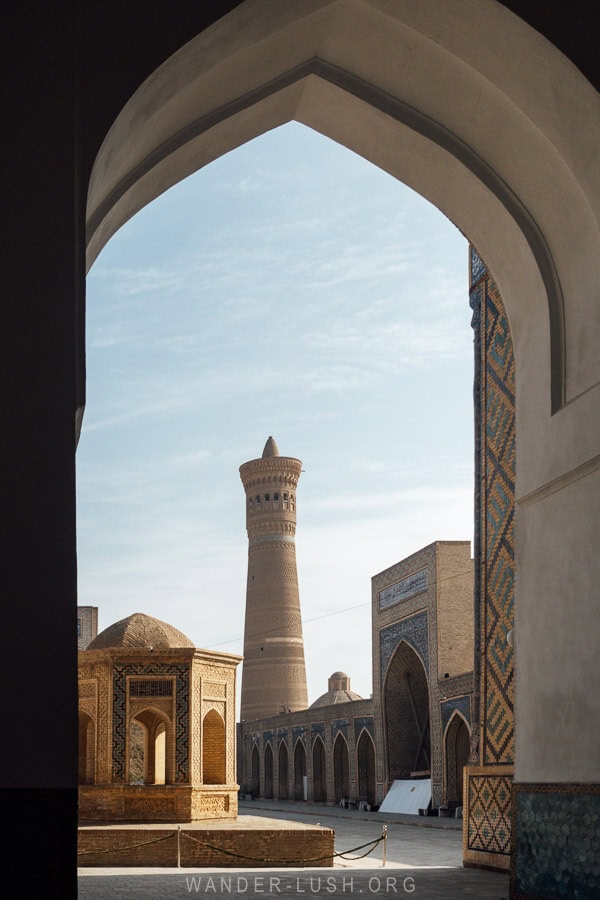

Constructed between the 12th-16th centuries, the ensemble includes the vast Kalan Mosque (1514), capable of holding 10,000 worshippers. Entrance to the mosque is paid – hold onto your paper ticket because it’s valid for a return visit in the evening (we will come back later to see the courtyard in a different light).
Across the square, the Mir-i Arab Madrasa was established in 1536 and is still an active religious school. Between them stands the magnificent Kalan Minaret, a 47-metre-tall tower built in 1127 to call the faithful to prayer. Legend has it that this was the only structure spared by Genghis Khan during his devastating invasion of Bukhara in 1220. It remains the enduring symbol of the city to this day.
Give yourself at least two hours to explore the Po-i-Kalan thoroughly. There will be more opportunities to return to the site later in the itinerary.


Before you move on, duck down a side street to find the Silk Road Tea House, one of Bukhara’s most beloved cafes run by the Ubaydov family who have a 600-year history as spice merchants. For around 70,000 som you’ll be served a pot of saffron tea or cardamom coffee alongside a plate of traditional sweets designed to accentuate the flavours of your beverage.
The spread includes kozinaki (sesame and apricot kernel brittle with honey – very similar to Georgian gozinaki!), halva with pistachio and walnut, and crystal-like sugar candies (watch your teeth on those). Souvenir-sized bags of loose-leaf tea are sold at the counter.


Afternoon: Trading domes & Lyabi Khause Square
Leaving Po-i-Kalan, find your way into the tangle of covered bazaars known locally as the Toki (Toqi). These domed pedestrian malls were Bukhara’s most important Silk Road trading hubs, and now characterise the centre of the city.
Toqi Zargaron (traditionally the jewellers’ dome) once housed more than 30 merchants specialising in gold and silver. It is now filled with Soviet memorabilia, spice stalls and antique carpets. Most of these shops are very touristy, but there is no harm in looking.
Continue to the Tim Abdulla Khan Trading Dome, built in the 16th century as a caravanserai and trading house. Inside, you’ll find stalls selling miniature paintings, embroidered doppa caps, and suzani textiles.


The Toki are liveliest in the late morning and early afternoon, when business is at its peak. Later in the day, many traders start to close up and the atmosphere becomes quieter. It’s worth browsing, but I’d suggest holding off on any major textile purchases – I’ll point you to a much better option later.
Moving south through the Toki Telpakfurushon, you will eventually emerge into an open space with the Caravansarai Ulugbek (under renovation at the time of our visit) on your right, and the foundations of a hammam bathhouse directly ahead. The exposed ruins and excavation sites in progress gives this part of Bukhara a bit of an Athens vibe.
The Magoki Attori Mosque and Carpet Museum has a beautifully weathered facade, but an unremarkable whitewashed interior. It’s only worth buying a ticket if you are particularly interested in antique textiles.

Continue east along Mehtar Ambar Street and you will eventually come to Lyabi Khause Square, the true heart of old Bukhara. The leafy plaza centres on a square pool shaded by mulberry trees, with teahouse tables spilling out along the water’s edge. Ducks glide across the water, friends meet over pots of tea, and children weave between the leafy trees on their bicycles.
At one end of the pool, the Nadir Divan Begi Khanaka (an old Sufi lodge) houses a small ceramics museum. Buy a ticket to gain entrance to the main hall, with its intricate painted ceilings and 16th-century niche.


Opposite, the Nadir Divan-Begi Madrasah is the square’s most striking monument and the one to linger on. Its high facade mosaic depicts a pair of mythical simurgh (divine birds from Persian mythology) pictured against an inky blue sky with deer clutched in their talons.
In the centre of the composition, a radiant sun with a human face smiles down upon those who enter. This imagery serves as a rare example of animal and solar motifs in Islamic art – something that is usually forbidden.

Across the road, the Kukaldosh Madrasah – one of Bukhara’s largest – was built in the 16th century and became a cinema during the Soviet period. Unlike the heavily restored facades you see elsewhere, Kukaldosh has aged gracefully and appears pleasantly weathered – for now at least.
Find one of the concealed staircases located in all four corners of the spacious inner courtyard and climb to the upper levels, where former student rooms are decorated with similarly faded fragments of wall paintings and plaster. Once on the rooftop, you can walk between the brick domes to peek down at Lyabi Khause.


Kukaldosh is home to several shops including the Suzani embroidery workshop of master craftswoman Zaynab Murodova. While exploring the chambers, we ran into seamstress Zulya, who took us into her little sewing room for a cup of tea before guiding us onto the shop floor to admire her handiwork and meet her boss.
Bukhara is the historic centre of suzani embroidery, and this is definitely the best place to pick up an embroidered souvenir (overnight tailoring is available). Racks of colourful jackets line the walls – you need to finger through each one individually to fully appreciate the details.


Sitting at the front desk, working away at a new piece of embroidery, Zaynab was very generous with her knowledge, explaining the significance of different motifs: black and white thread for protection, pomegranates for abundance, chilis for fertility.
The quality of her silk-thread suzanis is top-notch, and there are also more affordable pieces made from cotton, viscose and polyester (I was quoted 1/4 of the price for a suzani table cloth compared to the nearby Suzani Centre). I ended up paying a very reasonable 80 USD for a full-length embroidered jacket that dear Zulya modified for me by adding buttons down the front.

When you’ve had your fill of handicrafts, treat yourself to something sweet at Donuts & Coffee, located back across the square. This small cafe serves great specialty coffee alongside freshly made donuts topped with chocolate and pistachio or raspberry. Needless to say it quickly became one of our favourite haunts in Bukhara.


Evening: Persian Square & Po-i-Kalan by night
As the day slips away, cross back through town via the Toki halls. By late afternoon, merchants are packing up their stalls, settling their final transactions, and sweeping dust from their thresholds. The market has a wonderful atmosphere.
We really enjoyed our evening walks around Persian Square – a big open space behind Po-i-Kalan. This area is less frequented by tourists and has a behind-the-curtain feel: children kick footballs against the brick walls of old buildings, neighbours exchange greetings, and workers hurry home through narrow lanes. It’s a lovely glimpse of everyday life unfolding against the backdrop of Bukhara’s monumental architecture.


Use the same ticket you bought earlier to return to the Kalan Mosque, which takes on a peaceful air at dusk. Dramatic shadows reach across the sahn courtyard as the sun starts to set.
Chasmai-Mirob, a rooftop restaurant overlooking the Kalan Mosque, is perfectly positioned for a drink with a view of the square. It was unfortunately closed at the time of our visit – but a kind young receptionist from one of the hotels nearby invited us up to their rooftop instead, even suggesting we bring some drinks. Travelling in the low season has its ups and downs!

Round out your first day in Bukhara with dinner at the lovely Ayvan back at Lyabi Khause Square. Reservations are recommended in high season. The hotel-restaurant in the Jewish mahallah was originally built for a local merchant and dates back to 1886.


Colourful plasterwork and wall niches filled with antique china contrast with crisp white tablecloths and polished silverware. It’s the closest you’ll come to dining in a madrasa.
Be sure to try the house specialty of ‘Meat Bukhara’ – tender beef stewed in a demi-glace with mashed potatoes and black pepper.
Day 2: Markets & mausoleums
Morning: Bazaars, birds & the Bolo Hauz Mosque
Day two opens with Bukhara’s Central Bazaar – a place that buzzes with energy in stark contrast to the quiet, museum-like madrasas of yesterday. Arrive just after opening time (around 8am) to see cohorts of women sweeping leaves from the entrance area with giant brooms, and men pushing carts piled high with crates of produce.

Inside the covered halls, you’ll find mountains of nuts, dried fruits, tea, and sacks of fragrant spices. There is an entire indoor wing dedicated to dairy products, including balls of qurut (tangy, fermented dried milk), stacked in photogenic pyramids like white and pink marbles.
This was definitely my favourite marketplace in Uzbekistan – grittier and more authentic than the Siyob in Samarkand, but more chilled than the Chorsu Bazaar in Tashkent.


If you skipped breakfast at your hotel, keep an eye out for the roving vendors who bake non (round flatbread) and samsa (pastries stuffed with minced meat or pumpkin) in clay tandoor ovens on wheels. Served blistering hot, they are a perfect on-the-go snack.
The bazaar sits just outside Bukhara’s city walls, with outdoor fruit and veg stalls set up against the sandy coloured, scalloped ramparts. Walk all the way to the end for a peek at the Talipach Gate, one of the oldest defensive gateways in Bukhara.


If it’s a Sunday, continue east around the back of the bazaar to the small park that hosts the weekly pigeon market. Some of the birds on display in their wicker cages are so-called ‘crack tumblers’ – a traditional Uzbek breed once kept by the emirs of Bukhara that are famous for their aerial acrobatics.
Their name comes from the audible ‘clap’ they make with their wings in mid-flight.


Birds are seen as symbols of peace and purity in Uzbek culture, and raising them is a prestigious pursuit passed down through the generations. Watching the traders weigh plump pigeons in the palm of their hand – inspecting their feathers with great care – is a really cool experience. If you are considering a visit to the Molbazaar Animal Market, this is a more-central – and almost certainly more-serene – alternative.
From the bazaar, it’s a pleasant 600-metre stroll to the Chashma-i Ayub Mausoleum, also known as the Spring of Job. According to legend, the biblical prophet conjured a spring of healing water here by striking the ground. Built in the 12th century, the mausoleum is unique in Bukhara for its conical dome – a flourish borrowed from Khorezm.
Inside, there is a small museum about what else but Bukhara’s water supply, along with the sacred spring itself. Next door stands the modern Imam al-Bukhari Museum, dedicated to the great Islamic scholar whose hadith collections are among the most venerated in Sunni Islam.


A short stroll through the park brings you to a second mausoleum, Ismail Samani. One of Uzbekistan’s architectural jewels, it was built in the 9th-10th centuries as the resting place for the Samanid Dynasty founder. Many consider it the oldest surviving Islamic monument in Central Asia.
At first glance, the stout, domed building looks simple, but look closer and you’ll see the genius of its design: thousands of baked bricks arranged in more than 20 intricate patterns, creating a lace-like effect that shifts with the light. The mausoleum is remarkably well preserved, especially considering it was buried in the sand for centuries.
Afternoon: Bolo Hauz & Bukhara backstreets
From the mausoleums, it’s around a 15-minute walk to the elegant Bolo Hauz Mosque. Built in the early 18th century, it is sometimes called the ‘Mosque of Forty Pillars’ thanks to the twenty slender wooden columns that – when reflected in the pool out front – appear doubled.
The carved cedar columns are topped with stalactite-like capitals painted in bright blues and reds, while inside, the crisp white prayer hall is trimmed with royal blue. Historically, this was the emir’s Friday mosque, where the ruler himself attended prayers.


Nearby, the latticework frame of the Shukhov Water Tower rises up as a striking piece of early 20th-century engineering. Designed by Russian engineer Vladimir Shukhov and completed in 1927, the hyperboloid steel structure is a radical contrast to Bukhara’s mud-brick architecture. For a small fee you can take the lift to the top for a bird’s eye view of the Ark Citadel.
You might choose to visit the Ark Citadel itself – formerly the emir’s palace-fortress, now with a series of museums inside. If you’re short on time, simply admire the massive gateway and the details of the surrounding fortifications as you walk along the southern edge of the square back into town. You might even spot a camel or two.


Back in the centre, break for lunch at Joy Chaikhana, a popular restaurant set inside the former Ghulomjon Caravansaray. We ate here several times throughout our stay: the atmosphere is more lively at night, but by day, you can see all the details of the architecture and bask in the filtered light of the internal courtyard.
We loved the freshly grilled shashlik and the chakka strained yogurt. Order a side of village potatoes for a sour-cream-and-wedges treat.


After lunch, it’s time to explore an often-overlooked corner of the Old City: the Khoja Gaukushon Ensemble. Built in the 16th century during the Shaybanid Dynasty, the mosque and madrasa exemplify the understated beauty and restraint of the period as a contrast to Timurid opulence and extravagance. To me, sites like this embody the contrast between Samarkand and Bukhara – the former designed to impress the world, the latter to serve its people.
The name Gaukushon references the area’s past life as a cattle market and slaughterhouse. The precinct couldn’t be more serene, with arched riwaqs galleries edging a square dominated by a huge step fountain.

Just around the corner, the Bukhara Photo Gallery is an intimate exhibition space filled almost entirely with works by father-and-son photographers Shavkat and Behzod Boltaev. Shavkat’s black-and-white portraits document the rituals of a disappearing Uzbekistan, while Behzod continues the family tradition with images of modern life, often with a touch of humour. I love the photo of a group of young boys jumping from the roof of the Khoja Madrasa into the fountain!
Entry is free, but you’ll almost certainly want to purchase a postcard or a print as a keepsake.


If time permits, continue further south into the historic Jewish Mahalla, where a maze of narrow lanes winds between traditional courtyard houses and an active synagogue. The Medrese Goziyen – a restoration work in progress at the time of our visit – is interesting for a quick look-in. I was thrilled to find a few retro Volgas parked nearby.
Mavzoley Turki Zhandi, a small and tranquil mausoleum with a beautiful shady courtyard, is a must-see.
Evening: Hammam
No visit to Bukhara is complete without trying a traditional hammam bathhouse. The city has two solid options. The most famous is Bozori Kord Hammam, located near the bazaars, which has been in operation since the 16th century. Its domed chambers, lit by shafts of light through star-shaped holes in the ceiling, are atmospheric in the extreme.
The experience here is no-frills but traditional: a thorough scrub and massage on heated stone slabs that will leave you half exhausted and half invigorated (closer to the hammam experience in Istanbul rather than the Tbilisi sulfur baths).
For a women-only option, Hammomi Kunjak behind Po-i-Kalan offers a more intimate setting with a similar centuries-old pedigree.


As night falls, enjoy a leisurely dinner back near Lyabi Khause Square, where the mulberry trees are strung with lights.
Day 3: Palaces, mosaics & modern Bukhara
Morning: Sitori-i-Mokhi Khosa Palace
Today it’s time to venture beyond the centre of Bukhara. Begin with a short taxi ride to the Sitori-i-Mokhi Khosa Palace, the summer residence of the last emirs of Bukhara.
Built at the turn of the 20th century, the complex is a fascinating blend of Russian Imperial and Central Asian styles, with mirrored reception halls, carved stucco ceilings, and flashy imported furnishings to reflect the emir’s cosmopolitan tastes.
There is a marked walking route around the palace grounds, with several exhibitions on suzani textiles and traditional Uzbek dress mixed in.


After the palace, stroll through the nearby Mirzo Ulugbek Park, a leafy green space popular with families and students. Here you’ll find the monumental Ancient and Eternal Bukhara Complex (Ko’hna va Boqiy Buxoro) – a modern memorial ensemble built in the 1990s to commemorate the city’s history.
Stop for an early lunch at The Plov to indulge in Uzbekistan’s national dish. Bukhara-style plov is often made with beef and is known for being less oily than other versions. It features two of my favourite things – raisins and cumin – for a sweet-savoury profile.

Afternoon: Mosaic hunt
If you’re into Soviet-era mosaics and architecture – or you want to see a slice of everyday life in Bukhara – head to the outer suburbs south of the Old City after lunch. Our mission was to find Bukhara’s Misha Bear Mosaic, a larger-than-life tribute to the 1980 Moscow Olympic Games mascot.

Almost every apartment building in this neighbourhood is decorated with delicate floral or geometric mosaic pannos – some inspired by the Olympic games, others that draw on traditional Uzbek motifs.
Keep an eye out for the enormous water pipes (well, you can’t miss them!), faded Lada cars parked haphazardly, and other remnants of Soviet infrastructure.


The Umar ibn Khattab Mosque is a modern house of worship with clean lines and a contemporary design that makes an interesting contrast to the medieval madrasas and mosques in the Old City.
Evening: Local dinner
For your final dinner, book a table at Zaytoon Restaurant, a stylish spot known for blending traditional Middle Eastern, Central Asia and Mediterranean flavours with modern presentation. Its neighbourhood location gives it a local vibe – completely different to the touristy restaurants in the centre. This was without a doubt one of our best meals in Uzbekistan. Don’t miss the honey and pistachio labneh.
After dinner, you have the option to take one last evening stroll through the Old City, circling back to your favourite madrasas and squares, and walking all the way up to Po-i-Kalan to see the complex illuminated by colourful lights.


