Georgia Beyond the Highlights: 20+ Alternative Destinations
14 min readThe more you travel in Georgia, the more you realise that places like Tbilisi, Kazbegi, Mtskheta and Svaneti are just the beginning.
After almost a decade exploring Georgia from mountains to coast, I’ve distilled my favourite offbeat destinations into one list – places that deliver the same atmosphere as the classics, but from a different perspective. Think wild nature spots without the ticket booth, historic sites you can tour independently, scenic drives with zero other cars – and occasionally, something completely off the wall.
I’ve paired every destination with a familiar favourite – not to suggest it is a replacement, but because they have similar appeal.
When you’re ready to look beyond the must-see highlights, here is a different way to experience Georgia. If you’re deliberately trying to avoid the obvious, then some of these alternative places work brilliantly for a first trip as well.
Planning your first trip? Start here with my complete guide to the 50 best places to visit in Georgia.
Please note: This post contains affiliate links, meaning I may earn a commission if you make a purchase by clicking a link (at no extra cost to you). Learn more.
Remote landscapes & wild corners
Shatili: Georgia’s fortified northern frontier
If you loved: Ushguli.

Ushguli’s towers are iconic – and if they sparked an interest in Georgia’s fortified highlands, then Shatili is the next step. Built between the 7th and 18th centuries in Khevsureti, deep in the north-eastern Greater Caucasus between Kazbegi and Tusheti, Shatili embodies the region’s mythic reputation as a hardened borderland.
Flat-topped stone towers rise in a dense cluster directly from the Arghuni River valley floor, their interconnected walls forming a single defensive line. Where Ushguli is dispersed across the valley, Shatili is one compact, imposing stronghold, threaded with wooden balconies and narrow passageways.
Despite being just four hours’ drive from Tbilisi, development here remains light: A handful of guesthouses and simple restaurants serve road trippers and hikers tackling the Shatili-Omalo trek. Just up the road, Mutso (Mitsu) is an equally dramatic tower-settlement.
→ See my Shatili travel guide for more.
The Ossetian Military Highway: A roadtrip through highland Racha
If you loved: The Georgian Military Highway.

Northeast of Oni, Upper Racha unfolds in alpine valleys and small mountain settlements linked by fragments of the former Ossetian Military Road, a late imperial strategic route that once connected Kutaisi with North Ossetia via the (now closed) Mamison Pass.
Like the popular Georgian Military Highway, its western counterpart winds through dramatic mountain terrain. But here, traffic is sparse, viewpoints are informal, and the emphasis is on slow exploration rather than landmark stops. Highlights include Ghebi, Gona (often dubbed Georgia’s ‘Little Switzerland’) and Chiora, with the latter being a sensible base for an overnight stay. This road doesn‘t cross the border – it simply fades into the mountains.
→ Find a full driving itinerary and map in my Racha road trip guide.
Didgori Battle Memorial: A monumental sculpture in the hills near Tbilisi
If you loved: The Chronicles of Georgia.
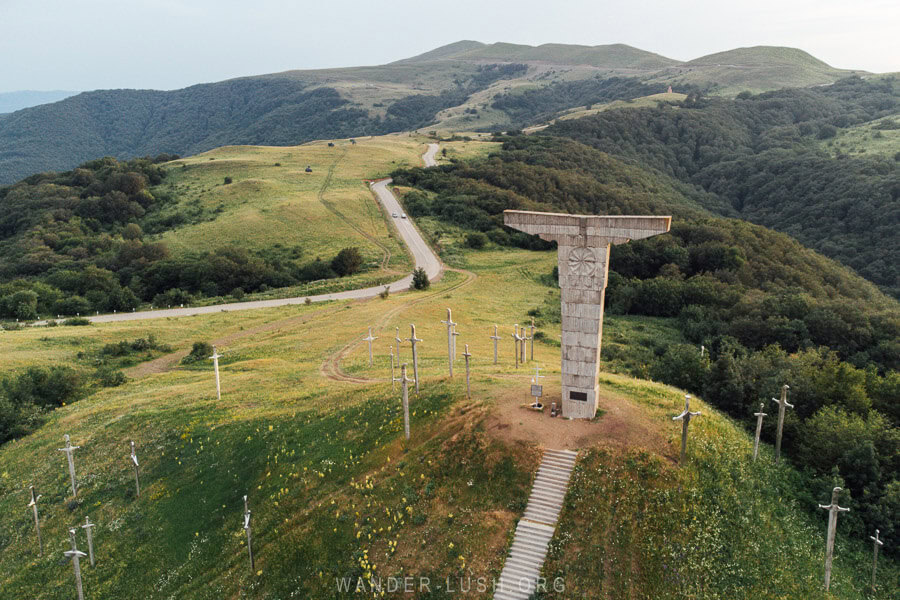
West of Tbilisi, the Didgori Memorial marks the site of the 1121 battle where King David the Builder defeated Seljuk forces in what became known as the ‘Miraculous Victory’, clearing the path for Georgia’s Golden Age. Like the Chronicles monument, it commemorates medieval statehood with a monumental sculpture.
The memorial sits alone in open pastures, with the wide open landscape underscoring its symbolism. Giant steel cross-swords pierce the hillside and sculptural figures are scattered around wildflower meadows, with the drive in on a sealed road every bit as spectacular as the complex itself. The remote setting and sweeping views make it especially photogenic, with late afternoon and sunset offering the most dramatic light.
→ For tips, see my guide to visiting the Didgori Monument from Tbilisi.
The Abasha Riverside: Wild nature in Samegrelo
If you loved: Martvili Canyon.

Martvili Canyon is one of Georgia’s most popular nature attractions, but its managed walkways, boat rides and barriers aren’t to everyone’s taste. Upstream and downstream from the ticketed canyon, the river flows through largely undeveloped gorges, forming waterfalls and swimming holes that are primarily the domain of local families in summer.
It’s the same Abasha River – the same turquoise waters and mossy cliffs – just without the infrastructure. Gachedili Canyon, Kaghu Waterfall and Oniore Waterfall can be reached on foot and offer a more local, less curated way to experience Samegrelo’s waterways.
→ Learn more in my alternative guide to Martvili (published soon).
The Yaylas of Upper Adjara: Beshumi & beyond
If you loved: Tusheti’s landscapes & mountain traditions.

Mountainous Adjara feels a world away from the Black Sea – yet you only need to drive a couple of hours inland from Batumi before the landscape shifts from subtropical coast to dramatic mountains. Much like Tusheti, this part of Georgia is shaped by seasonal movement, and has a distinct cultural identity evident in the cuisine, traditions and beliefs.
Life on imperial frontiers – Tusheti along the Russian borderlands and Adjara on the Ottoman edge – runs as a common thread between the two regions. In Adjara, wooden mosques, covered bridges and yaylas (summer settlements) including Beshumi replace fortified towers. More developed infrastructure (sealed roads, glamping sites, and activities including one of Europe’s longest zip lines) makes Upper Adjara more accessible.
→ Find a full list of things to do in Upper Adjara in my detailed guide.
Vashlovani: Off the grid in Georgia’s wild east
If you loved: Tusheti’s remoteness & borderland feel.

Stretching along Georgia’s south-eastern border with Azerbaijan, the Vashlovani Protected Areas are a vast landscape of semi-desert steppe, badlands and dry canyons – closer in character to Central Asia than the Caucasus.
Like Tusheti, it requires planning and self-sufficiency. The two regions are historically linked by Transhumance traditions, with families from Omalo and beyond driving their herds down to Vashlovani’s winter pastures every October – a route that visitors can follow on organised horseback tours. Vashlovani is not a hiking destination: it is best explored by 4WD in spring or autumn, when Tusheti is still off-limits. Accommodations range from ranger huts to wild camping.
→ See my Vashlovani guide for route suggestions and driver recommendations.
Khvamli Mountain: A limestone massif above Lechkhumi
If you loved: The walk up to Gergeti Trinity Church.

Dominating the skyline north of Kutaisi, Khvamli Massif rises 2,000 metres above the rocky region of Lechkhumi. A marked trail from a newly sealed access road leads to the summit plateau in around 2-3 hours return.
Like Gergeti, this is a short, summit-focused hike with wide open Caucasus views. There is no iconic monastery at the top, but there is a small chapel on the way. The mountain’s mythological connection to Amirani, the Georgian Prometheus, and the largely unmapped network of 20-plus limestone caves at its base add to the intrigue. This is one of the most accessible high-elevation hikes in Western Georgia and a great day trip from Kutaisi.
→ For trail directions, see my Khvamli hiking guide.
Abudelauri Lakes Hike: The other side of the Georgian Dolomites
If you loved: The Juta Valley hike.

Starting outside Roshka, the Abudelauri Lakes trail approaches the Chaukhi Massif (AKA the ‘Georgian Dolomites’) from the western side, revealing the same dramatic rock formations that define Juta – just viewed from the opposite face.
Unlike Juta’s relatively gentle valley trail, this is a longer and slightly more demanding hike. The marked path follows the valley floor and crosses several rivers via new bridges to reach a trio of alpine lakes – Green, Blue and White – set beneath the cliffs. The full loop takes at least six hours and includes steep sections and shale descents, making it a natural progression for hikers finding their feet in the Greater Caucasus. (Or you can combine the two into a multi-day hike that crosses the pass.)
→ See my Khevsureti guide for hiking tips and where to fit the Abudelauri Lakes into your itinerary.
Tabatskuri Lake: Quiet villages & rare birds
If you loved: Paravani Lake.

Like nearby Paravani, Tabatskuri is part of the high volcanic lake system that defines the Javakheti Plateau – but it is noticeably wilder. Sitting at around 2,000 metres above sea level, the lake fills an ancient volcanic basin between the Trialeti and Javakheti ranges.
Reaching the shoreline requires leaving the sealed highway behind, with rough tracks and gusting winds defining the approach. The lake is an important habitat for waterbirds, including the critically endangered velvet scoter, while the small Doukhobor-founded village of Tabatskuri sits on a dramatic peninsular. The South Caucasus gas pipeline runs nearby, necessitating an ID check if you are travelling from the direction of Bakuriani via the unsealed Tskhratskaro Pass.
→ Find accommodation tips & things to do in my Tskhratskaro guide (published soon).
Tetnuldi: Big-mountain skiing in Svaneti
If you loved: Skiing in Gudauri.

Of Georgia’s three other ski resorts, Tetnuldi is closest in atmosphere to Gudauri, with a young crowd, apres-ski onsite, and a similarly energetic vibe. Svaneti is an adventurous winter destination, with comparatively more to do off the slopes versus its counterpart thanks to its museums and town infrastructure.
With high-alpine terrain rising above 3,000 metres, wide open runs and significant off-piste potential, Tetnuldi delivers similar scale and dramatic snowy scenery. But since there is no resort village at the base, access requires a daily commute from Mestia or Ushguli. This helps to keep lift lines short, and ensures you have plenty of room to stretch out on the slopes.
→ See my Svaneti winter guide for Tetnuldi tips.
Small towns & big histories
Abastumani: Romanov spa town & mountain observatory
If you loved: Borjomi.

Abastumani developed in the late 19th century as a Romanov-era health resort, famed for its mineral springs and clean mountain air. The imperial family and their entourage built summer residences here, and wooden dacha-style houses still line the main street. The town sits directly on the edge of Borjomi-Kharagauli National Park, with marked forest trails leading out of the centre.
Similar to Borjomi, it combines spa heritage and woodland hiking. But for now, it is smaller, lesser-visited, and far less commercialised. Its defining landmark is the Abastumani Astrophysical Observatory, established in 1932 as the first high-mountain observatory in the USSR, where guided night-time telescope sessions add a compelling scientific dimension to the classic spa-and-forest formula.
→ To book the tour, see my Abasturmani guide.
Saro: Cyclopean megaliths & subterranean houses
If you loved: Vardzia.

Set on a ridge between Akhaltsikhe and Vardzia, Saro layers Bronze Age and early medieval history within a compact but commanding landscape. A cyclopean fortress of massive, unmortared stone blocks crowns the hilltop, overlooking a wide valley that once formed part of an important regional route. The 7th-century Archangel Church and convent stands nearby.
Like Vardzia, Saro fuses archaeology and belief with a mystical atmosphere. But unlike the monumental cave complex, it is dispersed and invites unguided exploration. Scattered throughout the village are rare examples of Darbazuli Sakhi – traditional Meskhetian hall houses with distinctive pyramid-shaped wooden ceilings.
→ For details about Saro and more from this region, see my Meskheti guide.
Chobareti: Traditional Meskhetian cooking in a village home
If you loved: Visiting cellars in Kakheti.

Meskhetian cuisine is one of Georgia’s most distinct regional traditions, built around dried and salted ingredients (apokhti jerky-style meat, arishta noodles, and sweet-savoury breads such as kada) that could be easily stored during times of siege.
In the village of Chobareti near Akhaltsikhe, the family-run Meskhetian House offers visitors a rare chance to experience this food culture first-hand. Cooking demonstrations and generous feasts centre on tenili – an ancient string cheese made by stretching softened curds into delicate strands, a technique only preserved by a handful of producers in the region. Like Kakheti’s cellar tastings, the experience is rooted in regional traditions and hospitality – but instead of vineyards, the setting is a quiet Meskhetian village.
Lailashi: A mountain village shaped by faith & trade
If you loved: Kazbegi.
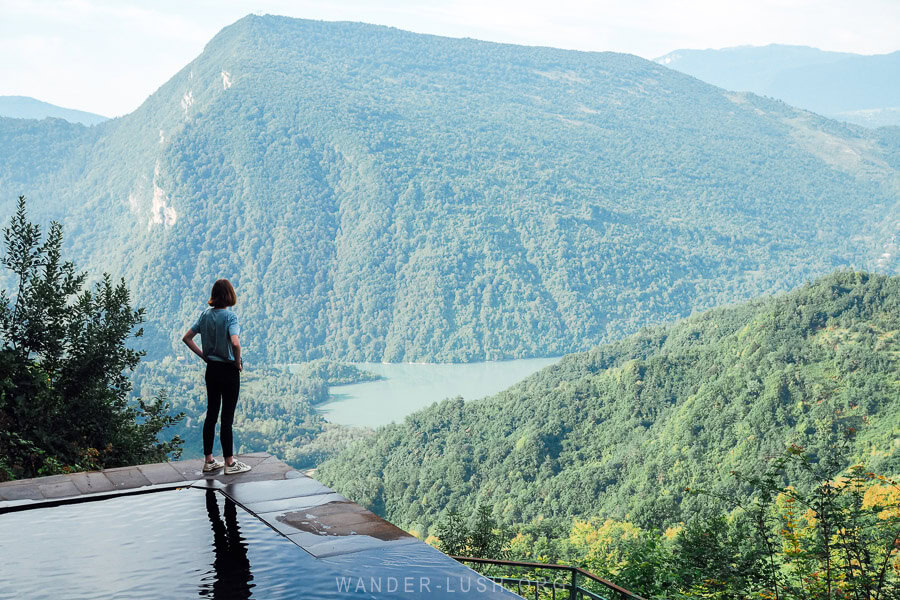
Located high above the main highway in Lechkhumi, Lailashi is an upland village defined by its layers of religious history. Its stone synagogue, built in the 1860s, once housed the Lailashi Codex – a 10th-century Masoretic Pentateuch – while the ruins of Armenian Apostolic and Georgian Orthodox churches reflect centuries of coexistence.
Like Kazbegi, it boasts dramatic mountain scenery. There is no tourism infrastructure save for a few low-key guesthouses, however – its appeal lies mostly in its atmosphere. The Lailashi Secret Pool (Okronishi Fountain), a spring-fed infinity pool overlooking the mountains and Lajanuri Reservoir below, is Lailashi’s postcard moment and answer to Gergeti Trinity.
→ For more on Lailashi, see day 4 of my Racha-Lechkhumi itinerary.
Gorelovka: An unlikely village born of exile
If you loved: The German villages of Kvemo Kartli.

Planted on the windswept Javakheti Plateau, Gorelovka was founded in the early 19th century by Doukhobors exiled from the Russian Empire for their pacifist beliefs and rejection of state and church authority.
Like the German settlements of Kvemo Kartli, it represents the architectural imprint of a relocated community. Village streets are lined with wooden vernacular houses painted blue and white, their carved fretwork and decorative window frames a counterpoint to building techniques designed to withstand the plateau’s severe winters. The so-called Blue House, originally built as an orphanage, together with other traditional Doukhobor ceremonial buildings defines one of the most intact Doukhobor settlements in the region.
As an active and sacred site for the Doukhobor community, visits should be approached respectfully. It is best to arrange a local guide in advance rather than wandering in independently.
→ Contact me by email for a recommendation.
Routes & relics
The Javakheti Plateau: An alternative way west
If you loved: Road tripping across Georgia, but want to skip the main highway.

The Javakheti Plateau is quite literally the scenic route across Georgia, bypassing the modern E60 highway and its dozens of tunnels in favour of empty roads, big volcanic landscapes, high lakes, and quiet towns. Instead of blasting through Rikoti, this route takes you across one of the country’s most striking landscapes.
Driving from Tbilisi via Tsalka and across the plateau to Akhaltsikhe takes around 5-6 hours without stops, making it doable in a long day. Traffic is light, roads are straightforward, and driving is far less stressful – the ideal way to start a road trip around Georgia.
→ See my Javakheti Plateau guide for suggested pit stops.
The Imereti Wine Route: Georgia’s second wine region
If you loved: The Kakheti Wine Route.

Imereti is Georgia’s second-largest wine region, but it has a low-key vibe compared to Kakheti. The wines here are lighter and fresher, dominated by indigenous grape varieties such as Tsitska, Tsolikouri, and Krakhuna. The same 8,000-year-old qvevri traditions are used – though in Imereti, the vessels are traditionally called churi, and the pressing troughs are made from wood rather than stone.
The harvest season runs later in the west, so if you missed the Rtveli in Kakheti, you can skip across to Imereti from late October through to early November to join the festivities. Instead of Kakheti’s monastery-dotted hills and Pirosmani references, vineyards here reflect the abstracted landscapes painted by David Kakabadze, with the Vani Museum a historical counterpoint.
→ Find a list of recommended wineries in Imereti here.
The Monument Route: Mosaics & memorials in Samegrelo
If you loved: Mosaic-hunting in Tbilisi.

The Monument Route is a name I use for the drive between Kutaisi and Zugdidi – one of the most mosaic and memorial-rich stretches of road in the country. Like mosaic-hunting in Tbilisi, the pleasure lies in stopping often, looking closely, and snapping lots of photos.
Once prized for agriculture, silk, and tea production, this corner of Imereti and Samegrelo is ripe with culture houses, abandoned sanatoriums, collective farms, and civic buildings. Large-scale pannos dominate village centres in places like Abasha and Khobi, while mosaic-clad bus stops and roadside monuments appear unexpectedly around villages such as Dziguri, Ingiri, and Kakhati.
→ My Monument Route guide and map covers all the essential stops.
Zestafoni: Industrial heritage in the Georgian Rust Belt
If you loved: Rustavi.

Zestafoni developed around a 1930s ferroalloy plant that still operates today, shaping the town’s economy and identity. Soviet-era apartment blocks, civic buildings and mosaics define the compact city centre, inviting visitors to explore by foot.
Like Rustavi, Zestafoni is defined by heavy industry – but it’s even more obscure, just a place you pass on the highway for most travellers (and Georgians). As well as bas-reliefs and several stunning mosaics, Zestafoni has a museum, a beautiful railway station, and a modern covered bazaar – making it a dream side quest for photographers and anyone interested in industrial-era Georgia.
→ See my Zestafoni guide for full details.
Tkibuli: A mining town in a mountain basin
If you loved: Chiatura.

Like Chiatura, Tkibuli is a mining town shaped equally by Soviet-era industry and its dramatic mountain setting. Wedged into a steep basin and surrounded by forested slopes, it has a similarly atmospheric, small-town feel.
The coal mines remain active here, and the town still bears the marks of its former importance: grand civic buildings, lines of apartment blocks, and a truly incredible theatre that feels improbably ornate for such a location. There is no network of cablecars here: Tkibuli only had one (once the longest ropeway in the Soviet Union, stretching towards the Tskhrajvari viewpoint), but it is now abandoned.
→ Refer to my Tkibuli guide for a guided walk around town (published soon).
Big Shiraki: An abandoned Soviet air base on the steppe
If you loved: Tskaltubo.
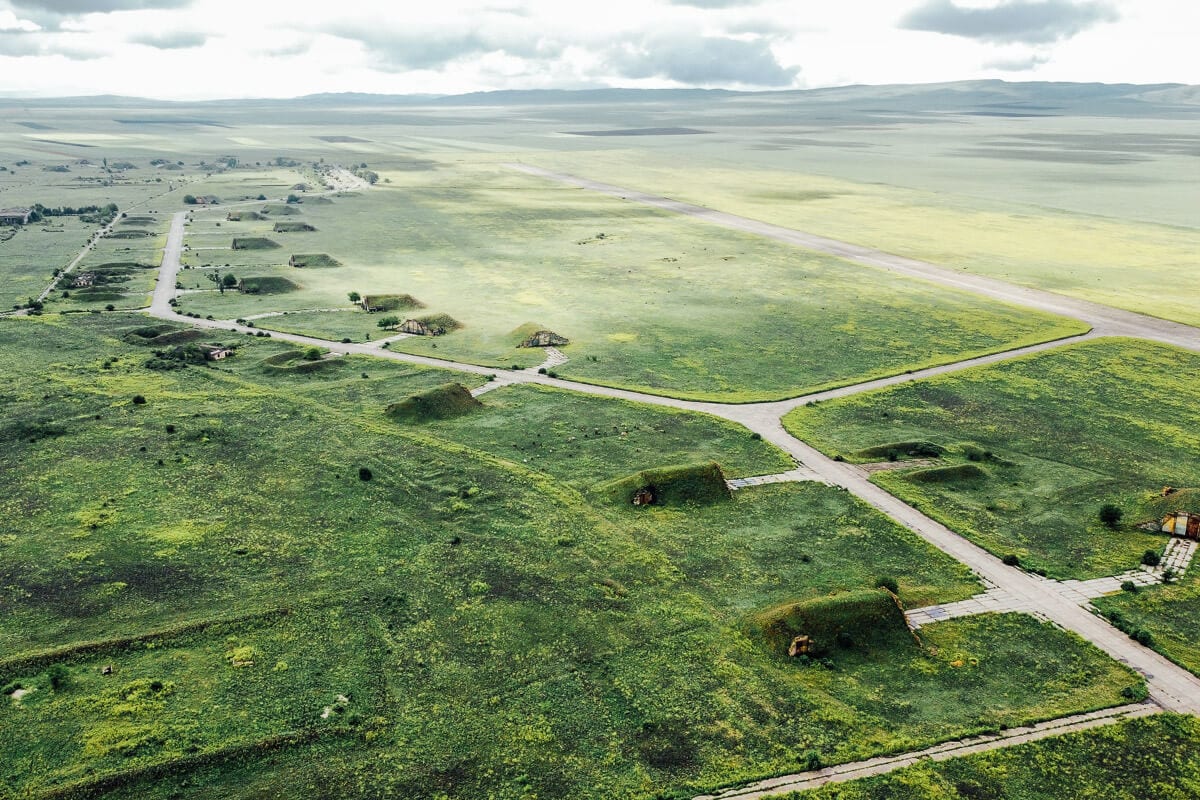
Built in the 1950s, Big Shiraki is one of Georgia’s most striking post-USSR landscapes. A vast space designed for power and permanence, it has been left to erode and return to nature.
A base for the 178th Guards Fighter Aviation Regiment, who flew out from Shiraki to Afghanistan during the Soviet–Afghan War, its concrete runways, barracks and service buildings stretch across the steppe, their peeling paint and rusted metal echoing the flaking sanatoriums of Tskaltubo. The most memorable structures are the dozens of numbered, dome-shaped hangars, each with a distinct patina. A single abandoned bomber plane, left behind when the base was evacuated, reinforces the feeling of a place frozen in time.
→ Find a full guide to visiting Big Shiraki here.
Anaklia: Georgia’s unfinished Black Sea megaproject
If you loved: Batumi’s outlandish architecture.

Anaklia feels a bit like Batumi stripped of crowds and commerce, leaving behind a surreal, dystopian architectural landscape by the sea. The Pier Sculpture, Anaklia Tower, wooden bridge and long, empty promenade (now being refurbished) combine to form a strange open-air installation – futuristic forms set against a quiet Black Sea backdrop.
Unlike Batumi, Anaklia has no (working) high-rise hotels, no nightlife, and no restaurant strip. This is a destination squarely for photographers drawn to unfinished modernism. Golden hour and stormy afternoons are especially striking, when the town’s megaproject aesthetics cross the line into the uncanny.
→ See my Anaklia guide for things to do.
Kvetera Fortress Church: A medieval stronghold in the forest
If you loved: Gremi, Nekresi & Kakheti’s mountainside churches.

Hidden beyond the Alazani Valley, Kvetera is a 10th-century domed church set within the ruins of a former fortress city once ruled by the medieval Kingdom of Kakheti. A short walk leads to the turquoise-roofed chapel, which stands alone inside crumbling defensive walls.
For travellers drawn to Gremi or Nekresi for their elevated settings and layered history, Kvetera is a quieter counterpart. There is no formal signage, and you might just have the site all to yourself depending on the day. It is perfectly positioned as a stop when driving between Kakheti and Stepantsminda via the scenic Tianeti backroad, which is especially beautiful in autumn.
Trusted travel resources for Georgia
Planning a trip to Georgia? Here are 5 essential resources that I recommend you check out.
- For private transfers in Georgia: GoTrip.ge. Find a professional, English-speaking driver. Prices are locked in when you book & you can stop wherever you want.
- For hiring a car in Georgia: Local Rent. Save money when you rent directly from a local agent. Pick-up & drop-off are available from any address in Georgia.
- For finding accommodations: Booking.com. This website has the biggest selection of properties in Georgia, including guesthouses in rural areas.
- For Tbilisi tours & day trips: Friendly.ge. Friendly.ge has knowledgeable guides, safe drivers & creative itineraries. I especially like their off-road tour to David Gareja.
- For tailored advice: Book a call with me! My Georgia Itinerary Planning service is perfect if you need feedback on your plans or personalised travel tips.


