25 Underrated Beach Towns to Discover in 2026—Before Everyone Else
37 min readSome beach towns become world-famous almost overnight. Word spreads, visitors pour in, and before long, the quiet seaside charm that made them special begins to fade beneath crowds, cruise ships, and high-rise resorts.
But around the world, there are still places where life by the sea moves at its own rhythm. Towns where fishermen still haul their boats onto the sand at sunset… where a café table overlooking the water costs a few dollars instead of a small fortune… and where the biggest decision of the day might be whether to swim before lunch or after.
These are the kinds of places our International Living correspondents love to uncover.
Because they live on the ground in their adopted countries, they’re often the first to notice when a coastal gem is flying under the radar. A beach town that locals cherish… but that hasn’t yet appeared on the mainstream travel map.
From sleepy fishing villages with golden-sand shores to laidback coastal enclaves where expats enjoy an enviable lifestyle for less, these underrated beach towns prove you don’t have to follow the crowds to find your slice of paradise.
Here are some of the most underrated beach towns our correspondents recommend right now.
24 Countries Compared, Contrasted, Ranked, and Rated.
You don’t have to be rich to enjoy a pampered retirement, you just need to know where to go. With our 35th Annual Global Retirement Index, our experts hand you a detailed roadmap.
Details—and a Special Offer—Here

By submitting your email address, you will receive a free subscription to IL Postcards, The Untourist Daily and special offers from International Living and our affiliates. You can unsubscribe at any time, and we encourage you to read more about our Privacy Policy.
Across Europe, seaside towns blend history, walkable centers, and beach life in ways that make everyday living feel like a vacation.
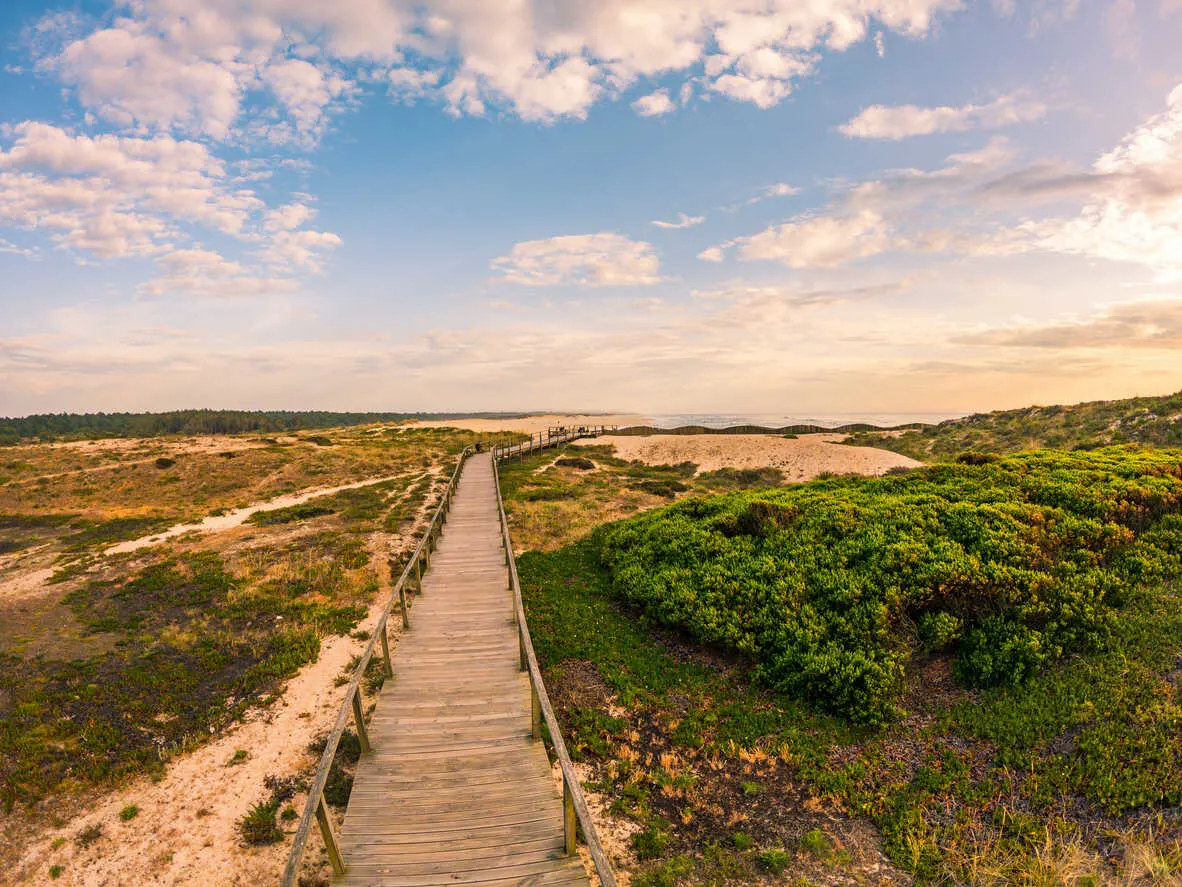
Furadouro serves up broad sands, tiled facades, and old fishing-village charm.|©iStock/homydesign
While many expats flock to the crowded, expensive Algarve, two of my absolute favorite underrated beach towns lie in the beautiful north. Just a scenic forty-minute drive south of Porto sits the charming village of Furadouro. It retains a sleepy, old-world charm, yet it’s only fifteen minutes west of Ovar, a town containing everything one needs for daily life, from major supermarkets to excellent healthcare.
Furadouro features a wide, six-block pedestrian promenade dotted with upscale boutiques and cafes, leading straight to the ocean. The surrounding low-rise buildings boast stunning, traditional azulejo tile facades. While the architecture feels beachy, cobbled sidewalks and local fruit stands keep it grounded in its sixteenth-century fishing roots. Just east, quiet farming fields offer the perfect, peaceful spots to walk your dog.
The main attraction is the expansive sandy beach. My favorite spot is next to the restaurant Bamboo, where you descend to the sand via a wooden platform. The north side features lovely restaurants where you can watch the surf while sipping affordable Portuguese wine or an espresso.
Best of all, the beaches are dog-friendly, and my pup loves exploring the coastline. While the town bustles in summer, it’s wonderfully calm the rest of the year. To the south, a peninsula stretches along the Aveiro Lagoon toward São Jacinto, offering wild dunes and beautiful hiking trails.
Real estate here offers coastal living without the premium price tag. Move-in-ready two-bedroom apartments start at $200,000, while a three-bedroom house with sea views runs about $300,000. Meanwhile, rentals for a one-bedroom average $1,000 to $1,500 monthly.
People who own their home can live comfortably here without a car for about $3,000 per month. This budget remains low because you avoid tourist markups; fresh produce, local seafood, and daily cafe outings are highly affordable, and your best entertainment—walking the beach—is completely free.
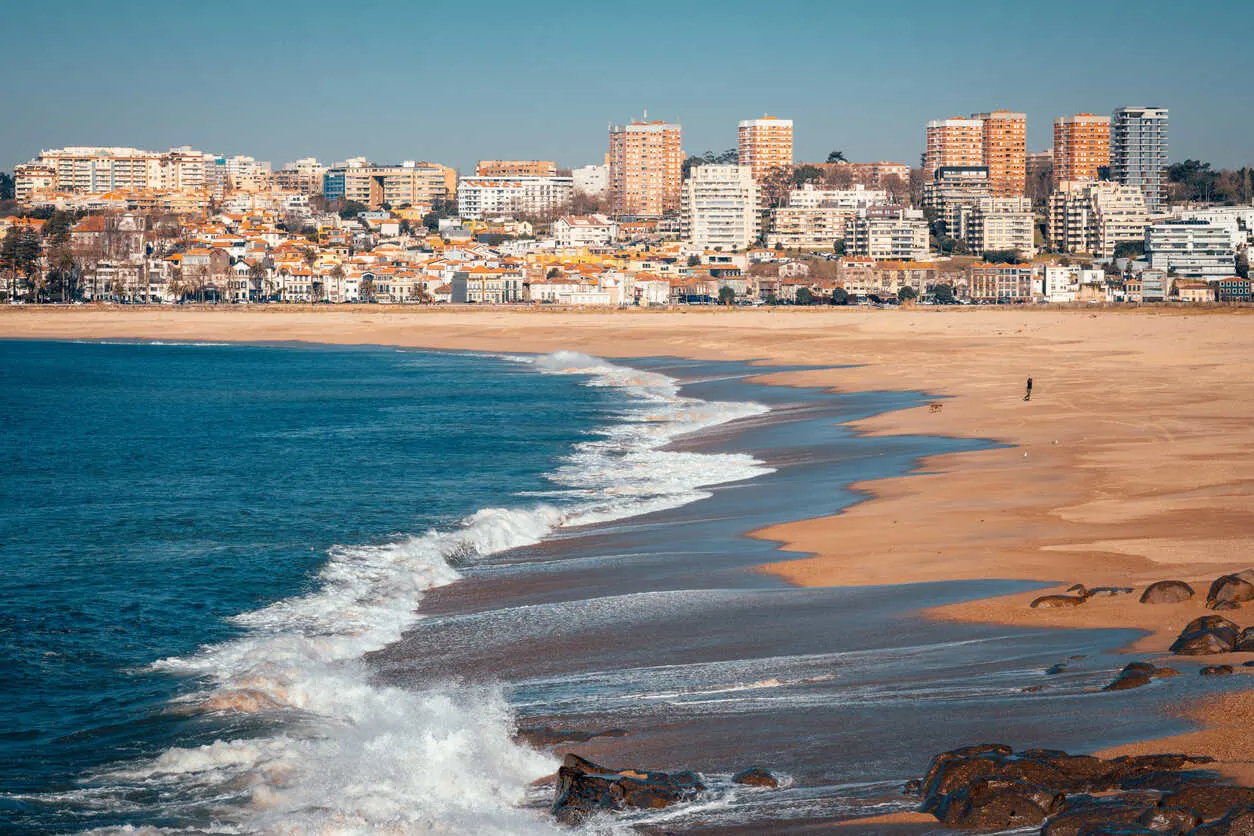
Gaia delivers ocean beaches, city convenience, and easy access to Porto.|©iStock/Photosbypatrik
Directly across the Douro River from Porto lies Vila Nova de Gaia. Often called Gaia for short, this thriving city is technically a suburb of Porto, but many locals and expats will argue that it’s actually a much better place to live. It offers gorgeous architecture, a quick, seamless metro ride into Porto, and beaches that are even more beautiful and numerous than those on the Porto side.
While Porto has just a few beaches, Gaia boasts over a dozen stunning ocean and river options. Praia da Madalena is a local favorite, featuring raised wooden walkways, thatched umbrellas, unique rock formations, and lively beach bars—a classic Portuguese staple I will never tire of. I find myself most often at Praia de Lavadores because it is just a ten-minute walk from the colorful, must-see fishing village of Afurada. For water sports, Praia de Canide Sul offers excellent paddleboarding and surfing lessons.
Gaia is a large, self-sufficient city with everything needed to call it home, from top-tier private hospitals to modern transit. It features several large shopping malls, including the popular El Corte Inglés. The vibrant Gaia riverfront is world-famous for its historic Port wine cellars, offering sweeping views of Porto’s stunning Ribeira district across the water.
Because of its premium amenities and proximity to Porto, real estate here is often higher than in other areas. A luxury three-bedroom beachfront apartment can easily reach $1 million. However, renting a modern, refurbished three-bedroom apartment within walking distance of the ocean costs a more reasonable $2,000 per month.
A person or a couple owning their home can live comfortably in Gaia without a car for about $3,500 per month. This budget remains manageable because daily expenses like groceries are affordable. Plus, excellent public transit helps offset the higher cost of living near the coast.
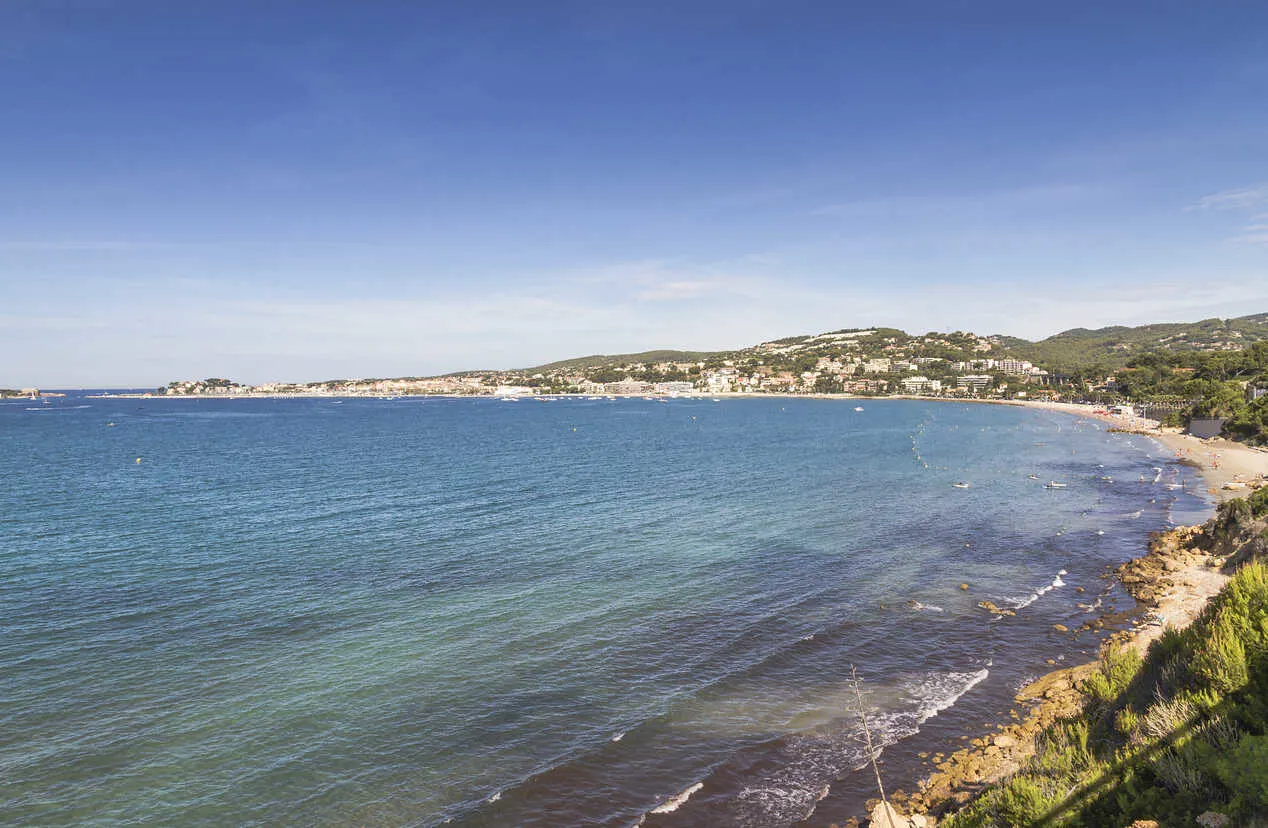
Sanary-sur-Mer mixes harbor charm with golden sand and Riviera calm.|©iStock/PJPhoto69
Sanary, as it’s affectionately known by locals, is a portside town in southeastern France. On the road between Toulon and Marseille, it’s a popular tourist spot for both French and European visitors. For those making the detour off the highway to visit the sailboat-filled marina, peruse the farmers market, or climb to the top of the medieval clocktower for views of the sparkling Mediterranean Sea below, Sanary-sur-Mer is one of the unparalleled gems of the south of France.
Although very few experience one of her most dazzling attributes: La Plage Dorée, or Golden Beach. While nearby Portissol Beach is accessible on foot from the town center, La Plage Dorée requires a short drive or bus ride from Sanary proper.
And it just happens to be one of the most spectacular drives in the region.
The iconic beaches of the south of France are talked about the world over, but you may not know that many of the beaches, like those in Nice, are made up of small stones. While picture-perfect ready, they might not always be, well… the most comfortable.
Then there’s La Plage Dorée. Leaving the center of Sanary, you’ll pass several palm-tree-lined roundabouts before the landscape opens up to a breathtaking view of turquoise waters and, you may have guessed it, golden sandy beaches.
For my money, it’s one of the nicest natural spots in southern France.
Since you do need a car or a local bus to arrive, the beach is less crowded than many others—incredibly, also in the summertime. If you arrive early enough!
Although Golden Beach is technically in Sanary-sur-Mer, it’s right on the limit with another beautiful southern town, Bandol. You’ll see views of this French Riviera favorite as you descend down the “corniche” seaside road.
The beach itself is made of fine sand, and, due in part to its cove-like location, it actually gets sizable waves for the Mediterranean, by which we mean about 3 feet high.
Those waves do allow for surfing lessons, and there’s a small surfing/paddleboard school on the beach, which gives lessons in the spring and summertime.
The beach also has two makeshift restaurants, built from the ground up at the start of summer and taken down for the off-season. At La Plage Dorée restaurant and Yuka Beach restaurant, you can get everything from cocktails to seared tuna dishes and Asian-inspired appetizer platters.
We learned to do as locals do… bring some cubes of cheese, a container of charcuterie, and a chilled bottle of rosé and have a picnic “apéro” (apéritif) on the beach. Folks come around 6 p.m. and stay until the sun goes down—a 10/10 south of France experience.
A couple renting a modest two-bedroom apartment (650 square feet) in Sanary-sur-Mer can expect an average monthly budget of €2,700 ($3,141).
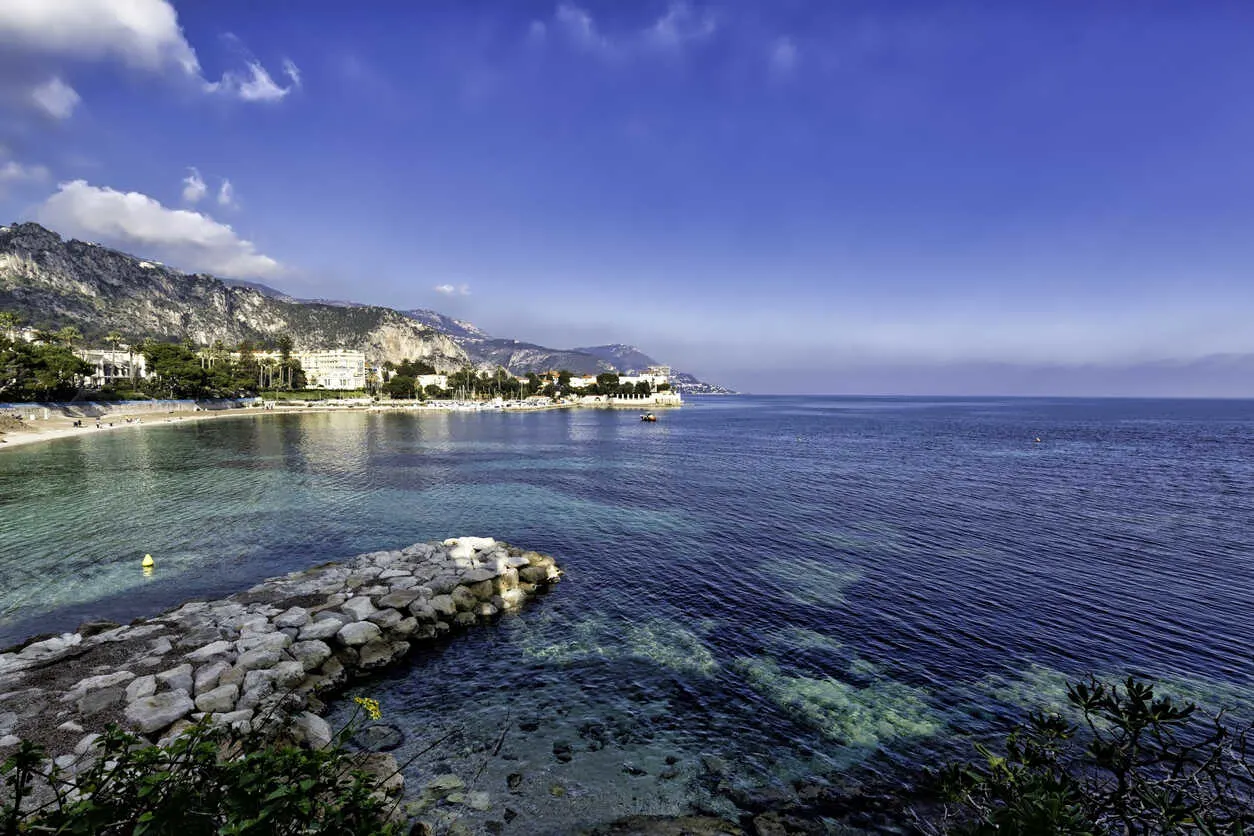
Beaulieu-sur-Mer offers Riviera elegance without the usual crowds.|©iStock/JMLPYT
There’s a lot to love about the French Riviera, but it’s certainly not the cheapest place to visit or live. While many visitors head to trusted favorites like Nice, Cannes, and Saint-Tropez, there’s a little Côte d’Azur enclave that tends to fly pretty low under the radar… and thus is a great way to experience the Riviera lifestyle sans bustling crowds.
Beaulieu-sur-Mer is a short 20-minute drive from Nice, or around a 15-minute train ride on the region’s RER system—recommended in the summer months when driving times can be slower. The town has a small train station, which is a quick walk to the center and the local beaches.
Originally part of the Roman province Gallia Narbonensis, Beaulieu was used initially for maritime travel along the Mediterranean. It grew into a fishing village in the Medieval period, with residents living from fishing, the olive trade, and local agriculture.
In the late 1800s, the French Riviera experienced its tourism boom, when the region became fashionable as a winter escape for European elites. Elaborate villas were built, and the quintessential French “good life” caught on fast.
Today, visitors and residents can still experience la belle vie, but on a decidedly more subdued scale. For one, life in Beaulieu is a lot quieter than her racy neighbors. Beaches like Plage de la Petite Afrique offer a laid-back, lounge-chair atmosphere and the opportunity to dine and spend the day.
The cozy waterfront is perfect for walking, jogging, or cycling, and several coastal hiking paths exist at nearby Cap Ferrat, also the home to the iconic Villa Ephrussi de Rothschild. An ideal spot to see lavish French gardens and awe-inspiring views of the Mediterranean.
Of course, there are several five-star dining opportunities in town, but we discovered a few budget-gourmet spots as well. At La Table de La Reserve, we found a three-course gourmet meal (lunch and dinner) for €28 ($32)—available during the week and the weekend. A rarity for the region.
A couple renting a modest two-bedroom apartment (650 square feet) in Sanary-sur-Mer can expect an average monthly budget of €3,100 ($3,607).

Le Grau du Roi pairs working-town grit with vast dunes and wild beaches.|©iStock/graemenicholson
This town is certainly the most out-of-the-way beach spot on the list… and frankly, not at all what most would think of when planning a destination trip or potentially a spot to call home.
Le Grau du Roi’s eccentricity is also part of its charm. Located in the Gard department in the Camargue National Park, the town has a colorful and surprising history, which informs much of the atmosphere you’ll find there today.
The name grau comes from the Occitan word (the original language of the region) meaning a natural channel linking a lagoon to the sea. The area was originally used as a passageway to local settlements in the Camargue, like fortified Aigues-Mortes (a launching spot of the Seventh and Eighth Crusades under King Louis IX).
Access to lagoons was constantly shifting due to the sand flows arriving into the Mediterranean from the Rhône River. The waterway was eventually solidified and became Le Grau du Roi, the king’s channel, which allowed for the later development of the Port Camargue marina.
Incredibly, Port Camargue is considered one of the largest marinas in all of France. It contains an estimated 4,800–5,000 boat berths and over 14 miles of quays and canals. It was expanded to equip the region for growing tourism, specifically in the 1970s, and currently not only sustains pleasure boats but also Le Grau du Roi’s fishing industry.
While the area modernized rapidly, most notably around the resort of Grande Motte, Le Grau du Roi has another surprising feature—a collection of sand dunes known as the “wildest” Mediterranean beach in France.
At Espiguette Beach, massive dune fields stretch inland among the natural lagoons and wetlands of the Camargue. Considerably larger than most Mediterranean beaches (by hundreds of feet), seen from above, Espiguette resembles a kind of “small desert” meeting the sea.
One of the top destinations in Le Grau du Roi, the natural beach is a sharp contrast to the town itself. While the port is very pretty, the surrounding apartments could use a good refurbishing, and the atmosphere is less resort than working town. We love its “downhome” style and Coney Island-type boardwalk, but it might not be for everyone, although rents are a lot lower than in surrounding towns.
A couple renting a modest two-bedroom apartment (650 square feet) in Le Grau du Roi can count on an average budget of €1,900 ($2,210) a month.
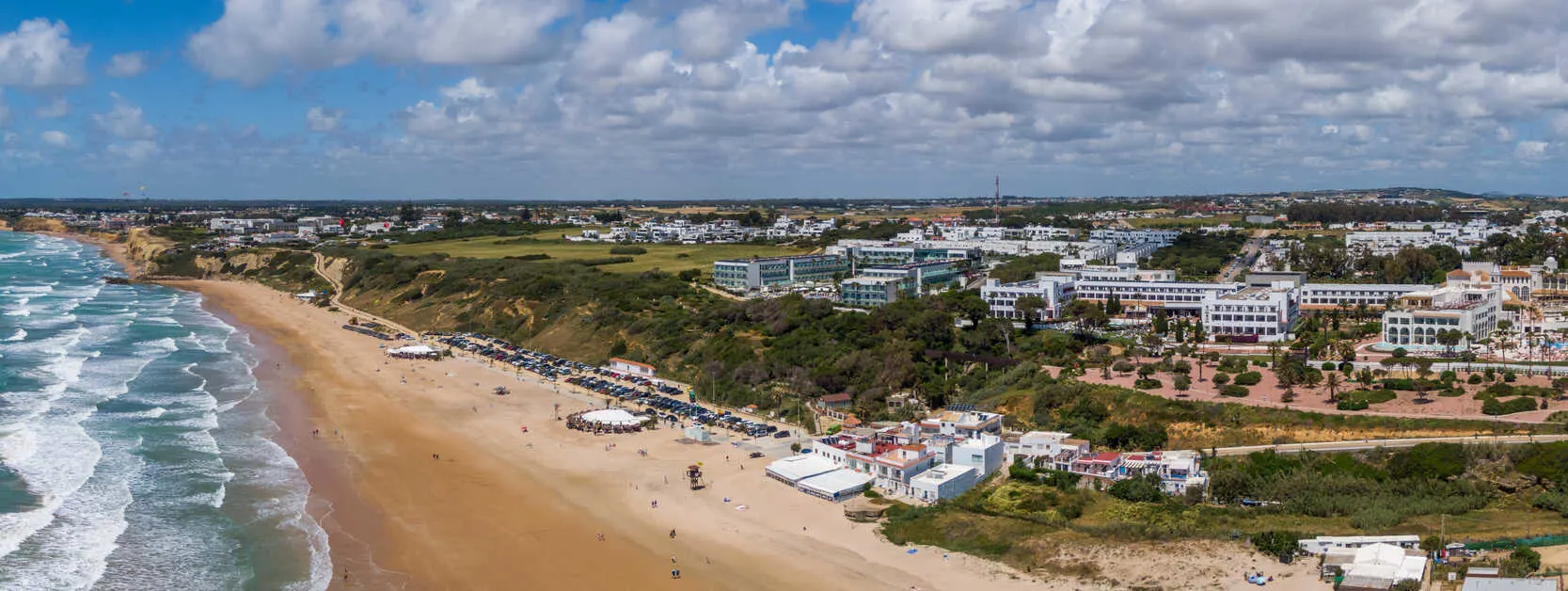
Conil draws beach lovers with whitewashed streets and miles of golden sand.|©iStock/Iurii Buriak
You may have heard of Cádiz by now, a coastal city that feels like one of the last authentic beach towns in southern Spain. But drive 30 miles south, and you’ll find a place most people outside of Spain have never come across: Conil de la Frontera.
Conil is a whitewashed town on the Atlantic, home to roughly 24,000 people. Popular in Spain as a top summer destination, its population triples in size, and it has managed to stay off the international radar, unlike most of Spain’s seaside destinations. Only about 8% of residents are foreign, giving it a distinctly Spanish feel. Housing remains affordable, with a simple one-to two-bedroom rental starting around €450 a month, and apartments in the center starting at €170,000 to €220,000.
The charm of Conil starts in the old town, where you can pass through the Puerta de la Villa, one of the original entrances to the old city, built in 1502, and begin to wander. The streets are maze-like and narrow, and each step takes you past typical white buildings, flower pots hanging from the walls, bursts of bougainvillea, and wrought-iron balconies that are classically Andalusian. In the center of town, climb the Torre de Guzmán, a restored 14th-century tower, for panoramic views over the rooftops and out to the Atlantic. The perfect spot to catch a sunset.
While the old town is magical, the real draw to Conil is its beaches. Cádiz province is home to some of the best beaches in Spain, and many locals will tell you Conil’s are among the best around. Eight miles of wide, golden beaches and turquoise Atlantic water. Bateles Beach is the easiest to reach, a 15-minute walk from town, making it one of the busiest. For something quieter, head to the unspoiled beaches of Castilnovo. Even more untouched is Fuente del Gallo, where dramatic cliffs protect the beach from the Levante—strong easterly winds that whip through this part of Andalucía.
After a day at the beach, head to a chiringuito (an open-air beach bar) for fresh seafood. Conil is known for its red tuna, caught during the spring almadraba tuna harvest. If you’re visiting in May, try to time your trip with the town’s Gastronomic Day of Atún Rojo.
The best time to come is May or June, September, or October, when the weather is perfect, and the beaches feel empty—just keep in mind the Atlantic can still be too cold for swimming in late spring. It takes a little effort to get to Conil by public transport, but the best places usually do. Hire a car and drive here from Cádiz, Jerez de la Frontera, Seville, or Málaga.

Nerja blends Andalusian charm with coves, sea views, and mountain drama.|©iStock/xavierarnau
Located 46 miles east of Málaga, Nerja is a favorite day trip for locals and a popular relocation destination for Europeans seeking warm weather year-round, sea views, and a slower pace of life. With a population of about 22,000, it’s a small town that feels very lively.
If you want to live near the center, you’ll find plenty of short-term rentals ranging from about €700 to €1,200 a month, while long-term rentals are challenging to come by. For buyers, it’s still possible to find a decent small two-bedroom apartment in the center for €200,000 to €300,000.
Around 20–30% of residents are foreigners, and you’ll hear plenty of languages spoken around town. I wouldn’t exactly call Nerja a hidden gem (especially for Europeans), but North Americans are starting to discover it. Despite its popularity, the town has done a remarkable job preserving its charm and avoiding the high-rise resort development common along the Costa del Sol. It’s still a classically Andalusian town, with whitewashed houses, narrow cobbled streets, and flower-filled balconies.
The heart of Nerja is the Balcón de Europa, a seaside viewpoint that hangs over the Mediterranean below. From here, you get postcard views of the coastline, beaches, and the mountains of the Sierras de Tejeda, Almijara, and Alhama Natural Park in the distance.
Just below sits Calahonda Beach, a small cove tucked beneath cliffs and one of Nerja’s most photographed spots. Like many beaches around Málaga, the sand is darker and coarser than the golden beaches of Cádiz and stony around here. I’d opt for nearby sandy Burriana Beach, which is the most popular stretch, lined with restaurants, bars, and areas for water sports—like kayaking to the nearby cliffs. Torrecilla Beach is another local favorite.
Another highlight is the Nerja Cave, an underground cavern discovered in 1959. Cave paintings show that Neanderthals may have lived here more than 42,000 years ago. While the paintings are closed off, you’ll be able to visit the Hall of the Cataclysm, home to one of the world’s largest stalagmite columns.
Living in Málaga, I’ve taken many visitors to Nerja over the years. It’s an easy day trip, and one of my favorite things about coming here is pairing it with nearby Frigiliana, arguably one of Andalucía’s most beautiful whitewashed villages, just a 15-minute drive up the mountain.
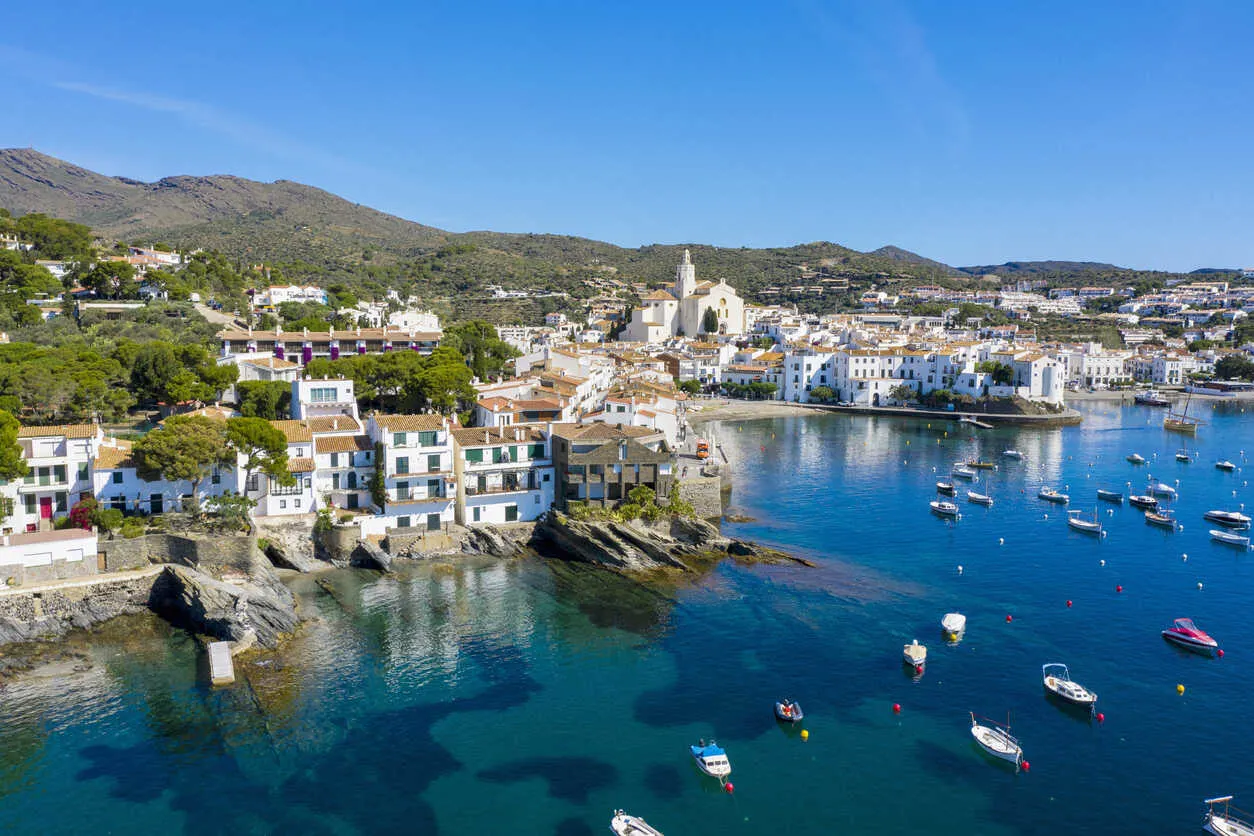
Cadaqués glows with whitewashed beauty, hidden coves, and artistic soul.|©iStock/xavierarnau
You’ve definitely heard of Barcelona, and maybe Girona or Tarragona, but have you heard of Cadaqués?
I first visited Cadaqués in 2017 and still dream about it. This idyllic fishing village sits on the Costa Brava in northeastern Spain, not far from the French border. Around 3,000 people live here year-round, though the population can swell to nearly 10 times that during the summer months. According to the 2025 census, only about 678 residents are foreign. Rental properties are scarce, but buyers can expect to pay roughly €375,000 to €500,000 for a two-bedroom apartment, depending on location and conditions.
Cadaqués is stunning—think whitewashed houses clustered around a curved bay. Similar but different from the white villages of Andalucía. Here you’ll find cobalt-blue doors and shutters that mirror the deep blue of the sky and sea, which give it a distinctive feel.
Part of what makes Cadaqués so special is how isolated it is. There’s only one winding road into town, which has helped maintain its charm. But it also means traffic and parking can become chaotic in the high season. I recommend visiting during the shoulder months, May and June, or September and October. Skip winter if you can, when the Tramuntana, a powerful cold wind from the Pyrenees, blows the strongest.
Cadaqués has long attracted artists and intellectuals, and today the narrow streets are dotted with galleries and small studios. The most famous artist from the area is Salvador Dalí, who spent much of his life nearby. His home in Portlligat, about a 30-minute walk along the coast from town, has been turned into a museum and offers an intimate glimpse into the surrealist’s world. Inside, you’ll find his studio, original furniture, and quirky personal touches like a pink lip-shaped sofa. Visiting it was one of the highlights of my trip.
But for me, the most memorable thing about Cadaqués was taking in its beauty—walking along the bay at sunset and watching the light hit the white buildings and the Santa Maria church as locals and visitors went for their evening stroll.
If you’re looking to swim, the town’s main beach, Platja Gran, is small and pebbly but perfect for a quick dip in deep blue water. For larger beaches and fewer crowds, I recommend taking a boat trip along the coastline, where you can discover hidden coves ideal for swimming and snorkeling.
Getting to Cadaqués requires a bit of effort. There’s no train, but buses run from Figueres and Barcelona, or you can drive.
Learn more about the lower cost of living in Spain and other countries in our free daily postcard e-letter. Simply enter your email address below and we’ll also send you a FREE REPORT — Live the Good Life in Sunny, Affordable Spain.

By submitting your email address, you will receive a free subscription to IL Postcards, The Untourist Daily and special offers from International Living and our affiliates. You can unsubscribe at any time, and we encourage you to read more about our Privacy Policy.

Kalamata blends mountain views, city comforts, and a lively seafront.|©iStock/ankarb
By Leena Horner
If you want the sea but aren’t ready to give up city comforts, Kalamata is hard to beat.
With a population of approximately 70,000, Kalamata offers the amenities of a city without the congestion or scale of Athens or Thessaloniki. The extensive waterfront promenade serves as the social hub year-round, frequented by walkers, runners, cyclists, and patrons of outdoor cafés that seldom close. Well-marked cycling lanes provide safe and convenient navigation for residents. Additionally, regular buses run every 30 minutes, connecting various parts of the city and ensuring effortless daily mobility.
The Taygetus Mountains rise behind the city and are often covered with snow in winter, making a beautiful backdrop to the bay. The mix of sea and mountains gives Kalamata a feeling of space and balance that many people find comforting.
What makes Kalamata especially desirable for long-term living is the infrastructure. There’s a modern hospital, cultural venues, a university, reliable public services, and an airport with domestic and some international flights. Farmers’ markets operate weekly, offering abundant local produce at low prices.
The social scene has depth as well. Folk festivals, music events, language schools, and a growing international community make it easy to build connections.
Rental prices usually range from €400 to €800, and a comfortable monthly lifestyle costs about €1,000 to €1,600.
Kalamata offers a rare gift: a place where you can live simply and never feel like you are missing out.
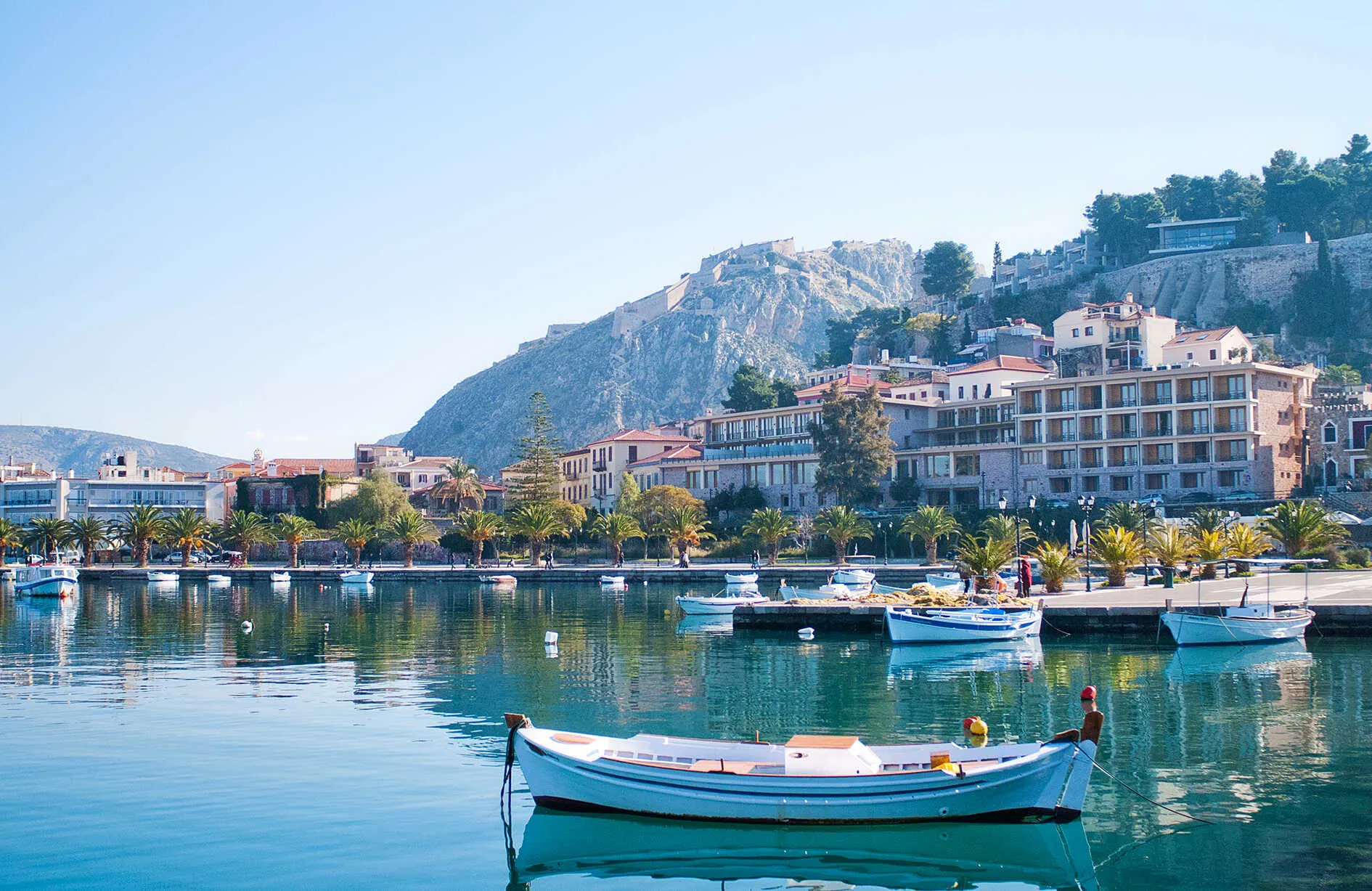
Nafplio charms with Venetian streets and an easygoing waterfront rhythm.|©iStock/wastesoul
By Leena Horner
Often called one of the most beautiful towns in Greece, Nafplio blends Venetian architecture, lively pedestrian streets, and a waterfront promenade that remains active year-round. Unlike many picturesque towns, this isn’t just a summer destination—it’s a weekend favorite for Athenians, which keeps the energy alive year-round.
The old town is packed with cafés, restaurants, small shops, and cultural events. It’s easy to build a social routine here—morning walks along the Arvanitia coastal path, coffee in a shaded square, evenings when the town glows with conversation and light.
There’s also a small but growing international community, and Athens is just two hours away, making travel and logistics easy.
The beaches immediately in town are smaller and more for quick swims, but larger sandy beaches are a short drive away.
Because of its popularity and beauty, prices are higher than in many small towns. Rentals typically range from €600–€1,100, and monthly living costs average €1,200–€1,800.

Colorful Parga wraps a sheltered bay in warmth, beauty, and local life.|©iStock/cipella
Parga has a rich and ancient history; the town has existed since the 1300s and was part of the Venetian Empire for over 300 years.
Parga is built like an amphitheater around a sheltered bay, with colorful houses rising up the hillside below a Venetian castle. In the evening, as the light fades, the harbor becomes the center of social life. People walk, dine, and greet each other along the waterfront. You might hear a local say, “The evenings are our gift from the sea,” as laughter and the sound of waves fill the air.
Summer brings a vibrant energy and international tourists. Many visitors return year after year, and it is not uncommon for them to become part-time or full-time residents. English is widely spoken, and it’s easy to settle into a social routine and connect with other residents for a game of chess at the local café or dinners out by the harbor watching the sunset.
Winter is quieter, but never empty. There’s a core of locals who stay, plus a handful of expats, and together they give the town a gentle, year-round social fabric.
The beaches—Valtos, Lichnos, and a few secret coves—are all close by. If you don’t mind a little chill, you can swim almost every day.
Long-term rentals usually range from €450 to €900, with monthly living costs around €1,000 to €1,600.
Parga is beautiful, but it’s the warmth and grace that linger. It’s the kind of place where you might arrive alone, but before long, you’re never eating dinner by yourself.

Kardamyli offers sea views, mountain backdrops, and a thoughtful expat scene.|©iStock/CoinUp
By Leena Horner
Kardamyli, on the Mani Peninsula, has long attracted a thoughtful international crowd—writers, artists, retirees, and remote workers who want both gorgeous vistas and meaningful connection.
With the Taygetos Mountains behind and the Messinian Gulf in front, the landscape is reason enough to stay. But what really keeps people here is the atmosphere: relaxed, thoughtful, gently social.
Life here centers on a handful of cafés, small restaurants, and the town plaza. Many foreign tourists and part-time residents return regularly and form long-term friendships. The local social life does not revolve around bars and nightclubs, but around weekly routines: hiking groups, informal dinners, book clubs, and cultural events.
Winters are quieter but still active compared to many small coastal villages, thanks to a stable local population and a committed expat community.
Housing costs are somewhat higher due to demand, with rentals usually between €500 and €900. Monthly living expenses average €1,100 to €1,700.
Kardamyli isn’t brash; it is cultured. It offers something more than activity: a sense of belonging.
In Southeast Asia, tropical beaches, low living costs, and welcoming communities make coastal life both accessible and deeply rewarding.
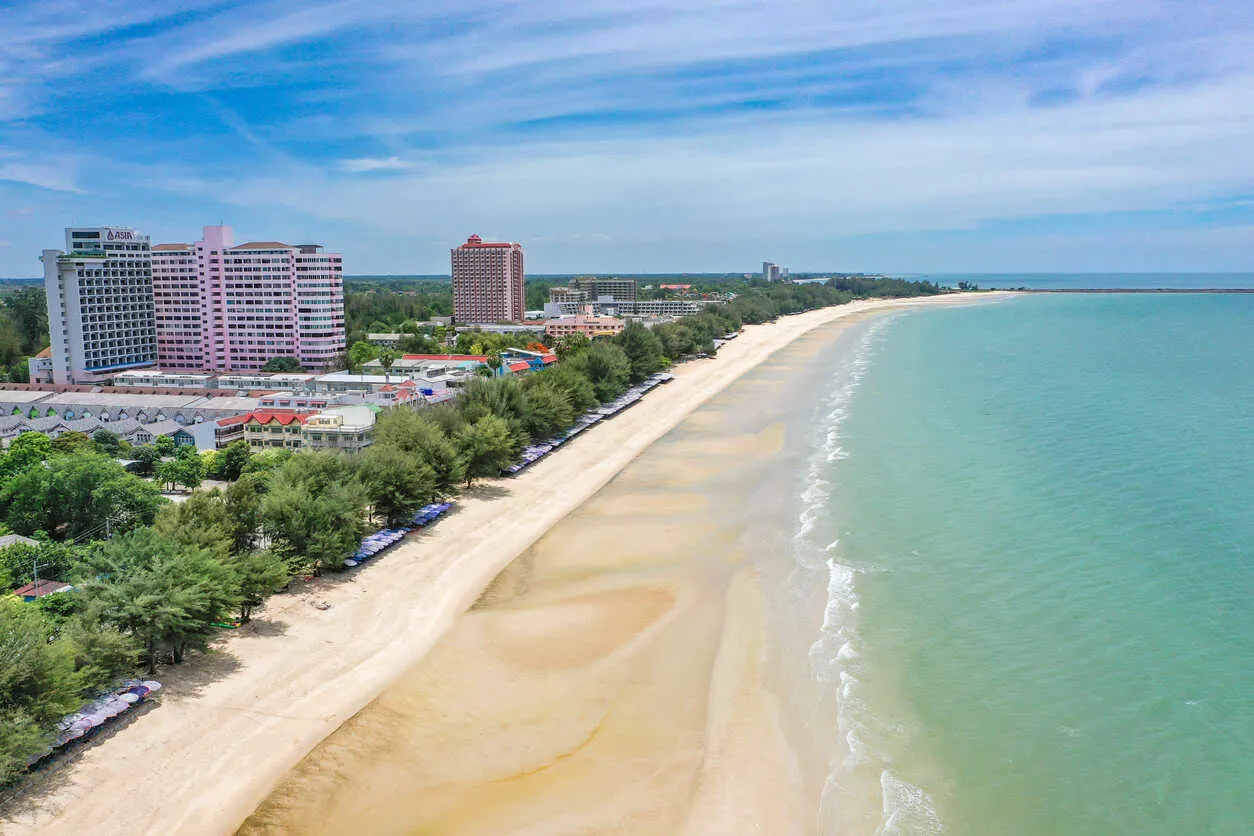
Cha-Am keeps beach life simple, livable, and refreshingly low-key.|©iStock/Pierrick Lemaret
Only about 20 minutes north of Hua Hin, Cha-Am is a sleepy, slightly bohemian beach town that feels refreshingly low-stress. Nearly seven kilometers of wide, pale sand stretch along the shoreline, backed by a town that’s long on charm and short on chaos.
Cha-Am’s biggest advantage is that it offers the convenience of a larger destination without the crowds. Roads are good, utilities are reliable, and internet connectivity is strong. Local clinics handle everyday healthcare needs, and full-scale medical services are nearby when needed.
But Cha-Am isn’t just practical, it’s quietly fun. Nature lovers shouldn’t miss Nayang Bat Cave, where at sunset millions of bats pour out in a smoky ribbon across the sky as they head out to feed. It’s one of those rare “this feels unreal” Thailand moments, like watching a Discovery Channel scene unfold in real life.
And if bats aren’t your thing, wine might be. Just inland is Monsoon Valley Vineyard, an award-winning vineyard producing tropical “New Latitude” wines. Visitors can tour the grounds, taste local varietals, and settle in for a meal at the on-site restaurant.
Housing is another reason Cha-Am wins people over. Options include beachfront condos, townhouses, detached villas, and traditional Thai-style homes. Long-term rentals range from older budget finds to gated developments. A cozy one- or two-bedroom place can be found for around $350 per month, while a family-friendly pool villa typically runs $600–$750.
For anyone who likes the Western Seaboard but doesn’t want the busier resort-town feel of Hua Hin, Cha-Am is an easy upgrade: laid-back, livable, and still comfortably connected.
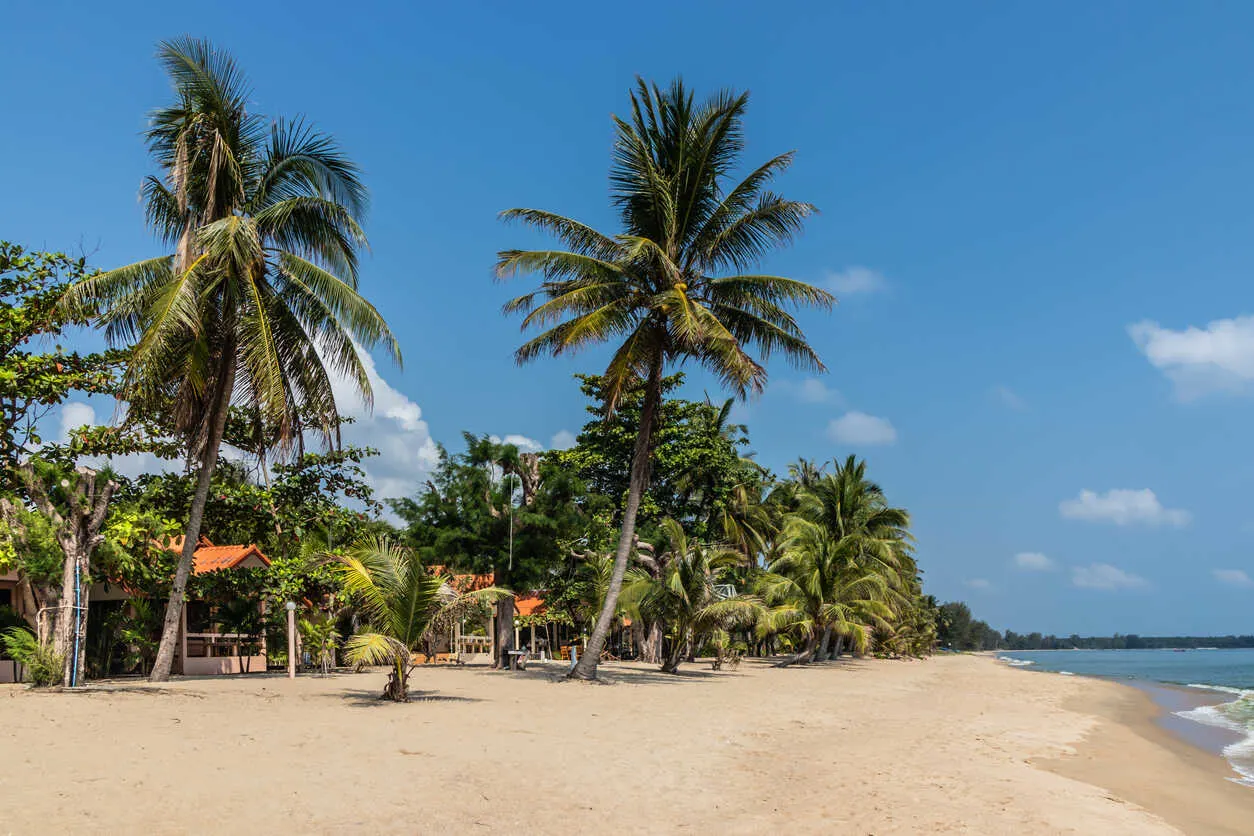
Chumphon offers long beaches, low costs, and a quieter side of Thailand.|©iStock/KHellon
Drive about three and a half hours south of Hua Hin down the Malay Peninsula, and you’ll reach Chumphon, often called the “Gateway to the South.” Most travelers only pass through on their way to Koh Samui, Koh Phangan, or Koh Tao—which is exactly why Chumphon remains such an underrated gem.
Chumphon Province stretches across more than 200 kilometers of coastline, making it a beachcomber’s dream. The standout is Thung Wua Laen Beach, a pristine stretch of sand that still feels quiet, walkable, and refreshingly uncurated. During the week, it’s often peaceful enough to feel like your own private beach.
Chumphon’s expat scene is small compared to Hua Hin or Phuket, but it exists—mostly retirees, teachers, and slow travelers who want a more authentic slice of Thai life. People come for the low cost of living, the quiet pace, and access to Mu Koh Chumphon National Park, which includes islands, mangrove boardwalks, and white-sand beaches like Hat Sai Ri. Offshore, divers and snorkelers can find coral reefs, sea turtles, and even the occasional whale shark near Ko Ngam Noi and Ko Ngam Yai.
Getting here is easier than most people expect. Chumphon has a domestic airport with regular flights, often served by budget and boutique carriers like Nok Air and Thai AirAsia.
Long-term rentals take a little more hunting since the market isn’t foreign-facing, but the prices are hard to beat. Studios and small houses often run under $200 per month, while two- and three-bedroom homes can still come in under $400.
And then there’s the food: Southern Thai flavors without tourist markups. Night markets offer dishes such as gaeng som, massaman curry, and locally grown durian. If you like your Thailand spicy, in the air and on the plate, Chumphon belongs on your shortlist.
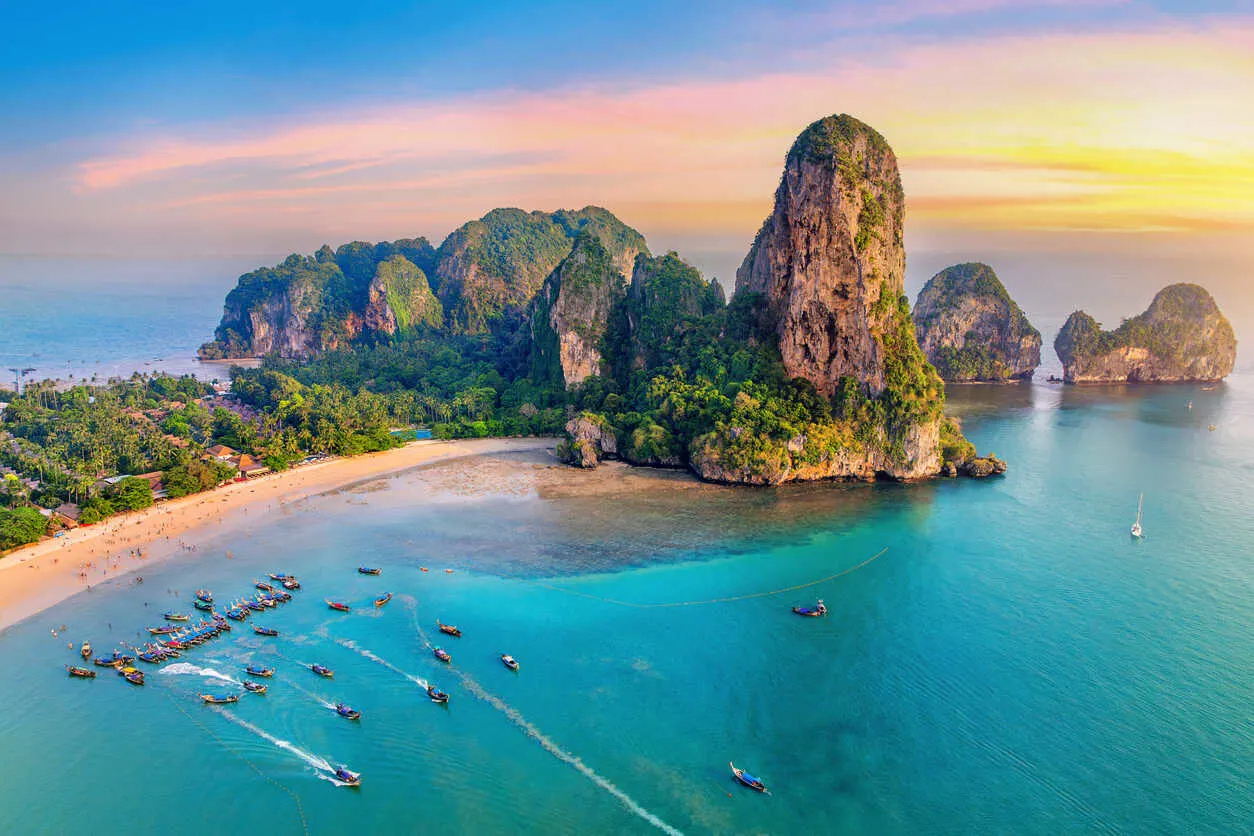
Krabi stuns with limestone cliffs, island access, and laidback daily life.|©iStock/tawatchaiprakobkit
Continue south another four-plus hours, and you’ll reach Krabi Province, home to Krabi Town, Ao Nang, Railay Beach, and some of Thailand’s most dramatic landscapes. Sitting on the Andaman Sea, Krabi is a mix of mangroves, jungle, white-sand beaches, and towering limestone cliffs bursting straight out of the water. The whole region has a Jurassic Park vibe.
Often seen as a more relaxed alternative to Phuket, Krabi offers more nature, more value, and less noise. The crowd skews toward active travelers: eco-resort travelers, island-hoppers, kayakers, and climbers drawn to the famous limestone walls.
Most visitors base themselves in Ao Nang or Railay while using Krabi as a launch point for nearby islands like Koh Lanta or the Phi Phi Islands. But the real sleeper hit is Krabi Town, the provincial capital about 20 minutes inland. It’s a charming working Thai town with a growing collection of co-working and co-living spaces, which has made it a quiet magnet for digital nomads.
Krabi’s expat community is surprisingly diverse: retirees, nomads, slow travelers, dive enthusiasts, and plenty of people on some kind of reset. The cultural mix is also part of the appeal. In Krabi Province, around 40% of the population is Muslim, and that influence shows up in the architecture, the mellow vibe, and especially the food. Curries lean sweeter and sneaky-hot, and you’ll learn a dozen new ways to love coconut milk.
Living here is comfortable. You’ll find malls, movie theaters, Western restaurants, and big grocery stores like Makro and Lotus. Prices tend to stay at “mainland” levels rather than inflated island rates. A one- or two-bedroom place averages around $300 per month, while luxury pool villas often sit around $650.
Like Chumphon, Krabi is often overlooked because people treat it as a jumping-off point. But for anyone who stays, the payoff is huge. With an international airport offering easy connections to Bangkok, Chiang Mai, Kuala Lumpur, and Singapore, Krabi works as both a dream destination and a real base—one of those places that quietly turns a “few days” into a few months.
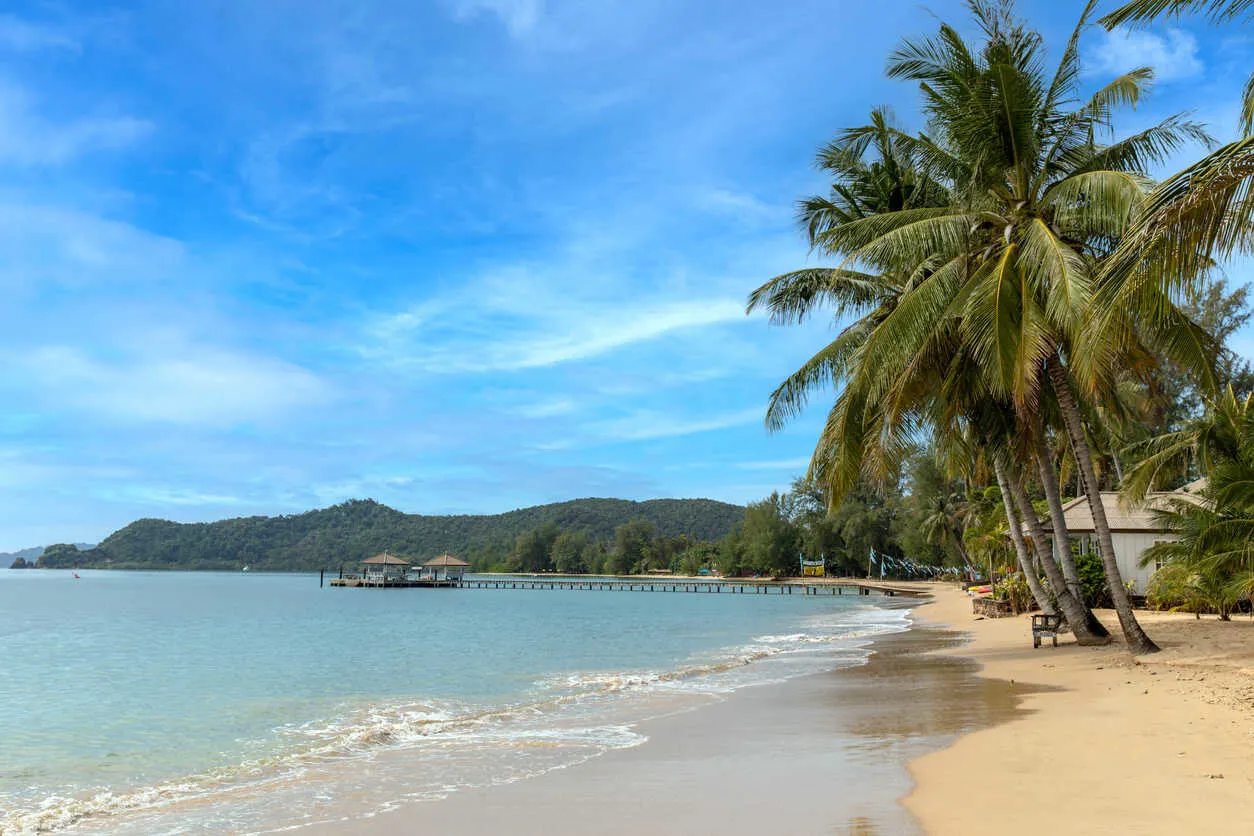
Koh Kood and Koh Mak slow life down with clear water and empty sands.|©iStock/tegmen
Near Trat on the Eastern Seaboard, ferries depart for a cluster of islands that feel like Thailand on mute. Most travelers head straight for Koh Chang, but its quieter neighbors—Koh Kood and Koh Mak—are the real slow-life gems.
Koh Kood (also spelled Koh Kut) is lush, low-key, and beautifully undeveloped. Expect empty white-sand beaches, clear turquoise water, and jungle-backed coves that still feel wild. The west coast is dotted with beaches like Bang Bao, Klong Chao, and Ao Noi, with calm, shallow water ideal for swimming. Many visitors come to snorkel, chase waterfalls (especially Klong Chao Waterfall), and unplug. For divers and snorkelers, the reef is a highlight reel: giant clams, barracuda, coral gardens, moray eels, triggerfish, and sea turtles.
There are no private cars on Koh Kood, so most visitors rent scooters for $8–$10 per day. Rooms start around $40 per night, while eco-luxury resorts push into premium territory.
If you really want to disappear, nearby Koh Mak goes even quieter. Flat, shaded, and built for bicycles, it’s covered in coconut and rubber plantations instead of mountainous jungle. Development is limited, nightlife is nearly nonexistent, and about 95% of the land remains in local families’ hands, helping the island remain authentic and family-friendly. Koh Rang Marine Park nearby is a favorite for kayaking, snorkeling, and diving. Ao Kao and Ao Suan Yai are known for their crystal-clear water.
Koh Mak’s charm is what it doesn’t have: no cars, no beach clubs, no loud music, and no luxury resorts swallowing the coastline. Rent a scooter ($10/day) or bicycle ($5/day), explore, and put your phone away.
Both islands have small expat communities and attract slow travelers, digital nomads, and snowbirds. In the low season (April–October), monthly stays can drop dramatically—sometimes as low as $500 per month for a simple beachfront bungalow.
Learn more about Thailand and other destinations by signing up to our daily IL Postcards e-letter and we’ll immediately send you a free report: 20 Countries Compared, Contrasted, Ranked, and Rated.
You don’t have to be rich to enjoy a pampered retirement, you just need to know where to go.
With our 34th Annual Global Retirement Index, our experts hand you a detailed roadmap.
Details and a Special Offer Here!

By submitting your email address, you will receive a free subscription to IL Postcards, The Untourist Daily and special offers from International Living and our affiliates. You can unsubscribe at any time, and we encourage you to read more about our Privacy Policy.
Along the coasts of Latin America, you’ll find beach towns where dramatic landscapes, vibrant culture, and affordable living combine to create some of the most appealing seaside lifestyles in the world.
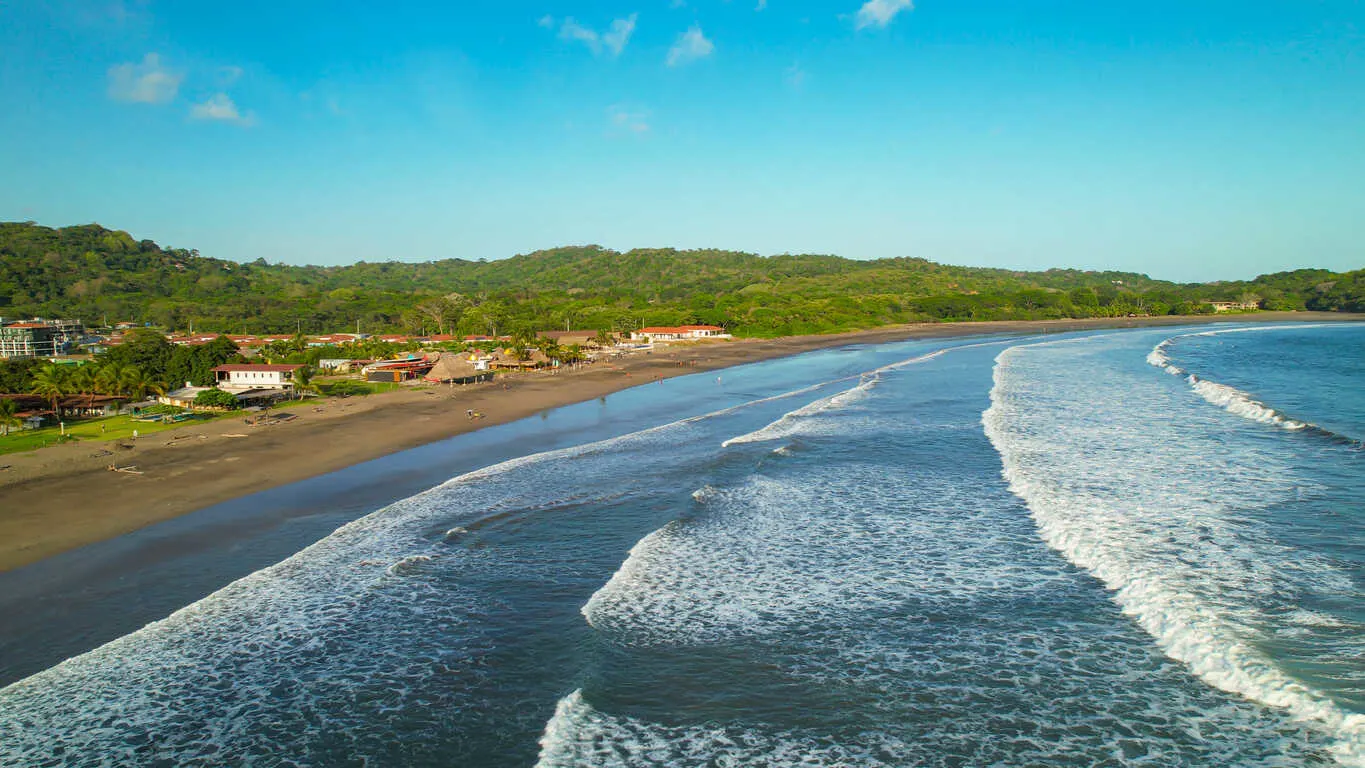
Venao mixes surf, wellness, and a growing international community.|©iStock/helivideo
By Jess Ramesch
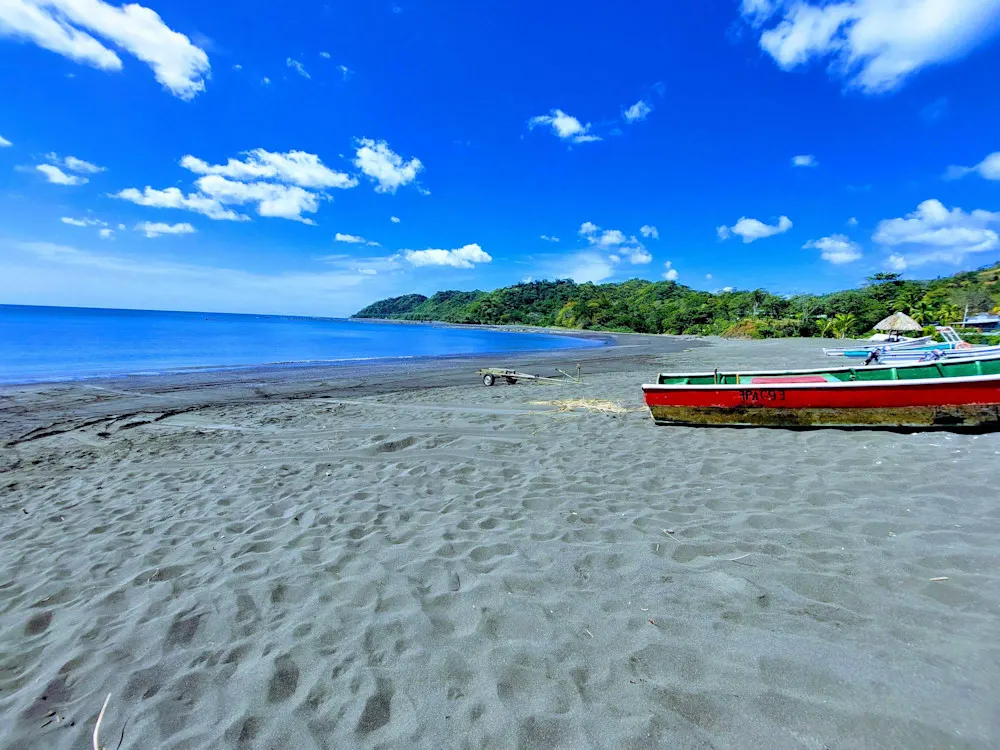
The half-moon bay of Venao was once the secret terrain of locals, mostly from the Azuero Peninsula, where Venao is located, and a handful of surfers. The perfect arc of burnished-bronze sand and a Hawaii-esque backdrop had yet to be discovered by the masses who streamed into neighboring Costa Rica in search of the perfect wave. Today, Venao has morphed into a bit of a busy little hub.
Though still small, population less than 5,000, it’s developed a reputation as a wellness and fitness destination, with an impressive roster of restaurants, many of them focused on healthful eating. Want to go for yoga or tai chi, then enjoy a flavorful mezze platter piled with hummus, baba ghanouj, and other heart-healthy (and yummy) things to eat? Venao is the perfect spot.
From reiki to meditation on the beach to pickleball, this is a place that embraces all the trends. Though also quite a party destination—live music and bonfires on the beach are regular affairs—lately, the expats settling in and around Venao come in search of a healing environment.
Truly a community that welcomes all nationalities and ages, it’s a surprising little melting pot six hours by car from Panama’s beautiful capital city. A couple can live here or in surrounding townships for $2,950 a month, including rent, outings, and your chosen wellness or fitness regime.
Cambutal rewards adventurous expats with surf, fishing, and total peace.|©Declan Aylward
By Jess Ramesch
If you love surfing, fishing, or simply having the ocean a stone’s throw from your front door, there’s a remote beach town in Panama that appeals to adventurous, independent expats: Cambutal. About seven hours by car from cosmopolitan Panama City, it’s literally the last stop on the road that runs along the populated coast of Panama’s Azuero Peninsula.
For bucket-list fishing and waves you don’t have to fight over (no crowds of surfers here), Cambutal is tough to beat. Row out and fish from a kayak (or just stand on the shore)… surf secret waves and discover tidal pools and waterfalls… it’s a safe, quiet, natural paradise.
Here, expats like artist Kevin Pento buy shrimp and veggies from ambling vendors that stop at their door. “For 20 bucks, we get 10 days’ worth of vegetables and fruit. And we get fresh, beautiful shrimp for $4 a pound—they’re nearly as big as my hand,” he says.
Of course, most expats here are also eager to enjoy their own “catch of the day.” Kevin fishes for big corvina (a light and flaky sea bass) right off the beach in front of his house. “I take the fish home, clean and vacuum-seal them, and put them in my freezer—which is pretty packed right now,” he says.
It’s an enviable life… in a tiny town where people truly do not lock their doors… and you could live it for as little as $1,800 a month.
Las Lajas offers wide-open beaches and a quiet life near David.|©iStock/Markpittimages
By Jess Ramesch
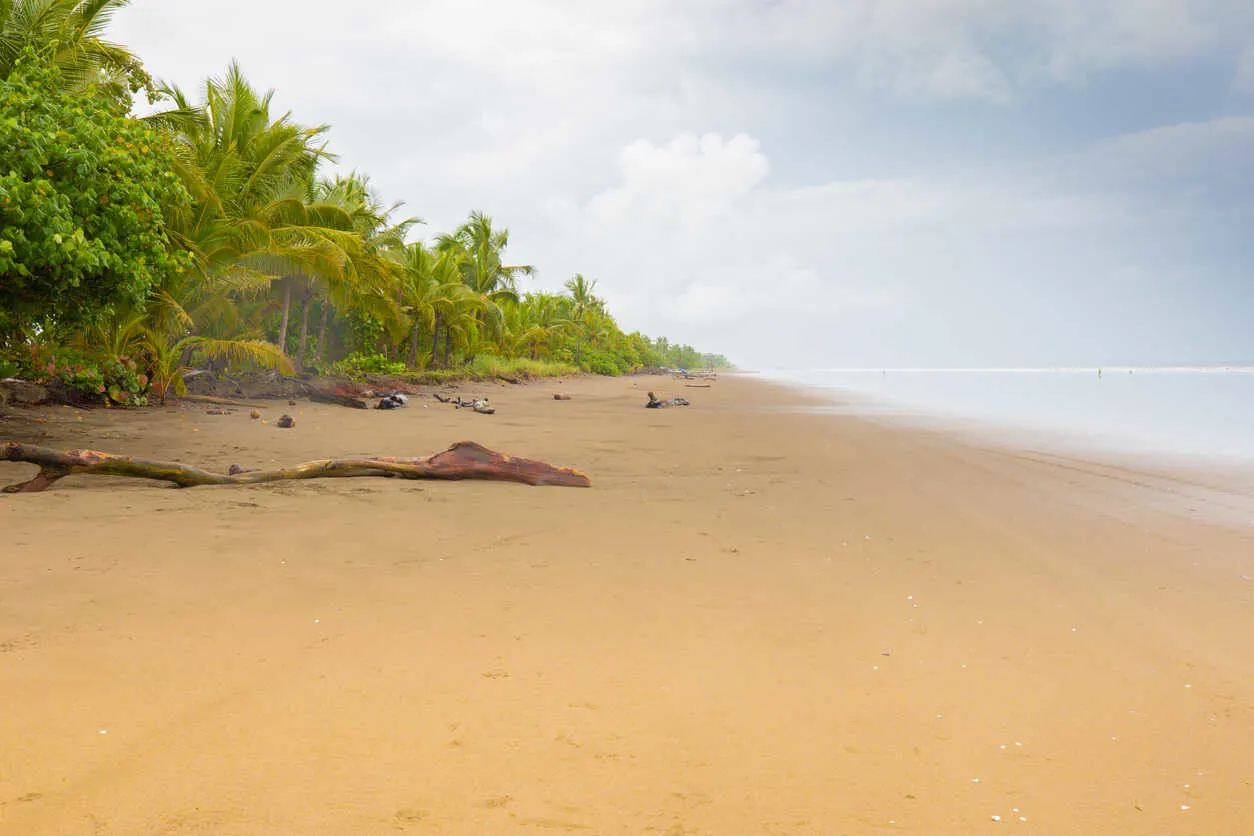
Just over an hour’s drive from the convenient, low-cost city of David, Las Lajas is a beach community few foreigners ever get to visit… and that’s a big part of its “undiscovered” charm. Live here, and you instantly feel like an insider, privy to secrets known only by chiricanos—locals from the verdant food-basket province of Chiriquí.
The main strip and town center are home to a small park square, a sweet little Spanish-style church, and a handful of restaurants sprinkled amongst the modest homes and shops. About six miles south of town, you’ll find one of the country’s longest, widest beaches… blissfully uncrowded most of the time, but festive and packed with families on local holidays.
A vast expanse of deep gold bordered by a long and often flat strip of blue, this is a place for anyone who yearns for big skies and open, sweeping vistas. (This region is also known for its sea turtles and whale-watching season.) There are a few small hotel-resorts on the beach and a nice little community here—local residents and weekenders, along with a handful of expats from Canada, the U.S., Germany, Italy, Switzerland, and more.
You won’t find any high culture here, and don’t expect a busy calendar full of social events. This idyll is best suited to folks who are content with their own pastimes… surfing, gardening, reading, beachcombing, birdwatching, etcetera… and who don’t need much else in the way of entertainment. A couple could live simply but happily here on $1,800 a month, with David’s hospitals and many conveniences within easy striking distance.

Bocas del Toro brings island color, Caribbean breezes, and easygoing charm.|©iStock/Mlenny
By Jess Ramesch
With its island breezes and warm Caribbean setting, Bocas del Toro, also known as Bocas Town, is a place to forget your woes. Park your tush on an over-water deck, sip a rum and cola, and enjoy the view. Depending on where you sit, the ocean looks a pale jade, electric blue, or translucent turquoise. It’s the kind of scenery that takes your blood pressure way down. At night, choose a softly lit restaurant—this town is foodie heaven—or dance till you can’t remember what you ever worried about in the first place.
Though a tourist hub, Bocas favors small inns and cabins for rent over large resorts and has a definite “off-the-radar” feel compared to Caribbean cousins like the Bahamas and Barbados, where you can live a luxurious lifestyle… if you’re wealthy. Here, however, a couple can live easily on less than $2,300 a month in jungle neighborhoods just outside the town proper, with your very own beach (or beaches) within walking distance or a short bike ride.
As there’s no major medical here, top-notch facilities in Panama City are an hour away by plane. Bocas tends to attract expats in relatively good health who enjoy the fun, social, party atmosphere.
You don’t need a car to live here (e-bikes and scooters are popular), and most homes are simple, with ceiling fans instead of air conditioning and hammocks instead of plush sofas. For anyone wanting to live a more “off-grid” lifestyle with solar and water catchment, Bocas is worth a trip. Get to know the active expat community, join in some happy hours or charity events, and you’ll have a support network of friends (and feel at home) in no time at all.
Puerto Viejo blends jungle living, Afro-Caribbean culture, and beach-town ease.|©Jason Holland
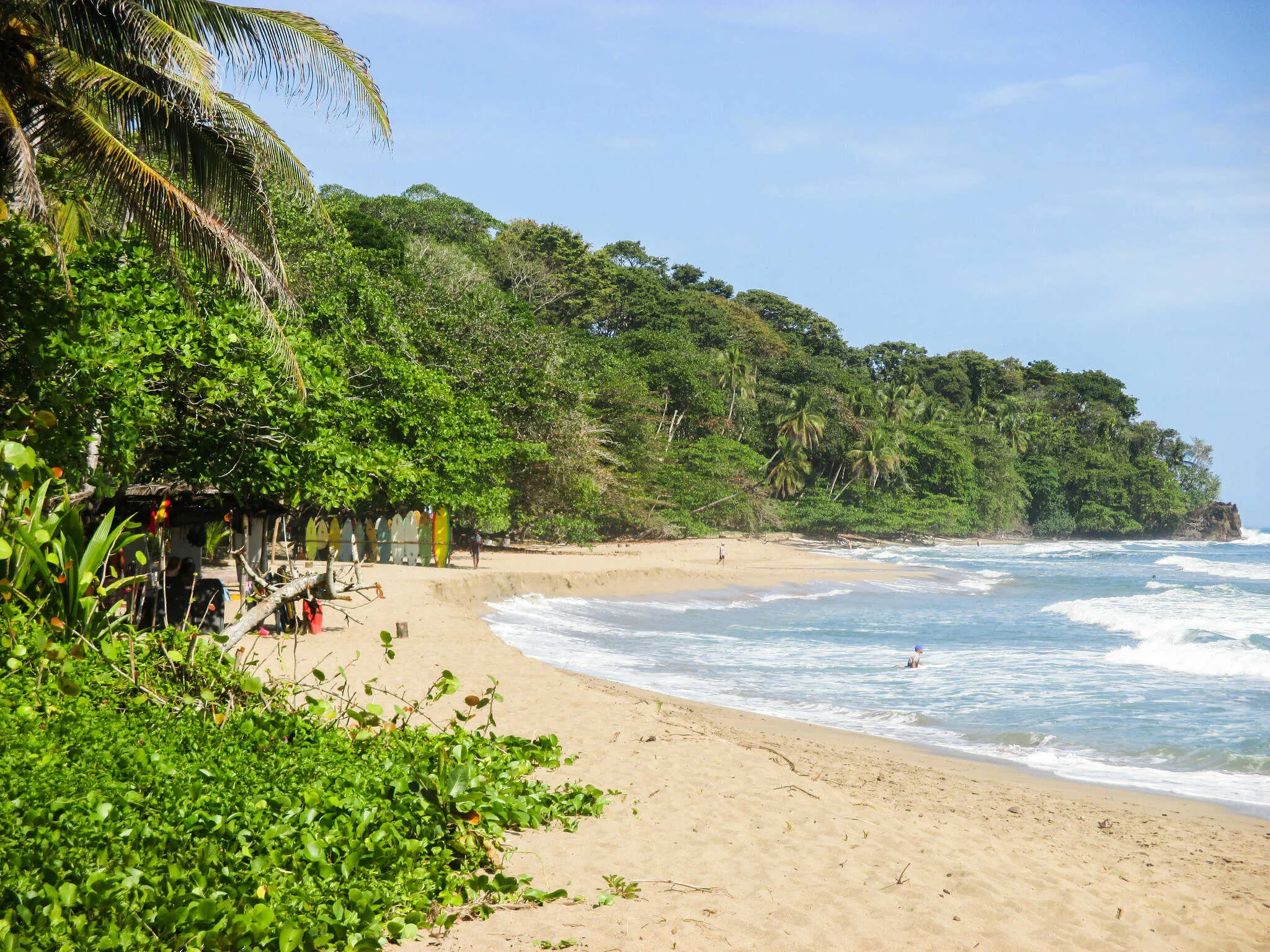
Locals and tourists take advantage of the scenic coastal route, often by bike. As my son and I hopped on our rentals (about $14 each per day) and headed north to the feria (local market) on Saturday morning, the road curved between jungle and sea, with flashes of sparkling waves through the palms. Reggae music sang from a beach bar, deep monkey calls echoed in the distance, and that Caribbean air—thick with humidity and buzzing with life.
While Costa Rica’s Pacific beach towns tend to draw more attention, Puerto Viejo has quietly maintained a lower profile. I used to think the Caribbean side was too sleepy and remote. Now I realize that’s the point. As one resident told me, stepping off the plane here feels “weightless”—your nervous system instantly relaxes.
The Afro-Caribbean heritage (the Limonese Creole called Patwa) is heard in conversation alongside Spanish and English. Order rice and beans cooked in coconut milk, eat fresh fish from the beach, and sit back with a cold local Imperial beer. Discover French cafés, Italian fine dining, and sodas (typical restaurants); most meals range from $8 to $25.
Daily life revolves around connection. You see the same faces at the beach, market, and favorite bar. Diversity is embraced, and residents stay actively involved in the community—supporting coral reef conservation, collaborating with Indigenous groups, and offering youth programs. The internet is strong enough for remote work, groceries are easy to find, and there are medical clinics.
Small homes and jungle properties can still be found starting in the mid-$200,000s, while modern builds or properties closer to the beach move into the $400,000–$700,000 range.
The simplicity makes life here more affordable. A single 45-year-old woman I spoke with lives comfortably on about $1,790 per month. Her rent is $600, which includes utilities and internet. Groceries average about $150 per month, plus another $250 for dining out and entertainment. She bought an electric tricycle for $3,000 and uses it as her primary mode of transportation.
Small homes and simple jungle properties can still be found starting in the mid-$200,000s, while modern builds or properties closer to the beach climb into the $400,000–$700,000 range.
Puerto Viejo is best suited for those who value community over convenience and peace over pressure. With its turquoise waters and black-to-golden sand beaches, it embodies jungle living. It’s not for everyone, but if you’re looking for a slower pace immersed in nature, this may be your place.
Montezuma pairs waterfalls, wildlife, and bohemian beach-town living.|©iStock/Christian Ouellet
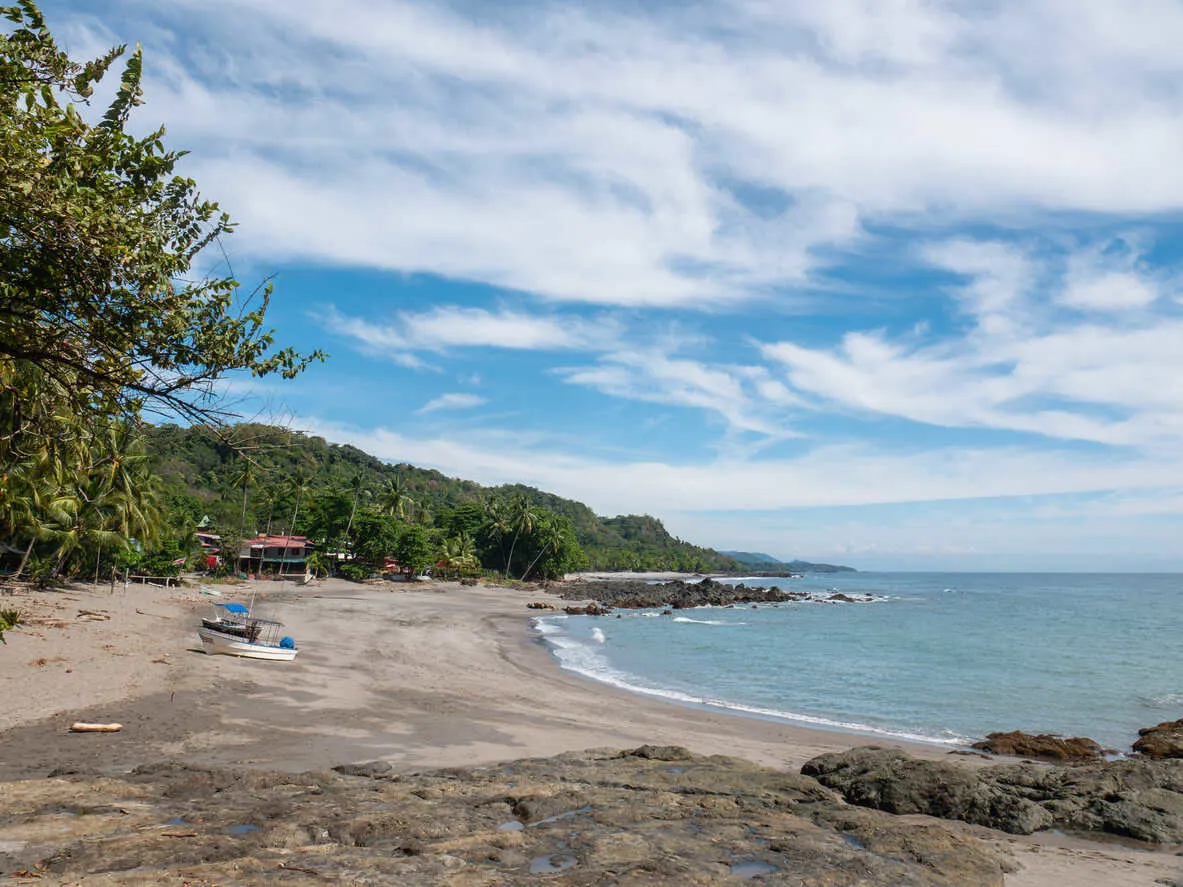
In Montezuma, a laid-back beach town on the Nicoya Peninsula, time doesn’t rush you. You’ll find drum circles in the park, fire dancers under the palms, and retirees dancing barefoot to the live music while kids chase each other on the beach. It still has a vibe reminiscent of the late-1990s version (I first visited in 1998)—a quaint, Bohemian beach town.
I used to think Montezuma was too remote for everyday living. Yet after hearing how fulfilling life is here, I began to see it’s ideal for those seeking a small community and simpler living. Cóbano, about 20 minutes away, is where residents run errands. Healthcare there is affordable; doctor visits cost around $40, and labs are often under $25.
Much of downtown sits inside the Maritime Zone, where structures can’t easily be rebuilt or expanded. Concessions are tied to original permits from the ’70s and ’80s, and very few have been updated. The result? A town that’s kind of stuck in time.
Daily life here embraces nature. Families walk 30 minutes along the beach to Playa Grande to surf. Wildlife corridors remain intact—howler monkeys booming through the canopy, white-faced capuchins hanging from trees, and macaws overhead, part of local reintroduction efforts. Two reserves, Romelia Wildlife Refuge and Cabo Blanco, help preserve the area’s biodiversity.
Río Lajas might be my favorite place in the world, off the road to Cabuya. Lined with towering palms, it winds through smooth rock formations and natural tide pools—the perfect place to breathe. And Montezuma Waterfall is right downtown, with easy access and a parking lot.
Colorful farmers’ markets with sweet fruits and fresh vegetables rotate through Montezuma, Cabuya, and Tambor. Fishermen go out every morning. The expat mix is diverse—retirees, Israeli families, long-established Europeans, and Costa Rican families who’ve been here for generations. Fiber-optic internet is available. There are public and private schools, including IB and Waldorf-style options, nearby.
One retired couple, whose husband still travels to the U.S. monthly, spends about $1,700 a month on living expenses. They don’t pay rent, having purchased their home outright when they moved. They chose not to own a car, spending about $80 a month on taxis, $450 on groceries, and $200 on entertainment.
Basic homes range from $350,000 to $450,000, while ocean-view homes can reach $1 million. The area isn’t known for low-cost housing.
Montezuma draws retirees, young families, and free-spirited creatives ready for a slower life shaped by waterfalls and surf.
Learn more about Costa Rica and other countries in our daily postcard e-letter. Simply enter your email address below and we’ll send you a FREE REPORT – Explore the Old World in Laidback Costa Rica.

By submitting your email address, you will receive a free subscription to IL Postcards, The Untourist Daily and special offers from International Living and our affiliates. You can unsubscribe at any time, and we encourage you to read more about our Privacy Policy.
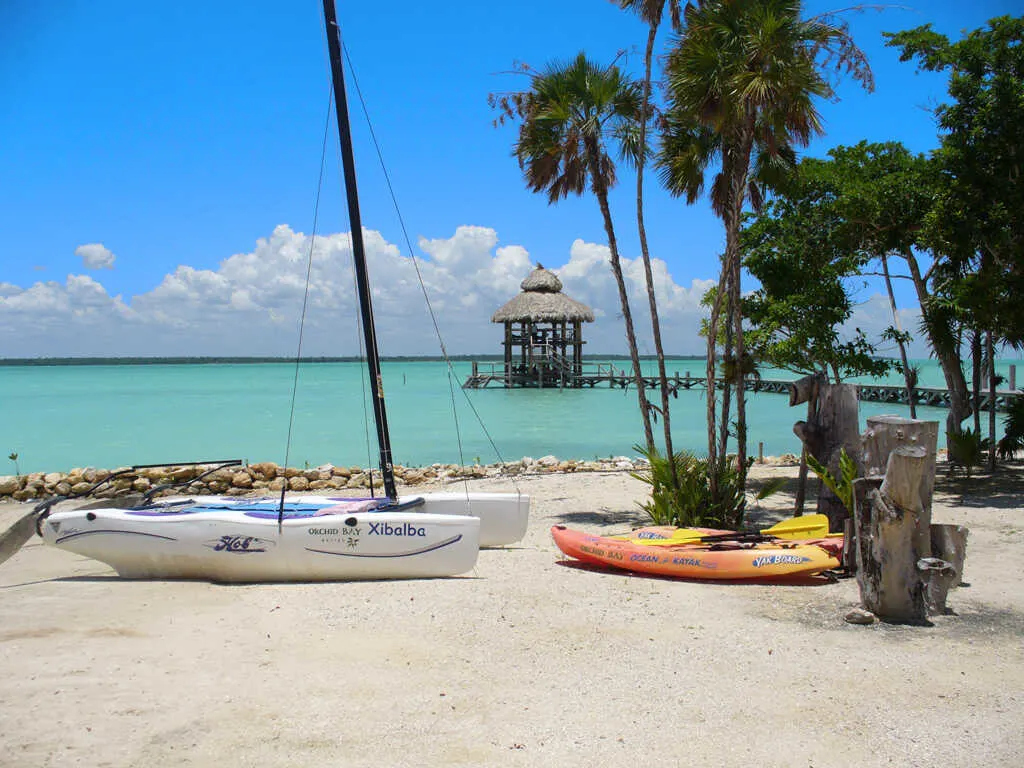
Orchid Bay pairs sandy shores with quiet, affordable Caribbean living.|©International Living
Along Belize’s northern coastline, Orchid Bay in the Corozal District offers a quiet escape from the hectic city life of North America. While the Corozal area is known for rocky beaches in most areas, Orchid Bay is an exception, with its beautiful sandy beach on the sargassum-free waters of Chetumal Bay. A designed and growing community, there is plenty going on in this area for residents. From beach volleyball and bocce ball to paddleboarding and kayaking, there is something for everyone, including a community infinity pool.
The Corozal region of Belize is easy to reach, either by flying to Corozal City from Belize City or by taking a two-hour drive up the Philip Goldson Highway. The prices in this part of Belize are more reasonable than in other areas. For instance, in Orchid Bay, a condo or cottage can start at around $199,000, and lots are still available in the $119,000 price range. Renting a place can run anywhere from $400 to $700 on the low end and on up. Utilities run from $100 to $200 a month, and food from $400 to $600. However, eating local—for instance, beans, rice, fresh fruit, veggies, and stewed chicken—can keep food costs down.
This is still a bit of a hidden retreat after eight years in the making, waiting for you with Mayan-inspired cottages or modern condos. Whichever you choose, this is a growing community of nature lovers and beauty seekers, so be prepared to fall in love with Chetumal Bay and the beauty of the countryside here. This beach is still one of the best-kept secrets in the least costly part of the country. You might come for a visit and never leave.
Life in Orchid Bay can be surprisingly affordable, with a single person spending around $1,400 a month and a couple averaging about $1,900.
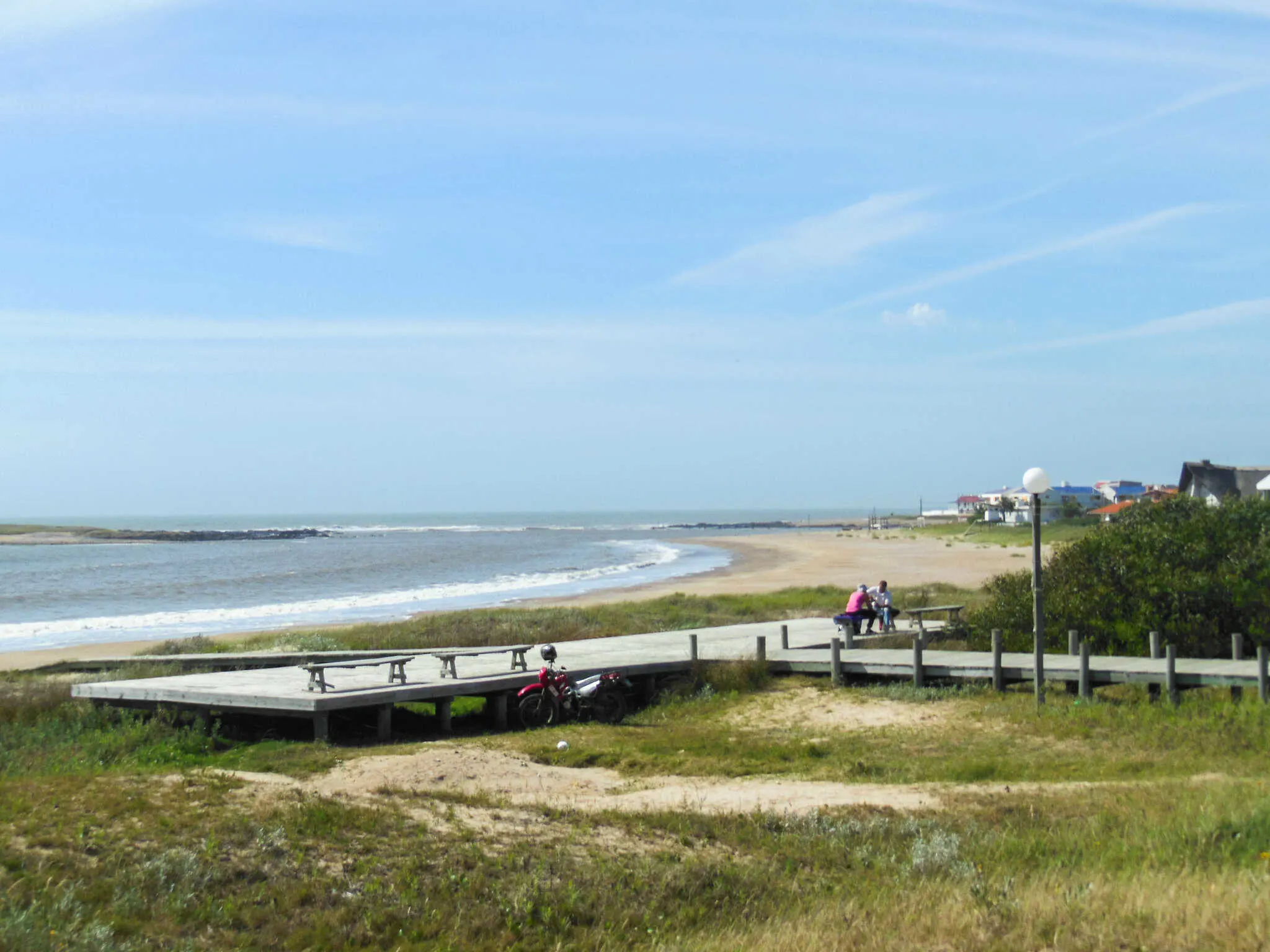
La Paloma combines real infrastructure with Uruguay’s relaxed Atlantic coast.|©David Hammond
La Paloma is in Uruguay’s Rocha Department, a mostly rural region that stretches for more than 100 miles along Uruguay’s Atlantic coast. It’s the Rocha beach town with the most infrastructure, including supermarkets, gas stations, and banks that are open all year.
The town’s main street, Solarí (lined with stores, hotels, and restaurants), extends down the Cape of Santa Maria. At the end of the cape is a large bay (Bahía Grande) and a lighthouse. West of the cape, you find several coastal neighborhoods with beautiful sand beaches. When you go east along the coast from Solarí, you pass several large campgrounds and the Port of La Paloma before coming to a number of other La Paloma beach neighborhoods.
During the summer months, the beaches of La Paloma fill with vacationers. Water sports include kayaking and kite-surfing on Bahía Grande and surfing on the ocean beaches.
Between the census year 2011 and the census year 2023, La Paloma’s full-time population grew from 3,495 to 5,939.
To help manage growth, zoning on Rocha’s coast includes protected areas, areas that allow low-intensity development to support tourism, and areas that allow and encourage urban development.
La Paloma is zoned for urban development. So the government is investing in projects such as paving more roads, improving the port, and planning the construction of an airport.
Cottage-style single-family homes 10 to 15 blocks from the beach start at around $130,000. You also find building lots 10 to 15 blocks from the beach for between $40,000 and $80,000.
A couple who own their home and car can live in La Paloma for about $2,800 per month. The budget is lower than in Punta Negra because grocery prices and dining-out costs are lower.

La Pedrera wins with blufftop views, surf culture, and a small-town feel.|©David Hammond
Eleven miles east of La Paloma is the beach town of La Pedrera, known for its waterfront bluff, about five blocks in length, which offers an amazing view. The bluff slopes down to sand beaches on each side. From the beach west of the bluff, Playa del Barco, the gentle rise of the landscape going inland provides ocean views several blocks back.
La Pedrera’s main avenue runs from the main coastal highway (Ruta 10) to the scenic bluff. It includes shops, restaurants (some highly rated), and examples of Art Deco architecture.
When the conditions are right, Playa del Barco offers surfers the best “left” on the Uruguayan coast.
Note: In the summer, many Uruguayan surfers get by wearing a rash guard or a spring suit. However, in winter, the water gets much colder, and a full suit—and sometimes booties and a hood—are needed.
La Pedrera is smaller than La Paloma, with a full-time population that’s grown from 225 in 2011 to 315 in 2023. People living in La Pedrera drive into La Paloma to get gas, bank, and shop for groceries.
You can find a selection of homes in La Pedrera for under $200,000. When you head east into La Pedrera’s outskirts (away from the main street and best ocean views), you’ll find a number of rustic homes listed for under $100,000 and building lots starting at around $30,000.
A couple that owns their home and car may budget $3,000 per month to live in La Pedrera proper, and $2,800 per month to live in one of the neighborhoods east of La Pedrera.
Of course, narrowing down the world’s underrated beach towns is no easy task. A few other places our correspondents love—but that didn’t quite make this list—include Gytheio, Methana, and Nafpaktos in Greece; Ban Amphur, Bang Sare, Mae Ramphueng, and Laem Mae Phim in Thailand; Zahara de los Atunes and Los Caños de Meca in Spain; Punta Negra in Panama; Puerto Morelos in Mexico; and Barra del Chuy in Uruguay.
What makes these beach towns special isn’t just their scenery—though the turquoise water, soft sand, and dramatic coastlines certainly help.
It’s the sense of possibility they offer.
In places like these, life slows down just enough to savor it. Morning swims replace morning commutes. Fresh seafood dinners come with ocean views. And the cost of living is often low enough that you can spend more time enjoying life, and less time worrying about paying for it.
Of course, today’s underrated beach town can become tomorrow’s hotspot. That’s why our correspondents are always on the lookout for the next hidden gem… places where the lifestyle is still authentic, the communities are welcoming, and the opportunities are wide open.
If the idea of living near the ocean has ever crossed your mind, these towns prove that paradise might be closer and more attainable than you think.
24 Countries Compared, Contrasted, Ranked, and Rated.
You don’t have to be rich to enjoy a pampered retirement, you just need to know where to go. With our 35th Annual Global Retirement Index, our experts hand you a detailed roadmap.
Details—and a Special Offer—Here
By submitting your email address, you will receive a free subscription to IL Postcards, The Untourist Daily and special offers from International Living and our affiliates. You can unsubscribe at any time, and we encourage you to read more about our Privacy Policy.


