Where to Go in the Caucasus Mountains: Georgia’s 5 Most Popular Mountain Regions Compared
21 min readNo trip to Georgia would be complete without visiting at least one of the country’s high mountain regions.
Beyond the spectacular scenery, hiking opportunities and old-fashioned guesthouse hospitality, the Greater and Lesser Caucasus both offer a gateway into some of Georgia’s most captivating histories, unique cultural traditions, and rich regional cuisines.
It can be a challenge to decide between popular Kazbegi and Svaneti, or the lesser-visited historical regions of Tusheti, Khevsureti and Racha. Seasonality, budget restrictions and your travel style are all things to consider.
Based on my own extensive experience travelling around the mountains, this guide is designed to help you decide which region/s are most suitable for your Georgia itinerary.
As well as weighing up transport and other logistics, I have included my own subjective thoughts on the scenery and general ‘vibe’ of each place.
If you are planning a winter trip, you might find this detailed comparison of Georgia’s ski resorts helpful.

Please note: This post contains affiliate links, meaning I may earn a commission if you make a purchase by clicking a link (at no extra cost to you). Learn more.
Kazbegi: Best for soft adventure
Under three hours from Tbilisi, Kazbegi is Georgia’s most-visited mountain region. From a single base in Stepantsminda, you can experience a variety of landscapes on easy to moderate day hikes through the surrounding valleys. While its popularity gives Kazbegi a more commercial feel, the excellent infrastructure and easy access are major advantages.
→ Read the guide: 21 Things to Know Before You Visit Kazbegi

Located in Mtskheta-Mtianeti Region at an elevation of 1,700 metres, Kazbegi sits in the heart of the Greater Caucasus mountains that form the Georgia-Russia border.
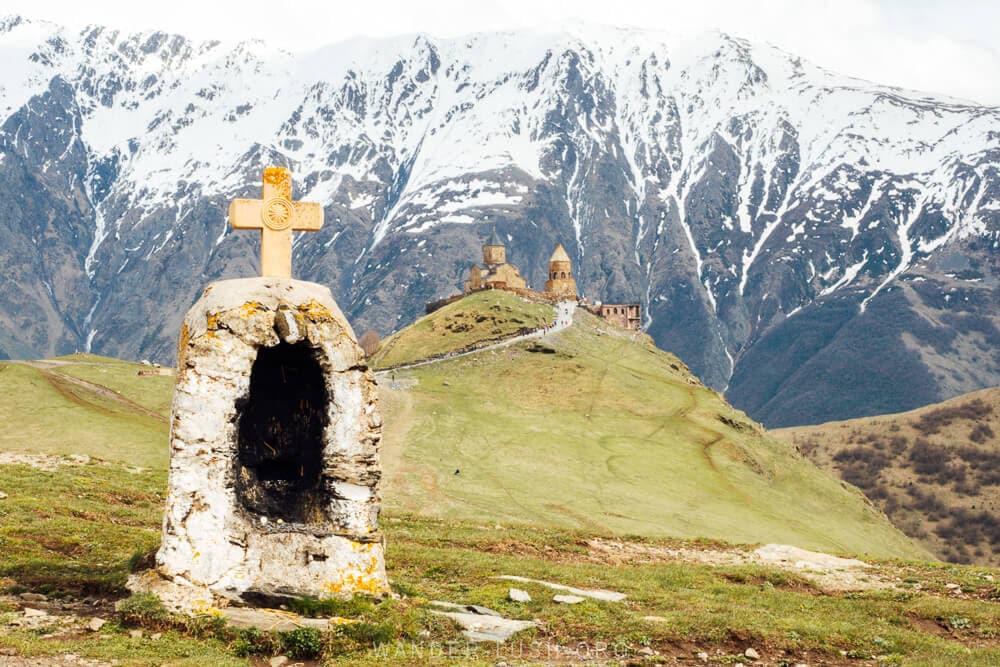
The drive from Tbilisi to Kazbegi along the Georgian Military Highway is more than half the fun. As you climb north, the mountains gradually reveal themselves, culminating with the perennially snow-capped Mkinvartsveri (Mount Kazbek) and the iconic Gergeti Trinity Church, which provide a backdrop to the town of Stepantsminda.
Despite its close proximity to the capital, the mountains here are every bit as impressive as in more isolated areas. Bougie restaurants and accommodations such as Rooms Hotel are a big part of the draw, yet humble homestay-style guesthouses and family kitchens are also in abundance.
Location & accessibility
- 150 kilometres (93 miles) north of Tbilisi; approx. 3 hours by road
- Only one road in and out: The Georgian Military Highway
- Open year-round, but prone to closures in deep winter lasting from a few hours to several days
- The main road is fully sealed and suitable for any vehicle
- Smaller roads into the valleys/villages are a mix of dirt and gravel (high-clearance vehicle required; 4WD preferable)
- Regular shared transport (marshrutka minivans) available from Didube Station
- Hire a private driver on GoTrip to make sightseeing stops along the way
- Use Mountain Freaks shuttles or local taxis (expensive) to travel to trailheads
→ Full guide: How to Get to Kazbegi from Tbilisi
Hiking
There are half a dozen day hikes in the area, starting with the easy climb to Gergeti Trinity Church, a short hike that can be extended by continuing to Gergeti Glacier.
The popular Juta Valley hike offers stunning views of Chaukhi Massive, an area sometimes referred to as ‘the Georgian Dolomites’, while the Truso Valley hike features colourful travertines and mineral springs, and culminates with Zakagori Fortress. For something offbeat, try hiking in the Sioni Valley.
Hiking trails in the Kazbegi area are signposted and well-trafficked.
→ Full guide: 8 Day Hikes & Day Trip Ideas from Kazbegi
Other things to do
While there are limited things to do in Kazbegi itself, there is plenty to see outside town. For those who don’t want to hike, there is a sealed road to Gergeti Trinity. Further north towards the border, the spectacular Dariali Gorge has its own monastery and a monk-run cafe and wine cellar.
Everything else can feasibly be done on the journey up via the Military Highway. Points of interest range from scenic viewpoints to Soviet-era mosaics. The Sno Giant Stone Heads is a fun detour.
Whilst in the area, don’t miss your chance to ride the four-stage Kobi-Gudauri Gondola. The scenic ropeway is open in winter and summer.


Accommodations
Kazbegi has a number of boutique accommodations, including the iconic Rooms Kazbegi, a restored sanatorium that overlooks the town.
For those on a budget, guesthouses are ubiquitous – my favourites being Guest House Tamta, Ketino’s Home, and Red Stone. A-frame cabins are also popular.
Outside Kazbegi, you have mountain cabins such as Fifth Season in Juta, and AltiHut near Gergeti Glacier.
→ Full guide: Where to Stay in Kazbegi
Food & drink
Kazbegi has a great food scene, with half a dozen restaurants that specialise in local cuisine: mountain-style khinkali, khabizgina (potato and cheese pie), mkhlovani (a type of khachapuri stuffed with greens such as nettle), and khachoerbo (Georgian cheese fondue).
Some smaller restaurants only open for the summer season.
→ Full guide: Where to Eat & Drink in Kazbegi


Services & amenities
- Supermarkets, pharmacies, bakeries, etc. are all available in Stepantsminda
- Banks exist, but ATM facilities are limited
- Bring cash with you for ease
- Good mobile network coverage in town and in the valleys
Best time to visit
- Hiking season runs from the beginning of May until the end of October
- July and August are the peak months in Kazbegi
- September and October are ideal for hiking and autumn colours
- Avoid road travel on the day of Lomisoba, a festival held in early summer in Zemo Mleta – traffic around Kazbegi can be at a stand-still for hours
- The Juta and Truso are closed in winter and reopen in spring
- The sealed road to Gergeti Trinity Church might only be accessible by Delica in winter
- Ski season at the nearby Gudauri Resort runs from late December until mid April
Svaneti: Best for hiking or a road trip
Also located in the Greater Caucasus but on the opposite side of the country in Western Georgia – around five hours from Kutaisi – Svaneti is Georgia’s premier hiking destination. Thanks to a new set of sealed roads, it is also the best mountain area for a road trip. More remote and rugged than Kazbegi but still with decent infrastructure, impressive scenery meets Svan culture and UNESCO-Listed defensive towers in the mountain region that has it all. Svaneti lends itself to a slower paced multi-day exploration, whether on foot or by car.
→ Read the guide: The Ultimate Svaneti Itinerary
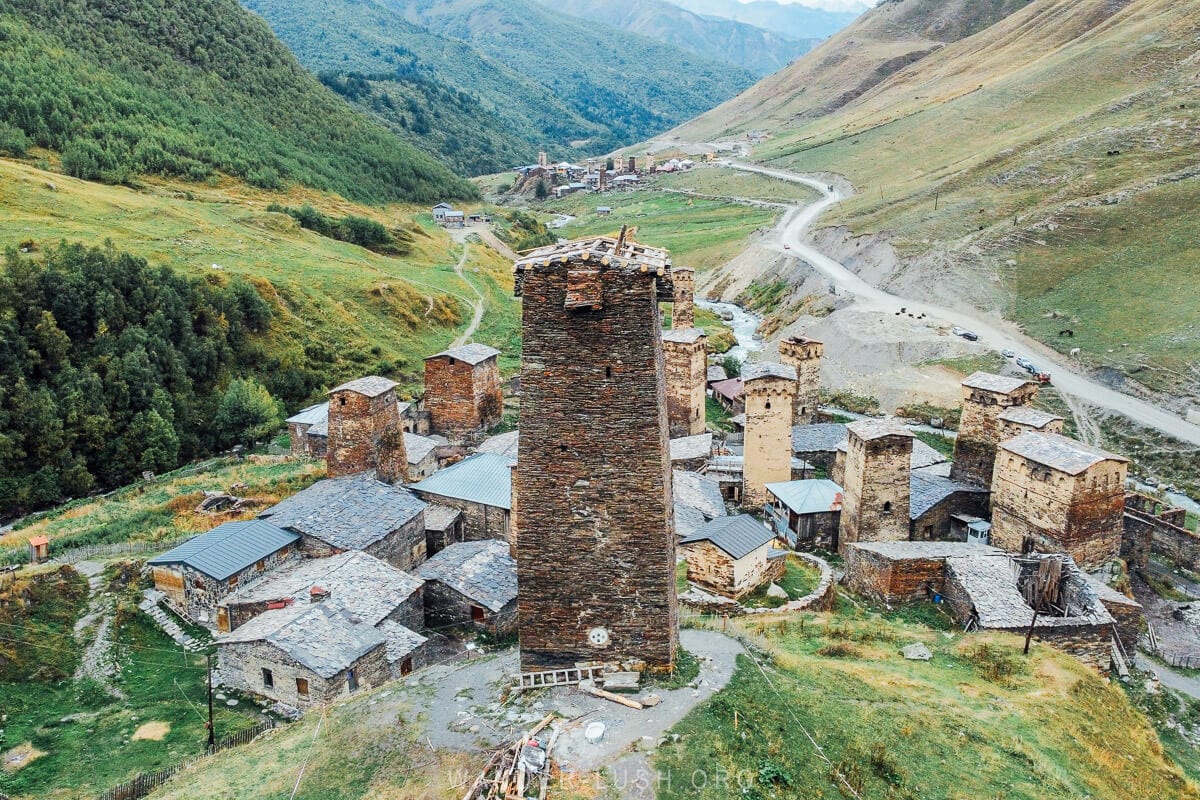
You do need to invest more time and resources to reach Svaneti – but the pay off is an altogether more immersive experience. With Georgia’s highest peak, Shkhara 5,193 metres) and the distinctive Ushba on the horizon, the scenery is hard to beat.
This is not the only place in Georgia where you’ll find defensive tower dwellings, but the high volume of koshki in Svaneti gives the towns and villages a very unique aesthetic.
The town of Mestia (1,500 metres) and the UNESCO-Listed Ushguli (2,100 metres) are the two destinations of choice for the majority of visitors. The trail that links them – the Mestia-Ushguli Hike – is far and away the most popular multi-day trek in the country. In between, there are a dozen picturesque hamlets and villages, each with its own beautiful church. The new road between Ushguli and Lentekhi makes it easier to explore Lower Svaneti, an emerging destination that is well and truly off the tourist trail.
Svan culture and cuisine is pronounced, with Mestia’s world-class museum and excellent restaurants being the first point of contact for most visitors.
Location & accessibility
- 450 kilometres (280 miles) north-west of Tbilisi; approx. 8 hours by road
- Better accessed from Kutaisi (220 kilometres/137 miles; 5 hours) or Zugdidi (140 kilometres/87 miles; 3 hours)
- Two roads to choose from: through Zugdidi (reaching Mestia first; open year-round), or through Lentekhi (reaching Ushguli first; open May-October)
- As of autumn 2024, both roads are sealed/concreted with some gravel patches
- The entire road (Zugdidi-Mestia-Ushguli-Lentekhi-Kutaisi) is suitable for any vehicle – but if renting, double-check the company’s T&Cs
- See my Svaneti Road Trip Itinerary for a suggested self-drive loop
- Shared transport (marshrutka minivans) also available from Kutaisi and Zugdidi – but services are limited
- Hire a private driver on GoTrip for convenience
- Flights to Mestia Airport from Tbilisi (Natakhtari) and Kutaisi are operated by Vanilla Sky – but tickets are difficult to come by, and flights are often cancelled at short notice
- Local drivers can be found at the Mestia Bus Station for trips to Ushguli, Koruldi Lakes, and other destinations within Svaneti
→ Full guide: How to Get to Svaneti


Hiking
Svaneti’s trails are well worn and its paths clearly marked – I’d say it probably has the highest number of trails of any mountain region. These range from the four-day Mestia Ushguli Trek, a village to village hike, to day walks around Mestia.
Koruldi Lakes, Chalaadi Glacier and Chkhuti Ridge are all spectacular routes, but in my opinion there is less diversity in the landscape compared to the valleys around Kazbegi. Hikes out of Mazeri, a smaller village beneath Ushba, are also worth looking into.
Svaneti is more hiking-focused overall, with extensive infrastructure and an established hiking community.
Other things to do
Svaneti is a cultural destination as much as it is a place to hike. The Svaneti Museum of History and Ethnography is one of the leading institutions in Georgia, plus you have a gamut of smaller house museums and towers that are open to the public.
While you would never travel to Kazbegi to spend all your time in the town, you could quite feasibly do that in Mestia. It is very pleasant to wander the cobbled streets of Laghami Old Quarter, with picturesque mountain/tower views at every turn. The same goes for Ushguli, which non-hikers normally do as a day trip from Mestia.
There are two ski resorts near Mestia: Hatsvali and Tetnuldi. In summer, the Hatsvali Cable Car is a must-do for epic mountain views.


Accommodations
Like Kazbegi, Svaneti has an abundance of both guesthouses and hotels. You can also find self-contained apartments in Mestia that are suitable for longer stays. Ski lodges such as Lahili stay open for the summer.
In Ushguli, options are more limited, with humble guesthouses most prevalent. Some of the private rooms at Guesthouse Angelina have a direct line of sight to the spectacular Lamaria Church.
There are limited beds in the smaller villages between Mestia and Ushguli, and guesthouses do book out over the summer.
Food & drink
Mestia’s food scene is very well established, with a dozen great restaurants, at least two specialty coffee shops, and even a couple of cocktail bars. Svan cuisine is distinct again, with kubdari ‘meat pie’ being the specialty dish of choice.
Restaurants in Mestia are open both for the summer hiking season and for the winter ski season, with possible closures over autumn and spring.


Services & amenities
- Grocery stores, pharmacies, bakeries, etc. are all available in Mestia
- Banks and ATMs can be found around Seti Square
- There are no ATMs in Ushguli – take cash when leaving Mestia
- Good mobile network coverage in Mestia, but limited coverage in some villages
- Power outages are more common in Svaneti
Best time to visit
- July and August are the peak months in Svaneti
- September is less busy, with autumn colours showing towards the middle of October
- Temperatures can plummet overnight, and some guesthouses in Ushguli do not have heating – be prepared
- Cultural events take place throughout the year – Kviriloba in late July and Lamproba in February are two that are worth planning a trip around
Tusheti: Best for wild scenery & seclusion
Open for only a short window in summer and accessed via an infamously perilous road, Tusheti is the Holy Grail of Georgia’s highland regions. Only the brave venture north of Tbilisi to cross the Abano Pass into this isolated landscape of sparsely populated villages and soaring peaks. While Tusheti is undeniably spectacular, limited amenities and fewer activities beyond multi-day hikes and horse riding make it more of a niche adventure destination.
→ Read the guide: Everything You Need to Know About Visiting Tusheti

Home to Europe’s highest continuously inhabited village, Bochorna (2,345 metres), and the site of the famous Transhumance, the Tusheti Protected Landscapes contains the most remote settlements in Georgia’s Greater Caucasus. As a travel destination, it’s the place that requires the most forward-planning.
A professional driver and vehicle is required to make the long journey up from Tbilisi via the Abano Pass, a narrow, zigzagging road cut into the face of a mountain. In Omalo (1,880 metres) and the higher villages, you feel completely enveloped by the mountains. The scale of the valleys and the vast expansiveness of Tusheti gives it an aura that is difficult to put into words.
Tusheti is peak Caucasus scenery, and has all the ruggedness you might expect of a place that is completely cut-off from the rest of the world for most of the year. Not many people go here, so in many ways it feels unspoiled – although the new road, scheduled to be finished by the end of the 2025 season, may change that.
This might be controversial, but in my opinion the drive up to Tusheti is almost the highlight. Compared to other places, there are fewer ‘things to do’ once you arrive – aside from challenging hikes and horseback tours.
There are cultural norms and mores that visitors are expected to be aware of and observe whilst in Tusheti (see this guide for pointers). In my experience, people in this region can be comparatively more reserved and closed-off to outsiders.
Road safety is a serious consideration, and you have to be prepared for some level of discomfort during your stay. The bragging rights that come with saying you’ve visited Tusheti might be worth it to you. Personally, I am glad that I went – but this is the one mountain area that I’m not rushing to go back to.
Location & accessibility
- 185 kilometres (115 miles) northeast of Tbilisi; approx. 7-8 hours by road (to Omalo)
- Only one road in and out: The Abano Pass
- Navigable between mid June and the end of September approximately
- Some of the roads within Tusheti between the villages are even more perilous
- Given the challenging conditions and with no way to call for help if you need it, self-driving is only recommended for very experienced off-roaders
- Preferable to go with a driver – either purchase a seat in a shared Delica taxi, or hire a private driver for the duration of your trip
- Multi-day excursions from Tbilisi offered by companies such as Friendly.ge are an affordable alternative for budget-conscious and solo travellers
→ Full guide: How to Get to Tusheti from Tbilisi


Hiking
The majority of the hikes in Tusheti are 2-5 day treks that either start from or finish in the region. These are amongst the most remote and challenging routes in Georgia, suitable only for serious hikers.
There are a handful of day hikes within the villages, such as Omalo to Diklo Fortress Trek. Guided horse trekking is also a very popular activity.
Other things to do
Non-hiking options are limited in Tusheti. Keselo Fortress above Omalo looks stunning from a distance, but there is nothing to see inside.
For a cultural experience, I would prioritise visiting Dartlo, a partially reconstructed stone village that is my favorite place in Tusheti. It can also be very rewarding to simply enjoy time at your guesthouse and experience the rhythms of daily life whilst indulging in Tush cuisine, beer, and herbal tea.

Accommodations
Aside from the boutique hotel Samzeo Tusheti in Omalo, accommodation is limited to guesthouses. Places are more basic in terms of amenities (one power socket shared between several rooms is not uncommon, for example). Most houses are very comfortable and offer excellent home cooking.
Special accommodations include Above The Clouds in Shenako, Guesthouse Shuni and Qeto’s Guesthouse in Dartlo, and Shio’s Stonehouse in Girevi.
Food & drink
With no restaurants or cafes, visitors must eat at their guesthouses. Tushetian fare includes some of the dishes mentioned earlier, with khinkali dumplings made with lamb a specialty. Seasonal vegetable dishes made with mushrooms and foraged highland herbs are always a highlight.
Special beverages include kondori wild thyme tea, and non-alcoholic Tush beer.

Services & amenities
- Services are very limited in Tusheti: no grocery stores or pharmacies
- Bring everything you might need with you
- There are no ATMs in Tusheti – bring cash
- Mobile network coverage is limited to Omalo and larger villages
- Crucially, large sections of the Abano Pass are a dead zone, underlining the importance of self-sufficiency if you plan to drive yourself
- Power outages and water cuts do happen
Best time to visit
- The Abano Pass is open from mid June until the end of September approximately (weather-dependent)
- Early summer can bring heavy rain
- The safest months to travel are July and August
- August is a month of cultural festivals, with horse races and other celebrations in different villages almost every weekend
Khevsureti: Best for history & authenticity
Geographically, Khevsureti sits between Kazbegi and Tusheti – and in many ways the historic region also strikes a balance between the two. Improved roads make it relatively accessible, yet it still has a remote, untouched feel. Like Svaneti, Khevsureti has a distinct identity, with its own tower architecture and fascinating tales. The blend of day hikes and cultural experiences makes Khevsureti the dark horse of Georgia’s mountain regions – and quite possibly my top pick.
→ Read the guide: The Ultimate Khevsureti Itinerary
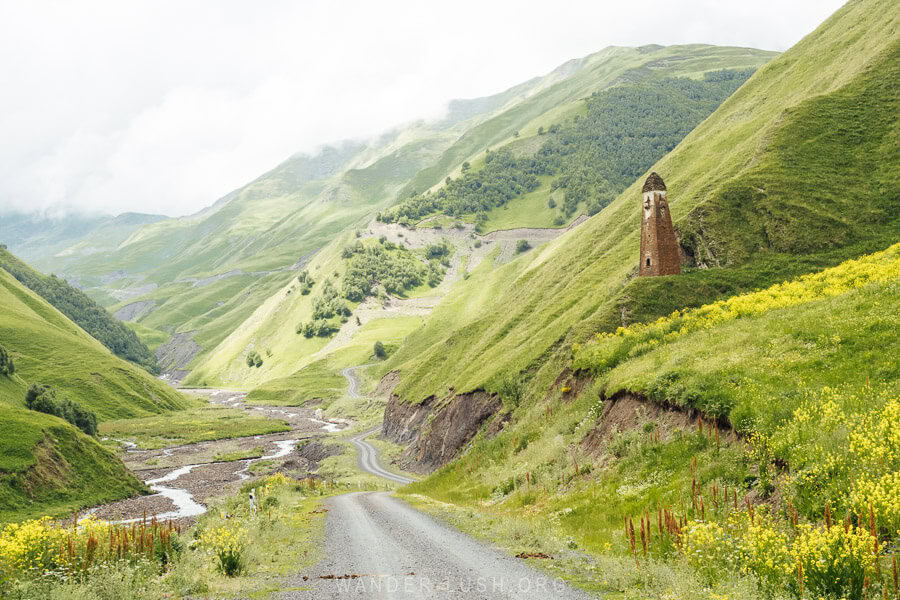
Khevsureti flies under the radar, and does not have the same reputation as Tusheti. It is almost as remote, yet the better roads mean the season here is longer, approximately May until November (weather pending). While summer weekends can be busy with local tour groups from Tbilisi, outside of these times it is very secluded.
Georgia’s extreme northern frontier has a long and storied history. The romance of the fortified villages, tales of warriors, and folk legends associated with burial crypts – combined with the enchanting scenery – gives Khevsureti a poetic, mystical quality.
I know it’s a cliche, but walking through medieval Shatili (1,400 metres) and Mutso (1,880 metres) feels like stepping back in time – something I have not experienced with such authenticity anywhere else in Georgia. While each mountain region has its own cultural richness, in Khevsureti, the history is tangible. And unlike in Ushguli, there are no disruptive road works or construction to ruin the mood (well, not yet!).
While you need 5-7 days to do Tusheti or Svaneti justice, three days is plenty of time for Khevsureti. As a destination, it has almost everything you want, from picturesque mountains dotted with fairytale towers, to historical sites, day hikes, and special accommodations.
Location & accessibility
- 150 kilometres (93 miles) northeast of Tbilisi; approx. 4 hours by road (to Shatili)
- Only one road in and out: The Datvisjvari Pass
- Navigable from late May until the end of November
- The road is sealed to Roshka, with gravel on and beyond the pass
- Not as narrow or steep as Tusheti – suitable for self-driving if you are confident with mountain roads
- Alternatively, hire a private driver on GoTrip
- Shared transport (marshrutka minivans) run from Didube to Shatili once a week during the season
→ Full guide: How to Get To Khevsureti from Tbilisi

Hiking
The most notable day hike in Khevsureti is to the Abudelauri Lakes, a very scenic, mid-level marked trail that culminates at the foot of Mount Chaukhi. You can do it either as a day hike from Roshka village, or as a thru-hike from Juta in Kazbegi.
Most other hikes in the area are multi-day affairs, linking Khevsureti with neighbouring Tusheti to the east or Kazbegi to the west. The climb up to Mutso Fortress (see below) could be considered a short hike!
Other things to do
Hours can be spent exploring and photographing the enigmatic Mutso Fortress and fortified Shatili. Other points of interest include the Anatori crypts, and the various towers and abandoned villages dotted along the road.
On the way into Khevsureti, you have the famous khinkali restaurants in Pshavi (Pshauri Balada is my favourite), and the Vazha-Pshavela House Museum in Chargali.


Accommodations
As the main base in Khevsureti, Shavili has a handful of guesthouses, including several properties in or overlooking the fortified towers. Ethnic Hotel is a great choice.
More remote lodgings cater to hikers and can be a nice (almost) off-grid experience. Try Korsha Guesthouse before the pass, the remote Ardoti Guest House, or Guesthouse Grilo in Khonischala.
Food & drink
While you will likely end up eating most meals at your guesthouse, there are other options in Shatili, including the delightful Cafe Firefly and the kitchen at Sulphoni Hotel. Kuserbo, a local dish of cheese, potatoes and ghee, is the perfect post-hike refuel.


Services & amenities
- Small markets where you can buy cold drinks and snacks are available in Shatili
- For anything beyond that, and for the villages outside Shatili, it is best to bring supplies with you
- There are no ATMs in Shatili – bring cash
- Mobile network coverage is good in and around Shatili, with some dead zones on the road
- Some of the more remote guesthouses have their own cellular networks
Best time to visit
- The Datvisjvari Pass is open from late May to the end of November (weather-dependent)
- The road is prone to flooding in late spring (May/June)
- July and August are best for hiking, while September and October bring beautiful autumn colours
Racha-Lechkhumi: Best for gastronomy & slow travel
Popular with Georgians but still under the radar for international tourists, Racha-Lechkhumi is a classic summer escape, known for its cooler climate and relaxed atmosphere. A neighbour to Svaneti, it is easily reached from Kutaisi in 90 minutes, making it ideal for an efficient, laid-back getaway. While there are some marked trails, the region is better known for glamping, wineries, and gastronomy than for hiking. Upper Racha remains relatively unexplored – a real hidden gem.
→ Read the guide: The Ultimate Racha-Lechkhumi Travel Guide
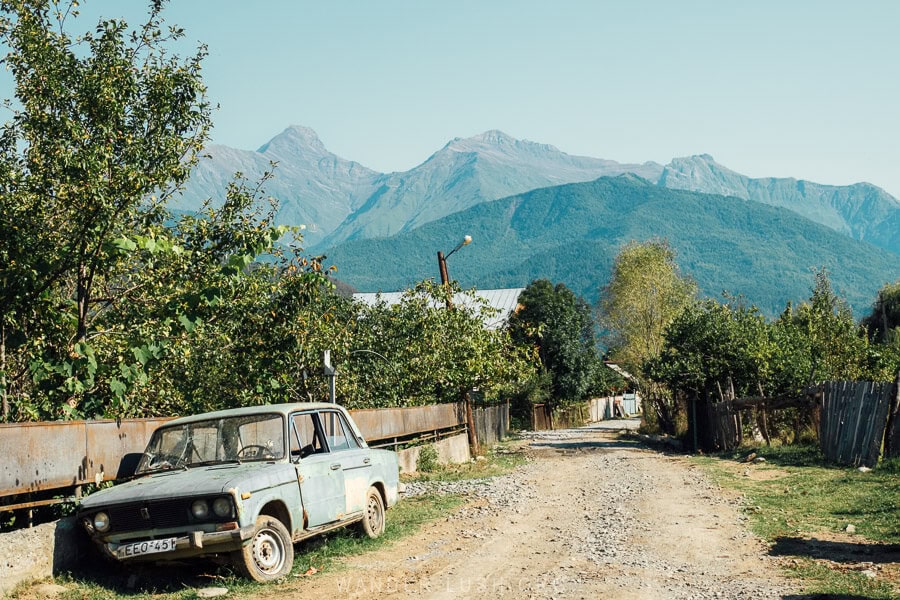
The twin regions of Racha and Lechkhumi in Western Georgia might not be as visually spectacular as other places on this list – but hey, this is still the Greater Caucasus. The lowland scenery here is very diverse, ranging from Racha’s Christmas tree forests to Lechkhumi’s impressive limestone cliffs.
What Kazbegi is to Tbilisi, Racha is to Kutaisi – an easy mountain weekend escape. The newish road over the mountains from Sachkhere makes it possible to reach the town of Oni in around four hours from the capital, making it a viable option from Tbilisi, too.
This area better lends itself to slow travel, however. The flatter, quieter roads are great for self-driving, but you will have a tough time getting around without your own car. It is more seasonal than some other areas, with many accommodations and small businesses shutting down outside the peak summer period.
Racha and Lechkhumi are both wine-producing regions with their own distinct grapes – Khvanchkhara being the most famous wine bottled here. Family cellars offer degustations and tours, while larger wineries double as restaurants. Racha in particular is known for its unique food culture and divine cuisine.
Oni is the ideal place to base yourself, with Upper Racha’s alpine villages of Gona and Ghebi (1,700 metres) a short drive northeast. The lowland town of Ambrolauri is also popular, with cabin and glamping resort offerings. To the west, Lechkhumi is a lesser-explored area, home to the Lailashi Secret Pool and Khvamli Mountain.
Location & accessibility
- 100 kilometres (622 miles) northeast of Kutaisi; approx. 2.5 hours by road (to Oni), and 230 kilometres (143 miles) northwest of Tbilisi; approx. 4 hours by road (to Oni)
- Roads are maintained year-round, with only the high mountain passes susceptible to closures
- Upper Racha (beyond Oni) is closed off in winter
- Roads around the region are sealed and suitable for any vehicle
- Shared transport (marshrutka minivans) available from Tbilisi and Kutaisi
- Minimal transport options within Racha means it’s best to go with your own car


Hiking
Popular day hikes in this region include the Mount Khvamli summit, the Sairme Pillars walk, and the more challenging multi-day Udziro Lake trek. The first two are entry-level and well-marked, with the trailheads accessible by paved roads.
Other hikes in the area are not as well documented, but they do exist. Stay at Family Hotel Gallery in Oni, and host Nika will point you in the right direction.
Other things to do
Racha-Lechkhumi has a lot of variety in terms of activities. Highlights include the Oni Synagogue and the Local Lore Museum, Orbeli Fortress in Lechkhumi, and Nikortsminda Cathedral outside Ambrolauri.
The road west towards Lechkhumi is dotted with wineries and cellars. Margvelidze Winery & Guesthouse in Sadmeli, and Aleko Sardanashvili’s Guest House and Winery in Khvanchkari are my personal favourites.
Upper Racha is great for a scenic drive, with the villages of Gona and Ghebi boasting gorgeous highland vistas.

Accommodations
Accommodations range from guesthouses and hotels to geodesic glamping domes and small family wineries. Family Hotel Gallery in Oni is the best place to stay in the region.
Food & drink
While every guesthouse has a kitchen, Racha has several notable restaurants that are worth trying, including Kesane Forget Me Not and Tchrebalo Wine Cellar. Lori cured ham and shkmeruli garlic chicken are two native Rachan dishes that appear on every menu.

Services & amenities
- Supermarkets, pharmacies, bakeries, etc. are available in Ambrolauri, Oni and Tsageri
- All three towns have banks and ATMs
- Bring cash for Upper Racha
- Good mobile network coverage across the region
Best time to visit
- Racha is very seasonal, with many businesses closing outside the peak tourism period of June-October
- Roads into Upper Racha close as early as the end of September due to snowfall
- Visit in the lowlands and Oni in late October/early November for peak autumn foliage
Alternative mountain regions in Georgia
Upper Ajara
Rising up behind Batumi and stretching along the Turkish border, the Ajarian highlands are one of the most underrated parts of Georgia. Sublime mountain scenery, summer pastures (yaylas), and painted wooden mosques characterise this culturally distinct corner of the Lesser Caucasus.
Glamping Tago is one of the region’s biggest calling cards and a great place to aim for. Hire a 4WD to traverse the partly unpaved Batumi-Akhaltsikhe Road, and you will be rewarded with charming villages, castles, and much more.
→ Read the guide: Things to Do in Upper Ajara (published soon)

Bakhmaro & Gomismta (Guria)
Bakhmaro and Gomismta are two highland areas in little-visited Guria, my favorite region of Georgia. Tourism is relatively underdeveloped here, so you won’t find much in the way of marked hiking trails. But highland Guria is a place where you can very easily slip away from the crowds.
Both peaks sport A-frame cottages, mineral water springs, and vast forests. The sunsets here are legendary: weather rolling in off the Black Sea creates a unique phenomenon where the valleys are flooded with clouds. The Bakhmaro Horse Cup, held every August, is a thrilling event.
→ Read the guide: Bakhmaro Travel Guide

Summary: Which mountain area in Georgia should you visit?
Georgia’s mountain zones are incredibly diverse, and each one has its pros and cons. While I have alluded to my favourites, in all honesty I love all of these locations for different reasons. No matter which destination you choose, you will not be disappointed!
Kazbegi and Mestia are more developed for tourism, while travellers looking for a more off-grid kind of adventure should consider Tusheti or Khevsureti (or even Upper Ajara). Racha is a chill alternative and along with Svaneti, perfect to incorporate into a broader Georgia Road Trip.
If you are travelling with kids, or if you have any mobility issues, Kazbegi is probably the best choice as it has good infrastructure and is not too far from the capital. If you are basing your stay in Kutaisi, Racha is a good alternative.
If you have enough time to dedicate 3-4 nights to the mountains, go for Svaneti or Khevsureti. Tusheti needs a minimum of 4-5 nights to compensate for the long drive, which Racha and Kazbegi can comfortably be done in 2-3 nights.
If budget is a factor, consider that Kazbegi and Svaneti have the best shared transport connections. Tusheti and Khevsureti are more of an investment due to the need for a driver, while you will need to hire a car for Racha.
If you have a favourite mountain destination in Georgia, I would love to hear your reasons in the comments below!
Georgia essentials
Here are the websites and services I personally use and recommend for Georgia. Check out my full list of travel resources for more tips.
FLIGHTS: Search for affordable flights to Tbilisi, Batumi or Kutaisi on Skyscanner.
TRAVEL INSURANCE: Insure your trip with HeyMondo, my preferred provider for single-trip and annual travel insurance (get 5% off when you book with my link).
SIM CARD: Magti is my preferred provider, with prices starting from 9 GEL/week for unlimited data. See this guide for all the details about buying a Georgian SIM card.
AIRPORT TRANSFERS: Most flights into Georgia arrive in the early hours. For ease, pre-book a private transfer from Tbilisi Airport to your hotel (from $19) or from Kutaisi Airport to Tbilisi (from $90) with my partners at GoTrip.ge.
ACCOMMODATION: Booking.com is the most widely used platform in Georgia. Use it to find family guesthouses, private apartments, hostels and hotels around the country.
CAR HIRE: Find a great deal on a rental car in Georgia – use the Local Rent website to book through a local agent (prices start from $20/day).
DAY TRIPS & CITY TOURS: Use Viator or Get Your Guide to browse a range of day trips and city tours. For off-beat programs, I recommend Friendly.ge (use the promocode wanderlush for 10% off). For in-depth day trips to Georgia’s wine regions, I recommend Eat This! Tours (use the promo code wanderlush for 5% off).
PRIVATE TRANSFERS: GoTrip.ge is a terrific service for booking a private professional driver and car for the day. Use it for A-to-B transfers, a customised round-trip itinerary, or a multi-day trip. You can stop wherever you like for as long as you like without the fixed price going up.
NEED SOME HELP?: Need feedback on your itinerary or personalised travel tips? I offer a one-on-one consultation call service for Tbilisi and Georgia. More information and bookings here.
Caucasus mountains: Pin it


