Things to Do in Racha-Lechkhumi: The Perfect 4-Day Itinerary for Georgia’s Hidden Highlands
33 min readSpend five minutes talking travel with a Georgian, and you’ll learn the secret password: Racha.
Racha is often cast as a kind of ‘mountain paradise’ – a pocket of peaks, mineral springs, stony river beaches, quiet trails and secluded cabins that, for now, has escaped the crowds that converge on Mestia and Kazbegi.
Set in the highlands of Western Georgia between Svaneti and South Ossetia (Samachablo), Racha and neighbouring Lechkhumi – together forming the Racha–Lechkhumi and Kvemo Svaneti region – are among the country’s most laid-back mountain areas. It’s the only highland area with an established wine culture – which I think says a lot.
For Georgians, this is where you come to cool off, eat well, and drink very good vino.
Among international visitors, Racha definitely falls under the category of lesser-visited places in Georgia, mostly because it’s not as well documented and a bit trickier to navigate. There are plans in the works to turn Racha into a four-season resort, so that might well change in the future. But for now, it remains something of an unsung treasure.

I have been lucky enough to visit Racha-Lechkhumi more than a dozen times since I moved to Georgia in 2020. My comprehensive guide touches on all the major points of interest in Lower Racha, Upper Racha and neighbouring Lechkhumi, covering 20 of the best things to do in Racha-Lechkhumi in 1-4 days.
If you have any questions about visiting Racha or any additional tips to share, please leave me a note in the comments below!
Please note: This post contains affiliate links, meaning I may earn a commission if you make a purchase by clicking a link (at no extra cost to you). Learn more.
Racha itinerary overview
My suggested route through Racha covers 250 kilometres. It starts from Kutaisi and ends in Lechkhumi, giving you the flexibility to return to Kutaisi/Tbilisi or continue to Ushguli via Lentekhi and the Zagari Pass.
For the first three days, you will zig-zag along the Ossetian Military Road, an historic supply line and trade corridor that once linked Georgia with Russia’s North Ossetia (the border has long been closed). As with the better-known Georgian Military Highway, there are dozens of places to stop along the way.
Here is a quick overview:
- Day 1: Lower Racha → Tskhradjvari Hike, Nakerala Pass, Nikortsminda, Ambrolauri, Khvanchkara & Sadmeli (overnight in Ambrolauri)
- Day 2: Upper Racha → Ghebi, Gona & Chiora (overnight in Chiora)
- Day 3: Upper Racha → Shovi & Oni (overnight in Oni)
- Day 4: Lechkhumi → Lailashi, Tchrebalo, Sairme Pillars Hike (continue to Kutaisi/Tbilisi/Ushguli)
Map of things to do in Racha-Lechkhumi

Best time to visit Racha-Lechkhumi
Timing is crucial when planning a trip to Racha. At a glance:
- April–mid June (spring shoulder season): Green and fresh but changeable; heavy rain possible
- Late June–August (peak season): Busiest months; best for hiking
- September: Quieter as families head home for the start of the school year
- October–early November: Popping autumn colours; Rtveli wine harvest; prime time for photography
- Mid November–March (winter): Quiet; snowy and cold; some higher villages become inaccessible
Because of the elevation – especially in Upper Racha and the mountain villages – the climate is noticeably cooler than the lowlands. Our host in Oni told us he often has to light up the fireplace as early (or late?) as August!
Summer is the most popular time to visit for hiking and lake time, while autumn brings some of Georgia’s best fall colours: in early September the change just begins, and by early November it can be spectacular.
These two photos were taken near Khvanchkara on November 9:


If you’re into wine, autumn is ideal. The Rtveli vintage happens here later than in Kakheti – usually late October into November.
Do keep an eye on the weather. Spring and summer storms can trigger floods and landslides; sections of road have been washed out before (repairs are typically quick). If you’re hiking or driving off-road, check local conditions before you set out.
Racha is also seasonal for services. Many smaller restaurants, cafes and bars close outside summer – some as early as 1 November. Guesthouses and museums generally remain open, but food and drink options are more limited in the shoulder months and during winter.
Upper Racha (Chiora, Ghebi, Gona) is snow-bound in winter and the roads are closed. The season finishes by the end of October, at which point most hotels and restaurants close.
These two photos were taken at Shaori Lake/Nikortsminda on January 6:


How to get to Racha
Racha-Lechkhumi is not all that remote, but it is spread out. While a handful of villages are linked by public transport, this itinerary can only be done with a car – ideally a rental or your own vehicle.
If that’s not an option, you can modify this itinerary to focus on Racha (the eastern part of the region). Oni has direct van connections from Kutaisi (~2 hours) and Tbilisi Tbilisi (~3.5 hours via the new road through Sachkhere), and is a convenient base between the mountainous and the lowlands.
Driving to Racha
For the most part, the roads are quiet and in good condition, with only a few unpaved sections in Upper Racha (around Shovi and Gona). Once again: the highlands of Racha are prone to landslides, so it is essential to check the GeoRoad Page for any important updates before you set out.
For peace of mind, a 4WD is recommended.
→ Use the Local Rent website to find a vehicle
→ See my tips for driving in Georgia


Getting to Racha without a car
Tbilisi to Oni
Since late 2021, the new Sachkhere–Oni road cuts travel time from Tbilisi to Oni to ~3.5-4 hours by road. And it’s a spectacular drive.
A more flexible option is to organise a private transfer from Tbilisi to Ambrolauri/Oni. I recommend using GoTrip to schedule photo stops along the way. Fares to Oni start from 230 GEL for the whole car.
→ Use GoTrip to book a transfer from Tbilisi to Oni
Vanilla Sky flies from Natakhtari to Ambrolauri 3 times a week in summer. A ticket costs ~50 GEL one-way, with a free transfer to the airfield near Mtskheta. Check current schedule/prices on the website.
For getting back to Tbilisi, double-check times and pick-up locations with your guesthouse in Racha.

Kutaisi to Racha (Ambrolauri/Oni)
- Two routes: Via Tkibuli (~2 hrs) or the new Alpana road (~2.5 hrs)
- Departures: Up to 5 daily in summer season
- From the Chain Bridge: 10am & 2pm via Alpana; 12 GEL to Ambrolauri or 15 GEL to Oni
- From Central Bus Station: 11am to Ambrolauri & 4pm to Ambrolauri & Oni; 15–20 GEL
Alternatively, a private transfer to Oni from Kutaisi starts from 150 GEL when booked through GoTrip.
→ Use GoTrip to book a transfer from Kutaisi to Oni
To get back to Kutaisi, marshrutka vans depart Oni at 9am, 10am and 3pm. Vans depart Ambrolauri at 8am and 9.30am. Double-check times and pick-up locations with your guesthouse in Racha.

Where to stay in Racha-Lechkhumi
If you decide to follow my itinerary, I recommend dividing your nights between three locations. If you would prefer to have one base, Oni is the most strategically located (and it’s home to my favourite guesthouse in Racha).
My preferred accommodations (where I always stay) are:
- Ambrolauri: Brotseulebi → Beautifully designed private cabins a short drive from the centre of town. Reserve on Booking.com.
- Oni: Family Hotel Gallery → Established guesthouse with comfortable private rooms, full board, and extremely helpful hosts. Reserve through Facebook DM (tell Nika I said hi!).
- Chiora: Chiora Inn → New lodge in Chiora village with luxe cabin-style rooms and an onsite kitchen. Reserve on Booking.com.

Day 1: Nakerala Pass, Sadmeli & Ambrolauri
Leaving Kutaisi, aim for Ambrolauri, a 90-minute (75-kilometre) drive northeast. Today is a full schedule so I recommend making an early start and planning to leave the city no later than 10am.
Book in advance:
- Kesane – Forget Me Not (lunch at ~2pm)
- Royal Khvanchkara (tour at ~4pm)
- Margvelidze Winery (wine tasting at ~6pm)
- Accommodation in Ambrolauri (check-in ~8pm)
Morning
Tour the incredible Tkibuli Theatre (Imereti)
Before you cross into Racha, set aside 30-60 minutes for a quick walk around the town of Tkibuli, an hour’s drive north-east of Kutaisi.
Like other industrial hubs in Imereti such as Chiatura and Zestafoni, Tkibuli took shape during the Soviet era, its economy built on coal mining. Production peaked after the 1930s at one million tonnes per year. The underground mines still operate today, but amidst growing safety and environmental concerns, the industry is a shadow of its former self.


Tkibuli has an awe-inspiring location at the foot of the Nakerala Pass. The town is ringed by forested hills; cloud and mist floats between the jagged limestone cliffs of the Greater Caucasus, visible from town.
Tkibuli’s industrial heritage can be felt in its Soviet-era architecture, apartment blocks, and monuments. If you’re into photography and are curious about places that have an air of melancholy about them, Tkibuli will definitely interest you.
Stop by the Monument to the Miners of Tkibuli, drive the backstreets to find the former cableway station, and if the door is open, pop inside the Tkibuli Theatre – the most majestic theatre in Western Georgia.


For more inspiration, see my short guide to Tkibuli (published soon).
Hike Tskhrajvari, the Nine Crosses Viewpoint
Leaving Tkibuli behind, a zig-zag road takes you out of the valley and up into the mountains. As you near the Nakerala Pass (see below) and make your formal entry into Racha, there is one more optional pit stop to consider: Tskhrajvari, or the ‘Nine Crosses’ Viewpoint.
The hike up the 1,570-metre-high massif is short but steep, with panoramic views of the Greater Caucasus (and on a clear day, the Black Sea) waiting for you at the top, along with a small chapel and a set of pilgrim crosses embedded in the rock.


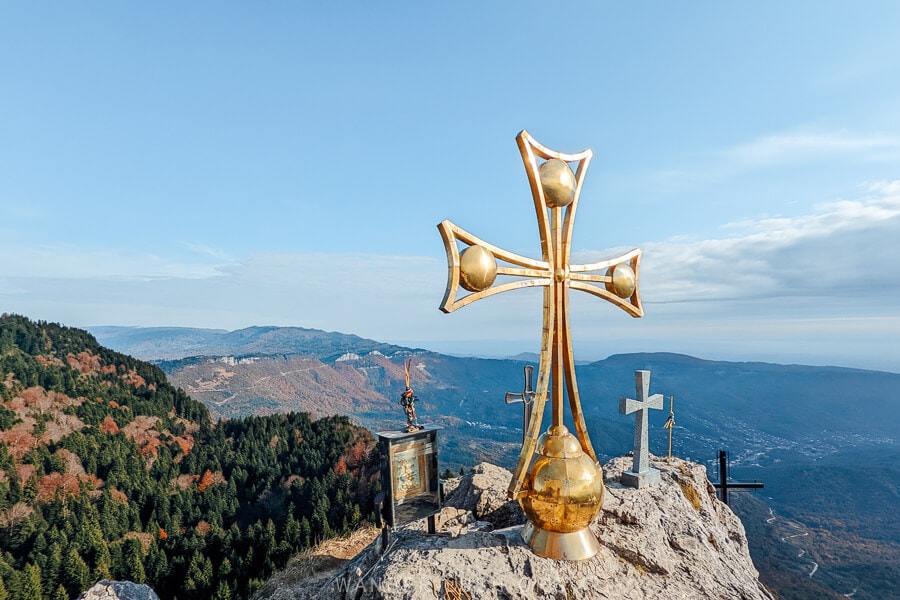
You need 60-90 minutes to complete the return route. The trail starts from behind the abandoned cable car station – a pair to the lower station in Tkibuli, and all that remains of what was once the second-longest tramway in the USSR – and takes you up makeshift staircases and over rough, uneven forest paths.
To reach the cable car station and trailhead, follow the turnoff left as you near the Nakerala Pass from Tkibuli. The road is sealed, but rockfalls are common, so watch out for stones and boulders.
For more tips for the hike, see my full guide to visiting Tskhrajvari.
Cross the Nakerala Pass
A picnic table and a metal crucifix mark the highest point of the drive from Kutaisi into Lower Racha. The Nakerala Pass peaks at 1,500 metres above sea level, and from here, the next part of the journey is all downhill before you venture into the Rachan highlands on Day 2.
Pull over at the top for a photo of the pine-clad valleys below – habitually shrouded in mist – with Tkibuli Reservoir glowing under the mid-morning sun.


The Pass is open year-round, but the road might be temporarily closed in winter if there is heavy snow.
Stop off at Shaori Reservoir
Three minutes after crossing the pass, you will arrive at Shaori Reservoir, your first destination in Racha proper. Created in the 1950s as part of a hydroelectric scheme, the artificial lake is fed by karst springs in its natural limestone banks. A series of hidden tunnels connect it to Tkibuli Reservoir, the first body of water you saw from Tskhradjvari and the top of the pass.
Shaori stretches for around 7 kilometres and is completely surrounded by a thick forest of pine and deciduous trees. In autumn, this whole area is lit up in crimson, making it one of the best places to see fall colours on this side of the country. In winter, it transforms into a fairytale snow forest.

Summer is a very popular time to visit the lake, and although amenities here are very limited, it’s not uncommon to see people fishing and grilling on the shoreline. There are several bars and campgrounds – plus a hotel and a youth camp – set up in the forest. Swimming in the lake is technically prohibited.
If you’re lucky, there will be a thin mist hanging over the water to enhance the scenery.


You can safely stop to take photos at this viewing area near the bridge, or further along at the marked forest clearing.
Admire the frescoes at Nikortsminda Cathedral
Four kilometres further along from Shaori, the town of Nikortsminda is an essential stop on the road to Ambrolauri. Its medieval cathedral is a Tentative UNESCO World Heritage Site, widely considered one of the finest examples of Georgian ecclesiastical architecture.
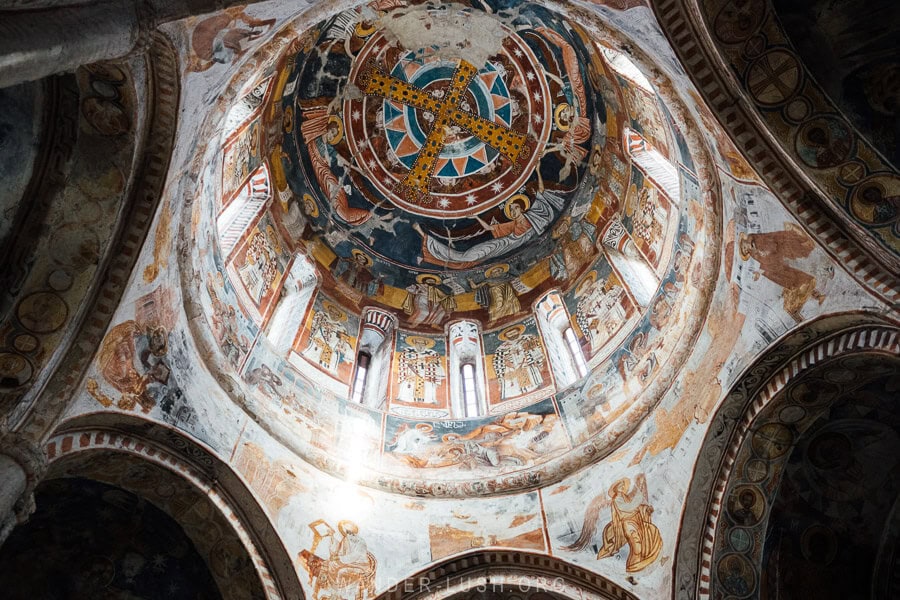
Completed in 1014 during the reign of King Bagrat III at the height of Georgia’s Golden Age, Nikortsminda is built from pale limestone, elaborately carved from its roofline to foundations with biblical vignettes and mythological imagery.
The frescoes inside date to the 16th-17th centuries, and retain their vivid shades of gold and blue. The painting of the Last Judgment on the western wall is celebrated as one of the most detailed frescoes of its kind in Georgia.
Afternoon
Lunch at Kesane – Forget Me Not
This little restaurant is one of Racha’s culinary gems, and it is perfectly positioned for a well-deserved lunch before you enter Ambrolauri. Less than 10 minutes’ drive from Nikortsminda, the kitchen is open daily from 1pm during the season (approximately end of April to end of October). Book a table in advance via Facebook.
Kesane’s menu spotlights Rachan produce and recipes. Shkmeruli chicken is my favourite Georgian dish, and Kesane’s rendition is the best I’ve ever had (the recipe hails from the village of Shkmeri in Racha). The garlic-cream sauce is so thick, it’s closer in texture to a fondue.
For a starter, I recommend the Rachuli Luka, mchadi cornbread topped with pickled jonjoli bladdernut and another local specialty, lori cured Rachan ham. Lobio stewed beans, salads, khachapuri with or without ham, and tsandili, a special dessert of boiled wheat with dried fruits and nuts, round-out the menu.


As you roll out the door, stop to visit the little shop on the roadside where the Kesane crew curate a selection of wines and fruit products made by local vintners.
Explore Ambrolauri town
Ambrolauri is the biggest settlement and main population centre in Lower Racha. As you descend into the valley, stop on the road shoulder for an overview of the town, with the Rioni and Krikhula Rivers coursing through, and the small Ambrolauri Airport on its western flank.
This is a favourite base for Georgians in summer, so much of the city consists of holiday homes and cabins.

A giant bottle of Khvanchkara wine greets you at the roundabout as you enter town. Racha’s signature wine is made from a blend of Alexandrouli and Mujuretuli grapes grown in the Khvanchkara PDO just outside Ambrolauri (on the agenda for this evening). Your first taste of the velvety sweet red comes a few blocks up from the roundabout, at the eponymous wine factory.


Before that, take a short drive or walk around Ambrolauri. There is nothing much to see here, but I do recommend stopping at the Church of the Virgin Mary for Machabeli Tower, a former guard post that resembles a Svan tower, built on the grounds of the (long gone) 17th-century palace.
At the top of Kostava Street, as you near the fountain, there is a great Soviet-era bas-relief sculpture decorating one of the facades (at this location). It incorporates a trio of weightless cosmonauts alongside typical symbols of agriculture and industry. The word ‘Peace’ is written along the top in English, French and Russian.

Nearby, the Ambrolauri Museum of Fine Arts is located inside the Culture Palace – but every time I have tried to visit the gallery (be it in summer or autumn), the doors have been closed.
Tour the region’s biggest winery, Royal Khvanchkara
One thing you might want to make time for in Ambroaluri is a visit to Royal Khvanchkara. This is by no means a must-do – it’s pretty standard as far as commercial winery tours go – but if you have time, and you’re interested in learning about an alternative wine region that is quite different from Kakheti, then why not.
Located behind a grand Soviet-style facade on the main drag, Royal Khvanchkara traces its history back to 1870. In 1907, the vintner Dimitri Kipiani took out the Gold Grand Prix for his wine at the International Exhibition in Ostend, Belgium, elevating Rachan wine on the world stage. The winery was nationalised under the Soviet Union, and the name ’Khvanchkara’ was applied.


Today, it produces more than 100,000 bottles of wine for both domestic consumption and the export market, making it the biggest winery in Racha (most vineyards here are well under one hectare – tiny in comparison to Kakheti).
The highlight of the short tour is seeing the massive barrels made from Russian oak. Once used to age wines, they were decommissioned long ago, but still take pride of place in the cellar.

Tours are short but sweet, taking around 45 minutes. The price is 30 GEL with a three-wine tasting, or 20 GEL for non-drinkers. Book in advance via phone (0439 22 12 04), and request Tatia as your guide.
Evening
Drive through Khvanchkhara at dusk
Two hours or so before sunset, drive west out of Ambrolauri through Racha’s wine country. Sadmeli, Ghviara and especially Khvanchkhara villages are all known for their wineries. Small vineyards – both flat plots and rows of vines pitched on the hillside – line both sides of the road.

Stop between the villages for some quintessential Racha scenes. One section of the west-facing road is lined with tall poplar trees, and the afternoon sun casts magical light and shadows on the asphalt and the vineyards. If you wait long enough, you might catch a Lada floating by – or maybe a horse ambling past.
On our last visit, this photogenic old truck was parked on the road shoulder.


This section of road is very beautiful at sunrise, too. You will be coming back this way on the morning of Day 4 (see photo below).
Degustation at Margvelidze Wine Cellar
Returning to Sadmeli village, be sure to book your degustation at Margvelidze Wine Cellar for an hour or so before sunset. More than half the pleasure of visiting this family-run winery is touring the historic house and cellar, and you won’t want to miss a single detail.
This year, the wooden house celebrates its 100-year birthday. Inside, the Margvelidze family have preserved the small details of their ancestors’ legacy with attention and dedication. The incredible zala room features a handmade fireplace, unique square-shaped wooden ceiling with hand-carved details, and a wall painting based on a Mihaly Zichy illustration.


Next door, the original wine cellar is even older. The qvevri embedded in the floor are still in use, and a gallery of family portraits and paintings hangs on the walls (it is not at all customary to display photos in a marani, but it’s a Margvelidze family tradition!). On the back wall, the huge oil canvas was commissioned by great-grandfather in the 1930s. No one knows for sure what it is supposed to symbolise – I think it must be related to Greek mythology.
After the walk-through, sit down in the garden to a gourmet degustation of red and white house wines (made with grapes growing right here in the yard), paired with lobiani, lori ham, homemade chilli jams, and other delicacies.
Mariam Margvelidze is an incredible host and will answer any questions you have. Reach her through Facebook to make a reservation. Allow at least 90 minutes for your visit.


At the end of the night, return to Ambrolauri (a 10-minute drive) to overnight at Brotseulebi or an alternative address in town. If you’re still hungry, No Bar is a popular local restaurant in Ambrolauri that stays open until 1am in summer.
Day 2: Upper Racha (Ghebi, Gona, Chiora)
On Day 2, follow the Rioni River east, leaving the lowlands and pushing into mountainous Upper Racha. From Ambrolauri, it’s a 70-minute (60-kilometre) drive to your first destination, Ghebi, via a fully asphalted road. Today is fairly slow-paced compared to yesterday, so you can take your time in the morning.
On the way to Chiora, you will pass through Tsesi, Oni and Utsera. To maximise your time in the villages, I suggest you drive directly through. There is only one road in this part of Racha, the Ossetian Military Road, and we will come back for these places when we retrace our steps on Days 3 and 4.
Book in advance:
- Accommodation at Chiora Inn (check-in ~2pm)
- Chiora Inn has an a-la-carte menu; meals do not need to be pre-booked
Note: There are no fuel stations in the smaller villages, so remember to top-up your tank in Ambrolauri or Oni. There are no shops either, so consider bringing a few snacks/drinks with you to enjoy during the drive or at the Inn.

Morning
See the svan towers in Ghebi
As you drive deeper and deeper into Upper Racha, the scenery becomes more and more picturesque. Forests of Caucasian (Nordmann) fir trees engulf the gently winding road. [Interesting fact: An estimated 80% of Europe’s Christmas trees are grown from Georgian seeds harvested here in Racha and in Borjomi!]
Following the road that branches off along the east bank of the Rioni, you will come to Ghebi, a small village at 1,350 metres above sea level.
Historically, Ghebi was culturally and linguistically Svan – hence why you see the ruins of fortified koshki tower houses, similar to those in Mestia and Ushguli, dotted throughout the village. The new tower in town, Ghebi’s Koshki, is privately owned. If you’re lucky, the owner might let you into the yard for a closer look.

Like everywhere in the highlands, this part of Georgia underwent major demographic changes in the 19th century, and many families departed for (or were forced to resettle in) the lowlands.
Today, Ghebi is more closely associated with Racha than Lower Svaneti. Elegant timber shushabandi (Racha is famed for its woodworking traditions) and drifts of squeaking piglets emphasise the connection. One of my favourite restaurants in Tbilisi is named after Ghebi, and it indeed specialises in Rachan recipes.


Ghebi is tiny. You can cover the whole village in 30-40 minutes, leaving your car at the church and setting out along the narrow streets by foot. We encountered very few people on our morning walk, but those who we met were cheery and offered us directions to the tower.
Near the church, there is a water fountain/trough – a freshwater source for humans and animals like. You will notice this feature in every village in Upper Racha. Ghebi’s has a lovely ram’s head decoration in marble and stone. Also note the interesting decoration inside the bus shelter!


The headwaters of the Rioni River are located northwest of Ghebi, near Gora Pasis-Mta. Living in Kutaisi – a city built around the Rioni and its mythology – it was a cool feeling to be this close to its point of origin!
Visit Gona, Georgia’s ‘Little Switzerland’
Gona is the highest and most remote village you can reach in Upper Racha. It sits northeast of Ghebi at 1,660 metres, along a tributary of the Rioni.
On the way into Ghebi, you would have noticed the turn-off – the sealed road ends here, and the track turns into a dirt/mud road. If it’s dry, you can manage it in any vehicle with high clearance (as long as you take it slowly). But if the ground is wet, you will need a 4WD. If you’re unsure, consider parking in Ghebi and hiking into Gona (around 14 kilometres return).

Gona is sometimes referred to as Georgia’s ‘Little Switzerland’. The scenery fits: the village is comprised of a handful of cabins set on hillsides, with a backdrop of dramatic mountain peaks and green summer pastures. If you weren’t already feeling the alpine vibes, you will be now.
When you reach the house the signboard out front (seemingly the only occupied building in the village), stop and park your car at this point. The road deteriorates rapidly after this point, and you will have to cross a small river. It’s better to do the rest of the area on foot.

Gona is maybe 25 kilometres shy of the Russian border – you are now well and truly in the border zone. We followed the road as far as we could go until we came to the border police post (located here) and had to turn around.
In front of the shop-house, there is an ‘I Lova Gona’ sign and selfie spot. The little path that starts from here leads up the hill to the Saint Michael Archangel Church. With the right vehicle, you can drive all the way to the chapel – otherwise, it’s around 10 minutes on foot.


Before leaving Gona, pop into the shop and buy a bottle of alpine honey to take home with you. Cheese and matsoni yogurt are also sold.
Afternoon/evening
Check into Chiora Inn & wander through charming Chiora
The drive back to Chiora via the same road takes around 40 minutes, giving you the whole afternoon to explore what I think is the most interesting village in the area. Chiora is bigger than Ghebi and Gona, with a spectacular setting in the foothills, and some very pretty architecture.


Chiora Inn is reminiscent of the Fifth Season cabin in Juta, only it is located right in the centre of the village. After checking in, enjoy a late lunch in the open-air dining room (note that the kitchen closes for a break at 3pm) then settle into your spacious cabin-style room.
The rooms on the lower level of the house each have a private balcony that faces a beautiful panorama of mountains.


I recommend setting off for a leisurely walk around the village a few hours before sunset. Heading northwest, the houses peter out, giving way to green fields studded with photogenic tivis zvini haystacks. A 3-kilometre trail to the mountaintop Kviratskhoveli Church starts from just past the final house.
There are other walks available around the village, including an easy 2-kilometre trail to Kovnebi, a green plateau with mountain views, and the 18-kilometre hike to Notsara, Chiora’s summer pasture.


We were more than satisfied with a long stroll around the village. (We were hosted by Chiora Inn and actually stayed in the village for two nights, repeating the same walk the following evening, too.) You will encounter grand stone houses, photogenic Soviet trucks, and packs of piglets.
On our first night, we met a local family on the road who took us into their garden and fed us up on fresh watermelon. We left with a huge bag of homemade plum sauce, tklapi fruit leather and chacha! They also helped us to find the key to Chiora’s St. George Church, the little chapel that sits on a hillock in town, above the WWII memorial and behind a locked gate.


We visited the sanctuary and lit votive candles together.
Day 3: Shovi & Oni
The town of Oni is my favourite place in Racha-Lechkhumi, and I recommend you spend the majority of Day 3 here in order to see everything. The drive back from Chiora takes less than 45 minutes, so you have plenty of time for a detour to Shovi to see ’Stalin’s Summer House’ on the way.
Book in advance:
- Accommodation, + dinner (Day 3) & breakfast (Day 4) at Hotel Gallery (check-in ~4pm)
Morning
Urbex at Stalin’s Summer House in Shovi
After breakfast in Chiora, drive down to rejoin the main road. Instead of heading west back towards Oni, cross the bridge and follow the Chanchakhi River east for 9 kilometres. The road is fully sealed up to this point, 600 metres outside Shovi, where it turns to compact gravel and rock.
As you edge closer to the historic Mamisoni Pass, the landscape shifts and becomes altogether more ominous. Just before Shovi, pause at the Dghviora Bridge for an iconic view of Racha, looking out along the Chanchakhi riverbed (usually dry in summer) framed by a colonnade of tall, dark trees.

At 1,520 metres above sea level, Shovi was a health resort founded in 1929 by a local doctor named Shamshe Lejava. Like Libani, Surami and countless others, it was created not for leisure, but for outpatients to convalesce in the alpine air and curative mineral waters.
In the Soviet period, German POWs were enlisted to build a military sanatorium here. The stunning wooden building with a dark history was sadly destroyed by fire several years ago – you can see images of it in this article.
On August 3, 2023, another tragedy hit Shovi when a massive landslide destroyed most of the resort, claiming the lives of 33 people. The area has not yet been completely cleared, and there is still evidence of the disaster all around – damaged holiday homes, trees crushed under rubble. I first visited Shovi in 2021 before the landslide, and seeing it now was sobering. The mountains have a way of reminding us who is in charge.

There are now plans to reconstruct Shovi. But at present, it is not possible to venture into the area, or to hike to Buba Glacier. Just over the newly reconstructed bridge, there is a small cluster of buildings that remain intact, and you are free to drive up to this point.
One of those buildings is ‘Stalin’s Summer House’ – a complete misnomer, as Joseph Stalin never once set foot in Racha. The landslide stopped right at the doorstep of this iconic house, sparing it from destruction.

The once-grand, now delightfully dilapidated three-storey dacha was built in the mid-1920s for a local physician (maybe Dr. Lejava). Crafted from wood on a stone foundation, it is perfectly symmetrical and resembles a tiered crown – pavilions and gables layered one above another.
The first time I visited this house, it was empty and deserted. The only sign of civilisation was a stack of besser bricks arranged in front of the house, clearly positioned to prop up one’s mobile phone when snapping selfies. This time we met a group of young women who were inside taking photos, and we decided to join them.


Not much remains of the interior, but you can see patches of old wallpaper and exposed lathwork, old doors with their original fittings, and fragments of decorative ceiling plaster.
If you decide to go in, take care – the floorboards are rotted through in places, and there’s lots of junk (including nails and glass) around.
If you have more time in Racha or you plan to return, the region’s most popular hike – the two-day trek to Udziro Lake – starts from the village of Glola, just outside Shovi.
Drink from the spring in Utsera
Twenty minutes’ drive from Shovi towards Oni, Utsera was also a balneological resort developed in the late 19th century when the health benefits of Racha’s mineral waters became widely recognised. This area has no fewer than 28 documented springs.
In Soviet times, Utsera was a spa destination – not unlike Tskaltubo. A few relics of the era remain, but there are lots of new builds here too, including the popular Manino Utsera. A Radisson is under construction.
Utsera’s natural springs are known for their acidic taste. There are several pavilions on the main road where you can stop to taste the water or fill up a bottle – Napertskala is one option. The Gverita Spring is located on the opposite bank of the river and accessed along a precarious ropeway. At the time of our visit, there had been a landslip and the path was blocked at the opposite end of the bridge.
As the story goes, Gverita was discovered by two local brothers who entered into discussions with a French company to start bottling the water and exporting it to Europe. But they would only commercialise the water if locals could retain unfettered access to the spring. This ultimately led to the deal falling through. (Interestingly, the bottling plants at Borjomi and Nabeghlavi on the way to Bakhmaro in Guria have free public springs – I guess that explains why!)
Afternoon
Photograph the incredible Oni Synagogue
Entering Oni from the east this time (20 minutes’ from Utsera), one of the first landmarks you’ll spot is the Oni Synagogue. Make time to take it in: the craftsmanship and scale of the facade are striking.
The synagogue looks out of place and yet right at home – perched on the bend of a suburban street, blue mountain peaks as its backdrop. I have been to Oni many times, and I still let out a little gasp every time I lay eyes on this magnificent structure.

Designed by Polish architects and constructed by labourers from Thessaloniki, the synagogue was built in 1895. At that time, Oni’s Jewish community was the third-largest in the country (after Tbilisi and Kutaisi), and the congregation numbered up to a quarter of a million people.
In the 1970s, the majority of Oni’s Jewish residents left for Israel. In 1992, an earthquake hit Racha and severely damaged the synagogue, prompting more people to make their exit. Today, there are only a handful of Jewish families left in Oni who keep the synagogue active.


Built in a Neo-Moorish style, the blockish exterior cuts an impressive figure with its golden stonework and silver-blue dome. The door is always locked, but it is possible to go inside with one of the caretakers. I recommend you enquire at your guesthouse.
When you’re done admiring the synagogue, set aside another hour or so to wander around Oni. The sleepy village I first encountered in 2021 is no more – there is a lot of construction going on in Oni. The shaded side streets are still filled with cute cabins and beautiful old wooden houses with typical Rachan fretwork.


If you’re hungry for lunch, Eat & Go Cafe on the main square (near the bridge) serves classic Georgian fare, while the new Onuka Coffee does barista coffee. Remember to save plenty of room for tonight’s dinner at the guesthouse!
If the door is open, drop into the Ethno-Oni shop on Rustaveli Street, where you’ll find a range of feltwork, rope macrame and other Rachan handicrafts made by local artisans such as Edena. The shop also sells wool slippers, ornaments, local honey, wine, and other small souvenirs.


Tour the Oni Local Lore Museum
In the centre of Oni, this regional museum is well worth a quick walk through – not necessarily for the exhibits, but rather to poke through the dimly lit rooms on the lower level, which resemble your quirky aunt’s storage closet.
Wooden racks and drawers house thousands upon thousands of objects: wooden snow shoes, sections of fretwork lifted from houses around town, stone and bronze tools, archival photographs, and a beautiful collection of timber trunks.
Another room serves as a gallery for paintings by local artist Shota Goshadze, some depicting Oni during its more illustrious days at the turn of the century.
Upstairs, you’ll find a magnificent hand-carved wooden bench seat that stretches almost the full length of the building. Apparently these traditional chairs had to be long enough to seat the entire family – in this case, the clan must have numbered at least a dozen people.
A very solemn and weather-worn painting of Stalin hangs on the wall above the stairs, creating a surreal and slightly eerie vignette.

Don’t miss seeing the carved stone blocks salvaged from churches around Racha, displayed on an outdoor terrace, or the very impressive large-scale macrame wall hangings in the upstairs corridor.


The Oni Museum is open until 5pm Tuesday to Sunday (closed Mondays). Entrance costs 3 GEL. Staff speak minimal English, but will happily chaperone you (actually, I’m not sure if you have a choice!) and point out any noteworthy objects in the collection.
A modern museum building was completed in summer 2022, but the collection is yet to relocate to its new digs.
Evening
Experience authentic hospitality at Family Hotel Gallery
Family Hotel Gallery is one of my favourite accommodations in Georgia. We have stayed with Nika and his family half a dozen times over the years, and we are always blown away by their warm hospitality.
Accommodation is upstairs in the main house, or inside a 200-year-old wooden home next door. I recommend taking one of the private rooms above the cellar.
The fretwork, chairs and everything else made of wood is the handiwork of Nika’s father, Temuri, while the macrame and feltwork that decorates every wall comes courtesy of his mother, Elene. Bombora II, your canine host, is a vital member of the welcoming party!


If you don’t have your own car, you could quite happily base yourself here for a couple of days, observing seasonal rituals such as apple harvesting and wine pressing, taking easy walks around town, and sourcing information from Nika, a mountain guide and professional photographer by trade, who knows everything there is to know about the area.
Full board comes in the form of home-cooked Rachan meals, always with bottomless wine, and with live folk music to accompany on summer weekends. I highly recommend eating both dinner and breakfast here – mention it to Nika at the time of booking.

If you have time before dinner, ask Nika to point you towards the trail to Bolta, a peaceful village on the plateau that you can reach via a forested trail behind the house.
The path is cool and green, and there are nice mountain views from the top. In the quiet village, fat pigs (tomorrow’s Rachan ham) wander the dirt roads past rusted trucks.
Day 4: Lechkhumi
After a couple of slow days, it’s time to pick up the pace again on Day 4 as you work your way west into neighbouring Lechkhumi. The final item on today’s agenda, Sairme Pillars, is a 70-minute drive from Oni. There is lots to see along the way as you drive back through Ambrolauri and Khvanchkara and along the next section of highway through Lechkhumi for the first time.
If you are short on time or you want to save Lechkhumi for another visit, there is always the option to return to Kutaisi/Tbilisi directly from Oni using the road through Sachkhere.

Morning
Admire the wooden iconostasis at Barakoni Church
Barakoni Church is located in the village of Tsesi, 25 minutes’ drive from Oni, just before Ambrolauri. You could stop here on Day 2, but because it opens quite late at 10.30am (or 9am on Sundays), I recommend saving it for your last day after breakfast.
Formally the Church of the Mother God, Barakoni is tucked below the road in leafy depression at the confluence of the Lukhuni and Rioni Rivers. Instead of following the steep access road, I suggest you park on the road shoulder and walk – there is a wonderful view of the church and graveyard on the way down.

Commissioned in 1753 by Rostom, the eristavi of Racha, and built by the architect Avtandil Shulavreli, it’s one of the last great monuments in the medieval Georgian domed tradition. The rectangular church is built of finely cut local stone quarried from Itsi. In the Soviet period, the church was closed and desecrated; it took minor damage in the 1991 Racha earthquake, but was quickly repaired.
The iconostasis (the screen that separates the nave of the church from the altar) has to be one of the most beautiful in the country. Made from dark wood, hard-carved and painted with icons and delicate floral flourishes, it is quite unlike most you’ll see elsewhere in Georgia.


Liturgy is held here on Sunday mornings (hence the earlier opening hour) – on our last drive through Racha, we saw a large crowd gathered at the gate.
The drive to Lailashi from Barakoni takes the better part of an hour, so if you need a snack for the road, Ilne Bakery outside the church is famous for its lobiani bean bread with Rachan ham.
Cool off in the Lailashi Secret Pool
Pass the turn-off from Ambrolauri and retrace your footsteps back through Sadmeli and Khvanchkara. After that, it’s all new territory as you drive west into Lechkhumi.
The landscape changes in an instant as you leave Racha. The Christmas-tree forests thin out, and the limestone cliffs that make Lechkhumi (and particularly its wines) famous start to dominate the landscape. The long, straight road through the vineyards starts to gently bend, accommodating the sheer rock walls. At one point, the cliffs curl over the road like a crashing wave, creating the impression that you are riding a barrel of limestone.
Fair to say this is one of my favourite drives in all of Georgia!

If you have the full day to play with, then I suggest you bypass Tchrebalo and Sairme Pillars and head straight to Lailashi first. It can get busy in this village in summer, and it’s honestly a much nicer experience without the crowds.
Lailashi sits at 900 metres elevation above the main road. The new access road is fully sealed, taking just 15 minutes from the highway.
When you reach the village, head straight to the Okronishi Decorative Fountain, better known as ‘Lailashi Secret Pool’. Basically Georgia’s answer to an infinity pool, it sits high in the mountains overlooking the valley and the Lajanura Reservoir below. The natural pool is fed by freshwater springs and extremely icy as a result!
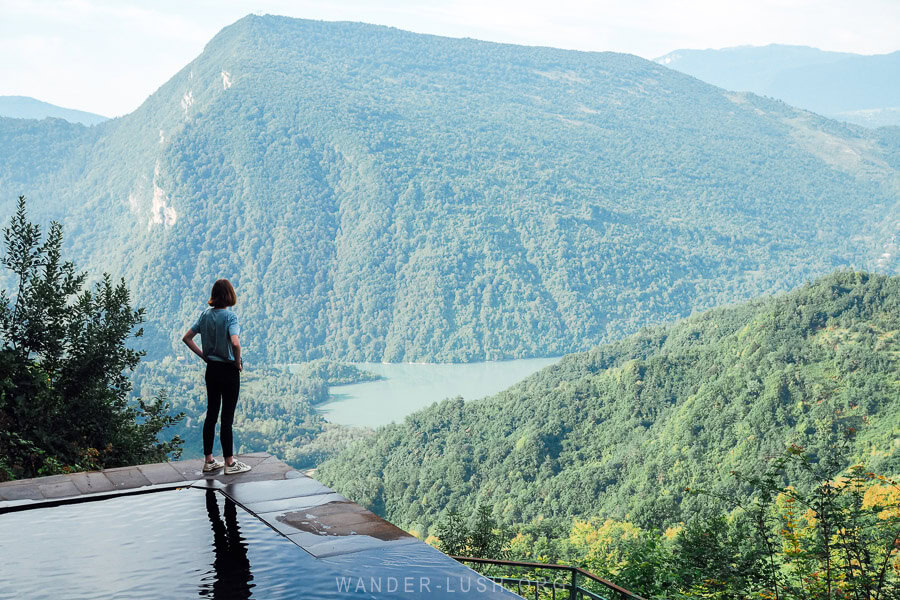
The fountain was built by Lailashi’s Jewish community (more below) and restored by USAID. Our first time here, we were not sure of the etiquette – but we later learned that it is completely acceptable to swim in the big pool.
There are two changing rooms on the water’s edge, and in summer, there is a cafe-bar set up. It is not maintained out of season, though – we came here one November and the pool was full of algae.
Visit the Lailashi Synagogue & Armenian Church
Lailashi is a fascinating place, with a rich history and a mystical feel that reminds me a lot of Saro, one of my favourite villages in southern Georgia’s Samtskhe-Javakheti. Once located on an important trade route, it was home to a bazaar and a diverse population. As well as a Georgian Orthodox church, there is an inactive but preserved synagogue, plus the ruins of an Armenian Apostolic temple (pictured below).


Built in the 1860s when the Jewish population numbered more than 1,000, this synagogue is famous for housing the 10th-century Lailashi Codex, the oldest known Torah scroll in Georgia. It is now held in the National Centre of Manuscripts in Tbilisi.


I was thrilled to find the door to the Lailashi Synagogue open on our most recent visit in July. It is inactive and virtually empty save for a timber bimah. Inside, there are a few information panels in Hebrew and Georgian, plus a collection of photos.
Afternoon
Lunch at Tchrebalo Wine Cellar
Like Kesane, this restaurant is an unexpected hidden gem. Tchrebalo Wine Cellar opens at 1pm – so depending on your timing, you can stop here for lunch either before or after the Sairme Pillars Hike (reservations are not required, so you can keep it flexible). A little bit of doubling-back is involved, but the drive times are all short.
Located off the main road in the tiny village of Tchrebalo (Chrebalo), the restaurant occupies a historic stone building that has been beautifully renovated into an upstairs dining room with a terrace, and a soon-to-launch wine hotel on the lower level. The space reminds me a lot of Bahnhof Station in Asureti – but as the owner informed me, this space was never a factory, it was always a restaurant.


We have eaten here twice now, and everything we’ve tried is outstanding. I particularly recommend the Shkmeruli Pâté – a clever take on the garlic chicken dish – and the locally caught river trout. For dessert, the apple pie is fantastic.
Walk the Sairme Pillars trail
The final stop in Lechkhumi is the Sairme Pillars Natural Monument, a run of striking limestone towers in Tsageri municipality, just outside Tchrebalo. A new waymarked path, completed in 2021, makes the 2-kilometre stroll simple and safe. You need about 2 hours to complete the walk in both directions.
Leave your car at this designated parking spot, and start along the paved, mostly shaded path. The walk culminates at a viewing area at the base of the brittle pillars.

If you have time and you are looking for a longer hike in Lechkhumi, I highly recommend the Khvamli Mountain Hike. The trailhead is located just outside Larchvali on the road from Lechkhumi back down to Tskaltubo, making it a convenient option if you are headed back towards Kutaisi.
Alternatively, there is a new road from Alpana (right near the Pillars) to Kutaisi, cutting through the heart of Lechkhumi. This road is also fully sealed and incredibly scenic.
A final option is to complete the drive west through Lechkhumi all the way to the regional capital of Tsageri, where you can join-up with the road to Ushguli. The Zagari Pass is open during the summer months and is an alternative way to reach Svaneti from Imereti without having to drive all the way to Zugdidi.
You might also be interested in…
Georgia essentials
Here are the websites and services I personally use and recommend for Georgia. Check out my full list of travel resources for more tips.
FLIGHTS: Search for affordable flights to Tbilisi, Batumi or Kutaisi on Skyscanner.
TRAVEL INSURANCE: Insure your trip with HeyMondo, my preferred provider for single-trip and annual travel insurance (get 5% off when you book with my link).
SIM CARD: Magti is my preferred provider, with prices starting from 9 GEL/week for unlimited data. See this guide for all the details about buying a Georgian SIM card.
AIRPORT TRANSFERS: Most flights into Georgia arrive in the early hours. For ease, pre-book a private transfer from Tbilisi Airport to your hotel (from $19) or from Kutaisi Airport to Tbilisi (from $90) with my partners at GoTrip.ge.
ACCOMMODATION: Booking.com is the most widely used platform in Georgia. Use it to find family guesthouses, private apartments, hostels and hotels around the country.
CAR HIRE: Find a great deal on a rental car in Georgia – use the Local Rent website to book through a local agent (prices start from $20/day).
DAY TRIPS & CITY TOURS: Use Viator or Get Your Guide to browse a range of day trips and city tours. For off-beat programs, I recommend Friendly.ge (use the promocode wanderlush for 10% off). For in-depth day trips to Georgia’s wine regions, I recommend Eat This! Tours (use the promo code wanderlush for 5% off).
PRIVATE TRANSFERS: GoTrip.ge is a terrific service for booking a private professional driver and car for the day. Use it for A-to-B transfers, a customised round-trip itinerary, or a multi-day trip. You can stop wherever you like for as long as you like without the fixed price going up.
NEED SOME HELP?: Need feedback on your itinerary or personalised travel tips? I offer a one-on-one consultation call service for Tbilisi and Georgia. More information and bookings here.