Barge Cruising Is a Slow-Travel Antidote to Overtourism
5 min readWith so much focus on overtourism and the pushback against it, scouting hidden gems has become the new travel sport. But what if the key to being a more thoughtful traveler isn’t about where you go, but how you go?
Instead of rushing through a sightseeing tour, lining up to take the same photo as everyone else, you could be boarding a small luxury boat with a few friends or family members, sailing at just four miles per hour down a secluded canal in the French countryside, periodically stopping for a glass of wine at a small village or hopping off the boat to bike along the riverbank.
Barge cruising has quietly become a desirable way to explore Europe, especially among travelers looking to trade the fast-paced, rigid itineraries of larger cruise ships and riverboats for a slower, more personal kind of journey. There are typically somewhere between two and six guests per barge, and the ratio of crew to guests is often something like one-to-one, including the captain, chef, tour guide, and hosts. That sort of privacy and service makes them ideal for couples, small groups like family reunions, and other travelers looking for a relaxed yet luxurious way to explore local culture and the countryside.
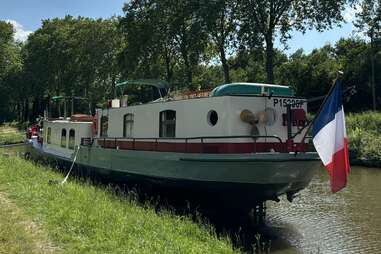
“Carrying just two, three, or four guests, our adorable micro-barges navigate France’s smaller canals and moor in charming, off-the-radar villages, spotlighting the small slices of local life that mass tourism misses entirely,” says Stephanie Sack of Barge Lady Cruises.
Barge cruising has its roots in the 19th and early 20th centuries, when canals were a vital part of Europe’s industrial transportation system. The flat-bottomed vessels were used to transport goods like wine, grain, and coal, but they were gradually phased out with the rise of railroads and highways. In recent decades, many old working barges were brought out of retirement and reimagined as floating boutique hotels; now they’re a niche luxury experience, offering travelers a scenic way to explore Europe’s smaller waterways.
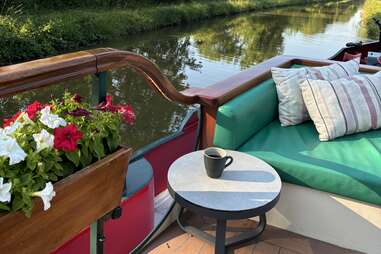
On many boats, there are thoughtful touches like fresh flowers, local decor, and meals prepared by an onboard chef. Guests dine together either in the ship’s dining room or al fresco on the deck. The goal is luxury without fuss — personal, quiet, and elegant. Guest rooms are surprisingly spacious and upscale despite the compact ship, more akin to a boutique hotel than a cruise liner. Most guests will spend their time on deck taking in the scenery, but a comfortable lounge area below deck is a great spot for playing games, enjoying a cocktail at the bar, or reading one of the books from the ship’s library.
Barge cruises typically range from $5,000 to $10,000 per person, depending on the route and ship’s rating. Cabin bookings, in which twosomes cruise with other twosomes, are a very popular way to barge cruise — and a great way to make new friends — but chartering a whole boat is also an option.
While France remains the most popular destination — especially in regions like Burgundy, Provence, and the Canal du Midi — barge cruises are also available in the Netherlands, Belgium, England, Scotland, and Ireland. Barges that sail through Burgundy stop at Beaune and Dijon, and often include visits to iconic sites in those destinations. The waterways of Venice are another popular route, with stops at the famous St. Mark’s Basilica and Doge’s Palace. English cruises offer guests an opportunity to visit Windsor Castle, and Holland barge cruises include a visit to the tulip fields.
But you don’t have to stick to the major tourist sites: The intimate scale of a barge cruise allows for bespoke itineraries. They are typically created by the tour guide, but there’s often flexibility to tailor parts of the experience to guest preferences. It’s not uncommon to add an impromptu vineyard visit or an extra stop at a charming town square. This flexibility, combined with the crew’s local knowledge, creates an experience that feels both curated and spontaneous. Unlike larger cruise ships dictated by a schedule, barge cruise guests are able to linger at their favorite spots; a cruising barge is often the only boat docked in the village, so arrival and departure times are totally fluid.
Mary Chong of Calculated Traveller believes that “there’s an undeniable magic in gliding through the heart of Burgundy on a barge,” and she luxuriated in “the quiet morning stretches on the sun deck, the delight of discovering small villages at our own pace, and the freedom to breathe and enjoy the simple beauty around every bend.”
Access to narrow canals and moorings unreachable by bigger cruise ships also makes barge cruising a more individualized experience. Barges dock in smaller towns, so they help spread tourism out more evenly, supporting local economies in a less intrusive way. Whether pedaling e-bikes along the towpath, exploring medieval villages, or sampling wine at a small vineyard, travelers enjoy a kind of access that larger tours can’t provide, and they get to experience the area without the burden of a large group of fellow tourists.
Rossana Wyatt, the writer behind Life is Full of Adventures, loved having “the freedom to hop off at the locks and stroll or cycle along scenic towpaths… It’s the perfect way to stretch your legs, enjoy a bit of time to yourself, and soak in the beauty of the countryside.”
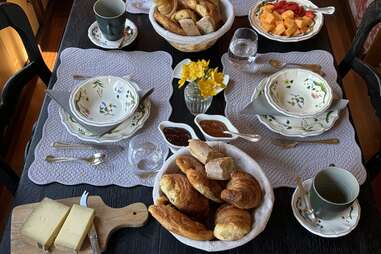
Access to regional food and wine is a signature highlight of many barge cruises. While guests are off on excursions, the barge chef is often out shopping at local markets and visiting family farms. Onboard Le Papillon, which sails through Burgundy, the ship’s captain rides an e-bike into town before dawn to get fresh-baked pastries from the local boulangerie. The small guest count also allows the chef to tailor meals to guests’ preferences and dietary restrictions.
“What truly elevated the experience was the personalized attention to dietary needs. Both my daughter and I are Celiac, but the chef and staff made sure our meals were completely safe, and thoroughly delicious. Each meal featured a trio of cheeses — and even though I can’t have anything made from cow’s milk, I was never left out. Instead, I was offered a delicious selection of goat and sheep cheeses,” says Wyatt.
Barge cruising epitomizes slow travel, both literally and philosophically. It offers the luxury of time — time to relax, to engage in long conversations over wine, to appreciate small details that could be missed in racing from one site to the next. For travelers in search of connection — to place, to people, and to the rhythm of daily life — it’s hard to imagine a more perfect match.


