I rode the new Maya Train to explore Mexico’s Caribbean coast, one of the country’s most intriguing slow-travel regions
5 min readSoon after my train pulls out of the Cancun Airport rail station, I settle into my seat and watch the jungle streak past in vivid shades of green. In the Yucatan’s Costa Maya region, Tren Maya (or the Maya Train) is still a novelty, made clear by the selfie-snapping excitement of my co-passengers. “Visitors don’t expect a beautiful, high-tech train in Mexico,” one tells me. “I’m proud that people can reach simple places like my family village this way.”
With Tren Maya’s final segment completed in Dec. 2024, riders can now travel the full loop — 34 stations and stops over more than 1,500 kilometres — around the Yucatan Peninsula. It passes through the states of Chiapas, Tabasco, Campeche, Yucatan and Quintana Roo.
I’m focusing on the 367-kilometre stretch from Cancun to Chetumal, with stops to explore Mahahual, a laid-back fishing village fronting Mexico’s largest coral atoll, and Bacalar, home to the radiant Lagoon of Seven Colors.
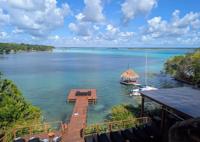
The lagoon at Bacalar is known for its varied shades of blue.
For decades, this southern curve of Mexico’s Caribbean coast was known mainly as a cruise-ship spillover zone, with day-trippers, beach bars and little reason to linger.
But the train is changing that story.
Now, connected by new stations and daily departures, Costa Maya is emerging as one of Mexico’s most intriguing slow-travel regions, encouraging visitors to stay longer, spend locally and explore inland history along with the seaside.
Still, you can’t talk about Tren Maya without acknowledging the controversy that has trailed it: concerns about environmental damage, the displacement of Indigenous communities, legal battles and the price tag, which ballooned to an estimated $28 billion USD to $30 billion.
In 2022, Alex Olivera, of the Center for Biological Diversity, warned in a lawsuit that the railway could threaten jungle ecosystems and the hidden web of underground rivers and caves beneath the Yucatan.

Tren Maya is a new fast train that travels a 1,500-kilometre loop around the Yucatan Peninsula.
To address environmental concerns, the train’s design was rerouted in sections, Bernardo Cueto Riestra, the secretary of tourism for Quintana Roo, tells me. Viaducts were built over sensitive areas, and wildlife corridors were added.
Proponents of the train believe the tourism benefits will be worth it. In Bacalar, for instance, Giuseppe Corral Ramirez, a guide with Adventure Lab, says he hopes the train will deliver steady, year-round visitors — the kind of travellers who make a career like his in sustainable tourism possible.
“I’ve moved around a lot for jobs, but my daughter loves living in Bacalar, so I want to build a life here,” Ramirez explains. “I’m even signing her up for sailing lessons.” The truth of the train’s impact, like the landscape flashing past at 120 kph, is blurry, not yet sharpened by time.
In Mahahual, five and a half hours from Cancun by rail, I find a seaside village with a hammock-lined malecón (waterfront) that feels worlds away from the hotel towers farther north.
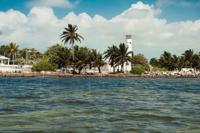
The village of Mahahual, known for its proximity to the Mesoamerican Barrier Reef.
Cruise ships dock just outside town, but locals such as Vanesa Goig, co-owner of Pepe Dive Mahahual, have been lobbying against Royal Caribbean’s Perfect Day Mexico cruise-park development. “We want to attract visitors interested in supporting small businesses and protecting the reef,” says Goig, referring to the Mesoamerican Barrier Reef I’m about to visit.
My snorkel tour in the clear, warm water is led by Pepe Dive guide Gregorio Leyva, who points out patches of healthy coral and rattles off fish species with easy affection. But what stays with me is his cheerful surprise when we spot an undersized lionfish. Leyva had taken part in a community-led effort to cull the invasive species, once a major threat to the reef. Today, however, we see just one. It’s a good sign.
From Mahahual, a 40-minute train ride brings me to Bacalar, a Pueblo Mágico (“magic town”) that once drew pirates inland through the man-made Canal de los Piratas in search of the logwood tree, prized for producing dyes used in textiles. Here, the Lagoon of Seven Colors shifts from turquoise to sapphire to milky jade, thanks to the sunlight, depth and stromatolites (fossil-like rocks formed by ancient blue-green algae).
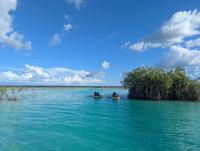
In Bacalar, paddling in the mangroves takes you through channels built by the Mayan people hundreds of years ago.
Between dips in the mineral-rich lagoon, I explore the waterways with Ramirez of Adventure Lab. He explains how the community’s sustainability plan aims to reduce reliance on fuel-powered boats by encouraging non-motorized tourism. And every Wednesday is “rest day,” when no one uses the lagoon at all. “The water became much clearer once we started,” he says, “and wildlife gets a break.”
The next day, I head inland to Ichkabal, one of Mexico’s largest and oldest Mayan sites, opened to visitors in Jan. 2025. My guide, Raymundo Castro, explains how this dense, low-lying jungle had hidden the city for centuries after it was abandoned around 1,500 AD.
“It was untouched. So when excavations started in the mid-’90s, everything they found — jadeite, masks, burials — had context.” Castro pauses, scanning the tree-shrouded pyramids. “This fills in gaps in what we know about the Maya. And it’s only a fraction of what might still be here.”
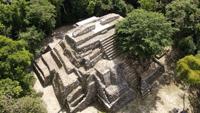
An aerial view of Ichkabal, the newly opened archaeological site deep in the jungle.
A few days later, as the train carries me back north and I watch the jungle flash by, I start to understand that my journey hasn’t just been between stations, but between ideas of what travel in Mexico can become. Costa Maya is a region in flux, being shaped by modern rail, ancient culture and the people who are determined to guide its future.
Diane Selkirk travelled as a guest of the Quintana Roo Tourism Board, which did not review or approve this article.


