How to Get Around Georgia: Trains, Prop Planes, Marshrutka Minivans & Other Transport Options
11 min readGeorgia might be a small country, but getting around is not always that intuitive.
Intercity and long-distance transport is decentralised and highly dependent on geography, with different systems operating side by side rather than through a unified network.
This is slowly changing, but at present, it can be tricky to plan multi-leg journeys or find information online – even for the most straightforward, direct connections.
Trains work well in some areas and marshrutkas fill in the gaps, while tourist shuttles and coaches are less common. In many regions, the most practical option is to arrange transport privately.
This guide provides a broad overview of the different transport options available. It is intended as a starting point to help you decide on the right mode of transport for your trip to Georgia based on where you’re going, how much time you have, and how much flexibility you need.
Please note: This post contains affiliate links, meaning I may earn a commission if you make a purchase by clicking a link (at no extra cost to you). Learn more.
Quick reference: My rule of thumb for getting around Georgia
After almost a decade travelling and living in Georgia, these are the transport rules I live by:
- City to city transfers → Train
- Between cities / towns / villages (< 4 hours) → Marshrutka
- To mountain destinations → Private driver or shared transfer
- To rural areas → Private transfer or hire car
- Winter travel → Train or private driver
- Kutaisi Airport transfers → Coach

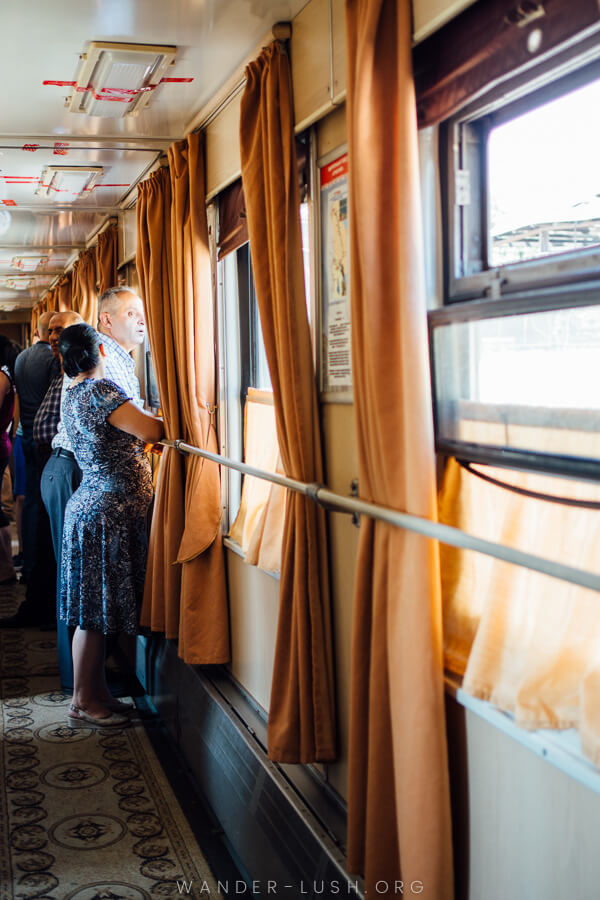
Take the train west
Trains might not be the fastest or fanciest form of transport in Georgia, but they are the most dependable in my eyes. Given the choice, I’ll always take the train instead of travelling by road.
On the country’s main westbound corridor linking Tbilisi with Western Georgia and the Black Sea Coast, rail travel is comfortable, safe, and generally good value (tickets range from 15-35 GEL). Trains offer a smoother journey, more space for luggage, reserved seating, and far greater predictability.
Georgia’s rail network isn’t extensive, but it is well developed where it matters most for travellers. Modern Swiss Stadler trains and fast services operate key connections between Tbilisi, Kutaisi, Zugdidi, Poti, Ozurgeti and Batumi. These trains are popular with locals for good reason, and delays are rare.
Not all trains in Georgia are equal, though. Older commuter and regional services also exist, such as the trains to Borjomi or Chiatura.
Unfortunately, trains only operate in western and southern Georgia. There are no rail services to Kakheti or the mountain regions. Outside the rail corridor, you’ll need to switch to road transport.
Want the details? My complete guide to trains in Georgia explores the railways in detail – which services to take (and which to avoid), different train types and classes, how and when to buy tickets, and other practical tips.

Use marshrutkas to go almost anywhere
If trains are the best option on certain routes, then marshrutkas are what make the rest of Georgia possible. These intercity minivans connect virtually every city, town and village – and they’re often the only realistic shared transport option for remote areas and mountain regions.
The backbone of Georgia’s local transport system, a marshrutka is almost like a bus-taxi hybrid: it follows a fixed route, but it can stop anywhere in between A and B. Vans start from a particular station, fill up, and then leave – meaning departures can be earlier than scheduled on popular runs, or later (or cancelled) during quieter periods.
You generally can’t book ahead, and there’s no single central timetable you can rely on, so flexibility is part of the deal. I have collected the schedules for vans from Tbilisi’s main bus station, Didube, here in this guide.
Marshrutkas are widely available and very affordable (5-30 GEL for most routes). But – some vans are old and uncomfortable (especially when passengers are packed in like sardines), AC is never guaranteed, and luggage space can be tight.
Seatbelts are usually nonexistent, and drivers are notorious for speeding and weaving, which makes road safety a real concern when using these vans. Personally I have had one too many close calls and try to avoid marshrutka vans whenever possible. You should never, ever travel on the road after dark.
For most travellers, marshrutka vans are a fine option for shorter journeys of 1-4 hours max. But you should upgrade when it matters most – for example if you’re travelling with a suitcase, with children, in winter conditions, or you’re heading into the mountains and want a calmer, safer ride.
Shared taxis are also available alongside vans, with a seat typically costing slightly more than a marshrutka ticket. You do have to wait for the car to fill up – and you can’t make stops if you are sharing the ride with other passengers – but in some situations, this is an easy last-minute upgrade.
Want the full version? My dedicated marshrutka guide covers exactly what you’ll need on the ground – how the system works, where to find stations in major cities, how fares and tickets are handled, what to expect with luggage and comfort, and my best tips for avoiding the most common first-timer mistakes.

Hire a private driver for mountain regions & scenic drives
For challenging mountain roads, longer drives, or journeys where the scenery is part of the experience, hiring a private car and driver can be the smartest choice. Even though I own my own car, I still use private drivers on occasion for airport transfers and for roads that I am not comfortable driving myself.
A private driver is an affordable luxury in Georgia, and it gives you the kind of flexibility that public transport simply can’t deliver: planned sightseeing stops, spontaneous photo breaks, and the freedom to travel at a comfortable pace. Routes such as Tbilisi to Kazbegi via the Military Highway are made for this.
I consistently recommend GoTrip.ge for finding a private driver. Almost like a long-distance Uber, it is designed specifically for cross-country travel in Georgia. You set your itinerary online, choose a vetted, well-reviewed driver, and lock in a fixed price for the whole car. Pricing is transparent and fixed, and stops along the way – planned or spontaneous – are all included.
All types of vehicle are available, from sedans to 4WDs for mountain roads and people movers for families or groups. Last-minute bookings are almost always possible.
GoTrip works across the country and can also be used for cross-border trips into Armenia. You can also use it to organise day trips from Tbilisi or any other location in Georgia. GoTrip has a multi-day transfer option, but you might find it’s more affordable to book separate legs.
Want to know how it works in practice? I’ve written a detailed review of GoTrip.ge, including how to plan routes and what to expect.

Rent a car to get off the beaten track
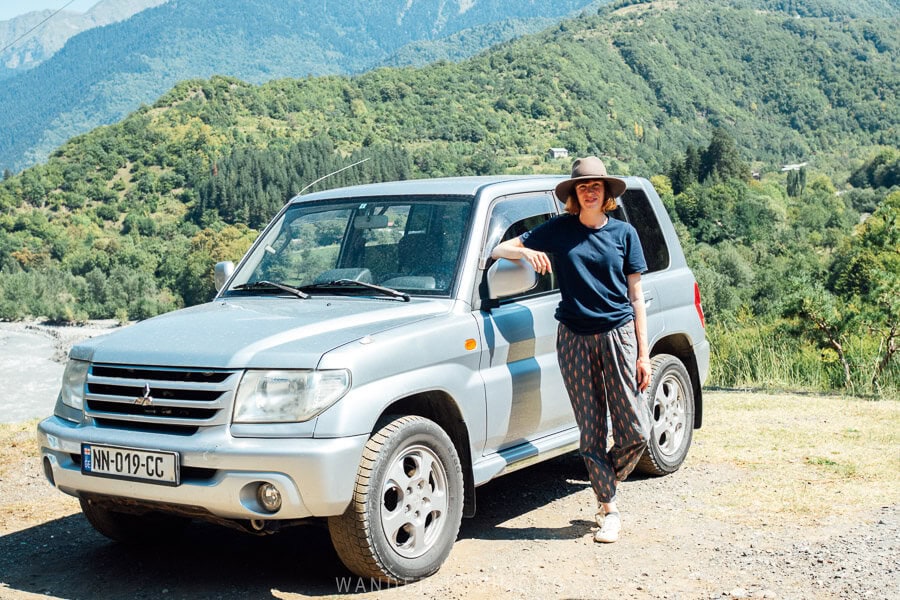
If flexibility is your top priority, renting a car gives you the most freedom of all. I rented dozens of times when I first moved to Georgia until I finally bought a car of my own.
Having your own vehicle allows you to reach places that are awkward, slow or simply impractical to get to with public transport – villages, trailheads, viewpoints, and lesser-visited regions. Some of my favourite trips in Georgia are self-driving routes – for example the Monument Route in Western Georgia and the Zagari Pass from Kutaisi to Svaneti.
Car hire makes the most sense for off-the-beaten-track itineraries, multi-day road trips, and regions where distances are short but travel times are long. It also lets you travel on your own schedule, pause where you want (hugely important for me), and change plans without factoring in timetables or connections.
Driving in Georgia is not as bad as some people would lead you to believe. The road culture is assertive, road rules are inconsistent, and conditions can change quickly at certain times of year – but if you are a confident and experienced driver, the payoff is worth it. Read-up on the driving style and etiquette before you go, plan your route sensibly, and hit the road in the early morning (never after dark) to avoid other cars.
Local Rent is my preferred rental platform in Georgia. It is far more affordable than traditional platforms (from 35 USD/day), with clear insurance terms, reasonable one-way fees, and flexible delivery and drop-off.
Thinking about hiring a car? My full guide to renting a car in Georgia covers when it makes sense, what to watch out for, insurance requirements, and my tips for navigating the driving style.
Consider coach buses for airport transfers & select intercity journeys
Coach buses fill a small but useful gap in Georgia’s intercity transport system. They are not available nationwide, and they do not replace marshrutkas (yet) – but on the routes where they do operate, coaches are a comfortable, arguably safer alternative to vans.
Coach services are currently available for longer intercity trips on major corridors (such as Tbilisi-Batumi, Tbilisi-Kutaisi and Tbilisi-Zugdidi), and for Kutaisi International Airport transfers to cities and resort areas. For most routes, there are 2-5 services a day.
The main operators are Georgian Bus, Omnibus, Metro Georgia and CityBus. There are no major differences between the four. Vehicles are modern, with comfortable seating, AC, free WIFI and charging outlets, and generous luggage storage in the hold.

Look for shared transfers on popular routes
Shared transfers are a handy upgrade for some high-demand routes provided you are travelling during the high season. They are cheaper than hiring a car outright, but generally more dependable and comfortable than a marshrutka.
Designed for tourists rather than locals, departures are pre-arranged, and pickup points are clearer than with informal road transport. Shared transfers work particularly well for mountain destinations and resort areas – for example Kutaisi-Mestia or Tbilisi-Gudauri.
One of the more established operators is Budget Georgia, with offices in Kutaisi and Tbilisi. Email them and mention me for a 10% discount on any of their tours or transfers.
Don’t count on tourist shuttles
Unlike some countries, Georgia does not have a network of tourist shuttle buses. At present, there’s only one: the Gareji Line shuttle from Tbilisi to David Gareja Monastery. It only operates during the tourist season.
Beyond this, destinations that travellers sometimes assume will have shuttle access – such as Vardzia or the canyons and caves around Kutaisi – actually require a guided tour or private transport. Dedicated tourist shuttles simply aren’t part of the system.
Use domestic flights sparingly
Domestic flights do exist, but they are best treated as a bonus rather than a dependable transport option.
Air services connect a small handful of domestic airports – in Natakhtari (outside Tbilisi), Mestia, Ambrolauri (Racha) and Kutaisi – and are operated exclusively by one carrier, Vanilla Sky. The aircraft used are small Let L-410 turboprops, and while the flights are spectacularly scenic, they’re also highly weather-dependent.
Flights operate under visual flight rules, which means departures rely on visibility rather than instruments. In practice, this makes the schedule highly vulnerable to Georgia’s changeable mountain weather. Same-day delays and cancellations are common, particularly for routes to Mestia and Racha, and tickets can be difficult to secure even when services are running as scheduled.
For travellers on a tight itinerary, domestic flights introduce too much uncertainty. Road transport is more predictable – even if it takes much longer.


Approach ride sharing & hitchhiking with care
Ride sharing and hitchhiking in Georgia are definitely possible, but like anywhere, they come with real uncertainties for travellers.
BlaBlaCar does not operate in Georgia, and there is no comparable local service. Instead, most ride-sharing arrangements are made through social media channels – the most popular being the Let’s Go Facebook Group. While this group can be useful, it’s important to understand that many posts are made by professional drivers, not private individuals – so payment might be expected.
Hitchhiking is culturally accepted in most areas, but it should be approached with caution, especially in the mountains and on remote roads. Hitchhiking comes with a higher risk of encountering unsafe vehicles or drivers who’ve been drinking. For solo travellers in particular, this requires good judgement and flexibility.
Quick tips for transport in Georgia
Timetables, tickets & online reservations
TKT.GE is a reliable and intuitive booking platform that you can use to reserve train tickets. You can also use it to pre-purchase marshrutka tickets on select routes departing from Ortachala Station in Tbilisi.
Train tickets are also sold on the official Georgian Railway website. Tickets do sell out – especially in summer and around holiday periods – so I recommend booking as far in advance as possible (up to 20 days for most routes).
You cannot pre-book tickets for most marshrutka services – sometimes the fare is paid at a ticket office on the spot, otherwise it goes directly to the driver (always in cash). On routes that don’t accept pre-sales, you should plan to arrive at the station 30-45 minutes ahead of your intended departure time to ensure you get a seat.
I have collected timetable and fare information for marshrutka services departing from Didube (Okirba) Bus Station, the main transport hub in Tbilisi. It also contains a video tour to help you find your van.
Coach buses can be booked direct on the company website (as linked above), at the airport kiosk for Kutaisi transfers, or via 12Go.
Seasonal routes
Some mountain roads in Georgia are only open for a short window in summer, typically from late June to early October, depending on snowmelt and other conditions. This applies to Tusheti and Khevsureti, as well as some valleys around Kazbegi and the high-altitude part of Racha. Outside this period, roads may be completely impassable or officially closed.
Even during the season, access can be disrupted at short notice by landslides, heavy rain, or road works. Schedules for marshrutkas and shared transfers in these regions are highly weather-dependent and may change from day to day.
If you’re travelling in shoulder season or winter, it’s wise to build more flexibility into your itinerary and avoid tight connections. Hiring a professional driver is often the safest and most dependable option for longer or more exposed routes. GoTrip drivers automatically use winter tires, and experienced local drivers are better equipped to assess road conditions and adapt plans if needed.
As a general rule, if a destination sits high, remote, or at the end of a long mountain road, always check current access conditions locally before committing to your plans. The official GeoRoad Facebook Page is a helpful resource.
Travelling with luggage
Luggage space is limited on marshrutka vans, so you will need to arrive early to secure a spot for your bag. If you are travelling with a large suitcase or oversized items (bicycles, skis, a stroller) then private transfer, train or coach is a safer option.
Georgian Railway claims to have a luggage limit, but I have never seen this enforced.
Travelling with kids
Children are welcome on all forms of transport in Georgia, but for comfort and safety reasons, I would advise against using marshrutka vans if you are travelling with young kids.
GoTrip can provide child safety seats on request, making it a great option for travelling with little ones. Local Rent offers infant safety seats and booster seats with its rental cars. Kids under five travel free on trains.


