Kvemo Kartli Travel Guide: Two Million Years of History in Three Days
20 min readHow to experience the best of Georgia’s Kvemo Kartli Region – Marneuli, Bolnisi, Dmanisi, Samshvilde, Asureti, and the Didgori Valley – in three days.
The oldest hominins outside Africa.
Some of the earliest evidence of winemaking.
The world’s oldest gold mine.
Georgia’s earliest churches.
Its best-preserved German villages.
And one of the most consequential battles in the nation’s history.
All in one region.
Kvemo Kartli is packed with more history per square kilometre than almost anywhere else in Georgia – and yet it is largely ignored by most visitors.
Just south of Tbilisi, it is also one of the most culturally layered landscapes in the country, home to German wine villages, Azerbaijani market towns, Armenian communities, and diaspora communities from Svaneti and Adjara.
There are many different ways to explore Kvemo Kartli. After multiple visits, I created this route that covers the highlights in an easy three-day driving loop: Marneuli, Bolnisi, Dmanisi, Samshvilde, Asureti, and Didgori.
→ I have separate guides for the western corner of Kvemo Kartli (Tsalka) and the city of Rustavi.
Please note: This post contains affiliate links, meaning I may earn a commission if you make a purchase by clicking a link (at no extra cost to you). Learn more.
Trip overview
- Duration: 3 days / 2 nights
- Start/finish: Tbilisi
- Region: Kvemo Kartli
- Style: Self-drive road trip
- Distance: ~280 km (174 mi) total
- Best season: Spring (April-May for poppies & green hills)

Kvemo Kartli map
Open this map in Google Maps to follow our exact route.

Where to stay
I recommend you use Bolnisi as a base for this trip and spend two nights in town. It’s the most convenient location for exploring the region, with Dmanisi, Asureti and Manglisi all within a short drive.
We stayed at Bolnisi Prime House, a comfortable guesthouse with simple rooms, access to a shared kitchen and bathroom, and parking inside the yard. Guests stay upstairs, so it feels private despite being inside a home.
For something more upscale, Hotel Deutsche Mühle Bolnisi occupies a restored millhouse by the river and has an on-site restaurant.

Day 1: Azerbaijani culture & German architecture
- Start: Tbilisi
- End: Bolnisi
- Total drive time: ~2 hours
- Highlights: Azerbaijani cuisine, Soviet-era monuments, award-winning Bolnisi Museum, German architecture & cellars
The road south
This road trip follows an anticlockwise loop from Tbilisi. Begin with a 45-minute drive south towards Marneuli, where the plains and big skies of Kvemo Kartli open up.
Your first stop is the They Will Grow monument. Erected in 1975 to mark the 30th anniversary of victory in the Second World War, the statue was designed by prominent Georgian sculptor Merab Berdzenishvili, whose large-scale public works appear across the country.
The monument shows a mother standing with her two children, oversized sword in their hands, and has a Romulus and Remus vibe. It’s unusual to see a piece from this period so carefully restored. The concrete is clean, the stairs intact, and the viewing platform offers a great panorama of Kvemo Kartli’s steppe.

If you are interested in Soviet-period history, I have heard about a set of abandoned airplane bunkers (Big Shiraki-style) near the monument, just outside Koda. If you have a chance to check them out, please let me know in the comments. The location is around this point.
If you continue south on this same road, you will reach the Sadakhlo border point, the main road and railway crossing into Armenia. Just off this highway is the Imiris Gora Archaeological Site, a low mound where excavations uncovered a Neolithic settlement dating to roughly 6,000-5,500 BC. The site has famously produced some of the earliest known evidence of grape cultivation and winemaking in the world, linking this area to Georgia’s early viticultural history.
A protective museum structure has recently been built over the excavations – we drove down for a look, but it was closed.

Marneuli
After They Will Grow, turn off the highway into Marneuli, the administrative centre of Kvemo Kartli and one of the largest towns in southern Georgia.
Marneuli has a population of roughly 25,000 people, and the municipality is overwhelmingly ethnic Azerbaijani (around 80-85%), giving it a noticeably different cultural feel from Tbilisi – or anywhere else in Georgia really. Azerbaijani is widely spoken, lamb is front and centre on restaurant menus, and mosques outnumber churches.
Marneuli is busy and and traffic can be heavy, especially around the large bazari market that draws people in from surrounding villages. If you have time, it’s worth a quick wander – there are produce stalls, bakeries, and several well-known kebab spots inside. Melodia is a popular sweet shop nearby where you can grab a box of Azerbaijani baklava for the road.


The highlight of Marneuli is undoubtedly lunch at Mugam Restaurant, an unexpectedly posh place just off the main square. Azerbaijani dishes are the focus: plov studded with apricots, qutab flatbreads stuffed with cheesy greens, and grilled lamb. Out front, a statue of Nizami Ganjavi and Shota Rustaveli nods to the town’s cultural mix.
Before leaving town, stop for a look at the blue-domed Marneuli Central Mosque.


Bolnisi Museum
Continue west past poppy fields and farmland towards Bolnisi, which is just 40 minutes from Marneuli by road.
You’ll pass by the Kuziani Bridge, dated to the 17th century and still in everyday use – yes, including by Ladas. Just beyond it is Chapala Fortress, a ruined stronghold above the Mashavera River Valley.
Your first stop upon entering Bolnisi is the Mineral Water Fountain on the roadside. Rust-coloured water trickles from metal taps beneath a large Soviet-era relief, and on the opposite side of the road a set of stairs leads up to an unusual sculpture and a viewing platform.

The Bolnisi Museum is one of the best regional museums in Georgia in my opinion – on par with Vani and Mestia. It reopened in a new purpose-built facility in 2020, and was nominated for the European Museum of the Year Awards soon after.
Displays are arranged chronologically and focus heavily on local archaeology and settlement history, with artefacts from the Neolithic through medieval periods – stone tools, pottery, jewellery, early metallurgy, and finds from sites around Bolnisi and Dmanisi. There’s also a nice section on the 19th-century German settlers of Katharinenfeld (as Bolnisi was formerly known), with photographs and everyday objects documenting Swabian life.
Give yourself around 60-90 minutes to see everything.

Bolnisi’s German architecture & wine cellars
As you enter the centre of Bolnisi, you might notice that it feels different from most provincial Georgian towns. It’s very tidy, walkable and orderly, with straight streets, low houses and well-kept gardens. People are openly friendly and there’s a calm, lived-in feel to the town.


Much of that character comes from its past as a German colony.
Founded in 1818 as Katharinenfeld, Bolnisi was one of several Swabian German settlements established in Georgia under the Russian Empire. Families from Württemberg – primarily viticulturalists and craftsmen – were resettled here as part of a broader agricultural programme.
When they arrived in Georgia, they built half-timbered Fachwerk houses with deep stone cellars, laid out neat streets, and centred the town around a Lutheran church. The colonies were largely self-governed and used German for administration, schooling and worship.


By the 1930s, around 24,000 ethnic Germans lived across southern and eastern Georgia. Bolnisi had been renamed Luxemburg (after Rosa Luxemburg) in 1921, and was at this point a major wine producer. On Aghmashenebeli Avenue in Tbilisi – also traditionally a German settlement known as Neu Tiflis – you can still see the painted sign for a period shop that traded in Luxemburg wine (it is now a cafe-bar called Slow).
At the start of WWII, most families were abruptly and cruelly deported to Central Asia – an episode that is covered at the Bolnisi Museum, and briefly at the Soviet Occupation Hall in Tbilisi.
Today, Bolnisi preserves more of this architectural legacy than anywhere else in the country, and many surviving buildings are protected under Georgia’s German Heritage Inventory.
The Bolnisi Lutheran Church became a cinema house during Soviet times, its bell tower severed in the process. It is still used as a community centre today, and is decorated with bas-relief sculptures on the facade.
Inscription on the former church: “In 1854, the Evangelical Lutheran Church was built by the German population of Bolnisi (formerly Katharinenfeld). It served as the religious centre of the Germans in the Caucasus. In 1943, the communists partially destroyed the church and converted it into a cinema. Since 1989, it has housed a sports school.”

The best examples of Fachwerk houses are clustered in the southern part of town, between the main street and the river. Some of the loveliest are along Pharnavaz Mepe Street, with more scattered along Rustaveli. Look for exposed timber frames, wooden balconies, steep roofs and cellar doors at street level – a layout designed for wine storage.
This row of houses on Pharnavaz Mepe Street is particularly distinctive.
Inscription on one of the houses: “In this house lived Mrs Anna (Aniko) Wachwachishvili (1915-2012) – the first female Germanist, distinguished educator and honorary citizen of the city of Bolnisi. Her contribution to the restoration and development of Georgian–German relations is very significant.”

Wine remains central to the town’s identity. The Georgian-German Wine House occupies a restored cellar-house that was built in 1915 by Immanuel Walker, founder of the Katharinenfeld Winemakers Union. In 2023, it was converted into an exhibition and events space. Open by appointment (give staff a call the day before), the complex traces Bolnisi’s winemaking heritage.


Roughly two dozen small wineries operate in Bolnisi today. In late spring, they come together for the Bolnisi PDO Wine Festival, which has fast become one of the most popular wine festivals in Georgia.
Brother’s Cellar, Barbale and Levan Kukchishvili Wine Cellar – the latter housed in an original early-19th-century German cellar, pictured below – are all located in the centre of Bolnisi. Get in touch a few days in advance to arrange a degustation, and perhaps dinner.
Down by the river, Hotel Deutsche Mühle Bolnisi occupies a converted water mill and has a restaurant on site, though it was open to guests only when we visited.


Day 2: Soviet mosaics, ancient churches & prehistoric Dmanisi
- Start: Bolnisi
- End: Bolnisi
- Total drive time: ~2.5 hours
- Highlights: Soviet mosaics, Georgia’s oldest church, Dmanisi Archaeological Reserve
Bolnisi Soviet mosaics
Start the morning with a slow walk to discover a different side of Bolnisi. The town has a surprisingly dense collection of Soviet-era public art, and many of the best pieces are concentrated within a few blocks of the centre.
Begin near the Culture House and Theatre, beside the statue of Sulkhan-Saba Orbeliani, then head down the main street to grab a coffee from one of the roadside shops.
At the entrance to Central Park, a long tiled wall runs the length of the gate, filled with scenes of Georgian dancers, grape harvesting and winemaking. The figures are simple and graphic, rendered in soft blues, reds and ochres. Inside the park, there are some very quirky buildings.


From there, continue back down Aghmashenebeli Street to the former Bolnisi Cinema. Its facade carries one of the town’s standout works: a large 1984 mosaic by Vazha Mishveladze depicting Sulkhan-Saba Orbeliani framed by script, churches and symbolic motifs.
Orbeliani was born in nearby Tandzia in Bolnisi Municipality, and is remembered as the 17th-century intellectual and diplomat who reached out to Louis XIV for help in orienting Christian Georgia away from its Persian/Ottoman neighbours and towards Europe.

Nearby, there’s a sculptural relief wall of churches and an old Coca-Cola sign hanging above the street.
Finish at the Bolnisi Wine Factory, where grape-themed mosaics wrap around the main building where trucks would have stopped to unload grapes down ramps and into hatched doors. The main gates are usually closed, but we arrived just as a truck was pulling in and were able to step into the yard for better photos of the mosaics and the weighing station.
Oh how I wish I could have gone inside the building!


Bolnisi churches
Grab your car for the short 15-minute drive south to Bolnisi’s church circuit.
Built between 478 and 493 AD, Bolnisi Sioni is widely considered the oldest surviving church structure in Georgia. The building is sunken and almost hidden from the road.
Carved into the exterior stone walls are the famous Bolnisi inscriptions, written in Georgian Asomtavruli script and dated to 493/494 AD – among the earliest securely dated Georgian inscriptions known. One explicitly references the reign of Peroz I, Shahanshah of the Sasanian Empire, which is how the building can be dated with such rare precision.
The church and yard are both open to visitors. In spring, the grounds bristle with brilliant red poppies.


A few kilometres past Bolnisi Sioni, the hilltop Tsughrughasheni is a perfect follow-up because it reflects a completely different era and aesthetic. This church dates to the early 13th century and has the classic high-medieval Georgian look: compact, finely proportioned, and richly carved, with an unusually tall, narrow drum supporting the dome. Built from a mix of natural gold-toned, dark purple and blue stones, the building has a subtle polychrome effect in changing morning light.
This photo I took of the caretaker, Leonidze, and his cat sitting in the churchyard is one of my all-time favourite photographs.


On the way back to Bolnisi, detour into the tight knot of streets that is Kvemo Bolnisi (Lower Bolnisi). It typifies the borderland blend of languages and cultures that defines this region. The modern Qasimovi Mosque is an easy stop if you want something to aim for. We didn’t venture inside, but a friendly group of men greeted us on the street and gifted us some fresh-cut flowers.
Finish with a viewpoint: the Saint Peter and Paul Monastery crowns a hilltop just outside Bolnisi. You can drive all the way to the top on the newly cobbled road. The curved wooden veranda is very pretty, but the real payoff is the 360-degree view you get from the lookout deck.

Nip back into Bolnisi for a quick lunch at Restaurant Marani, a low-key local spot with private wooden chalet-style seating. There’s no written menu, but the food is classic Georgian homefare: mtsvadi, salad, khachapuri.
Dmanisi Museum Reserve
Set high above the confluence of two rivers, the Dmanisi Museum-Reserve is, without exaggeration, one of the most important archaeological sites in the world. And yet hardly anyone talks about it.
Between 1991 and 2005, excavations here uncovered something extraordinary: the oldest hominin fossils ever found outside Africa.
Dating back around 1.8 million years, the skulls and bones discovered at Dmanisi fundamentally changed our understanding of early human migration. Until then, scientists had believed humans left Africa much later. These finds proved that our ancestors dispersed across Eurasia far earlier – and far more successfully – than previously believed.


Layered directly on top of those ancient remains are the ruins of a substantial medieval city. From the 5th to 13th centuries, Dmanisi was an important regional stronghold and trading centre positioned along a branch of the Silk Road. Walking the site today, you move seamlessly between eras: from deep-time archaeology to medieval Georgia.
A ruined citadel crowns the hill, and the remains of an early basilica stand nearby, its foundations exposed to the sky. From the highest point of the complex, you can spot fragments of old bridges down in the valley, remnants of the trade routes that once guided merchants and caravans through Kvemo Kartli.
It’s incredible to think that people have been living, trading and moving through this exact spot for nearly two million years.

The Museum-Reserve is a short 30-minute drive south of Bolnisi towards the Armenian border. We were lucky enough to tour the site with archaeologists Jimsher Chkhvimiani and Rike Roysta, which made the experience even more special. The gates are generally open during the summer season, but you should always contact the team in advance via Facebook or phone to confirm visiting hours.
In Dmanisi town, the Museum of Dmanisi Center of Culture and Art is a useful second stop, with exhibitions that add context to what you’ve just seen on the hill. It’s also a convenient place to grab dinner before heading back. On our visit the weather was bleak, so we called it early and returned to Bolnisi.
The drive down to Dmanisi is extremely impressive. Just near the site, you pass the old Abulmugi Bathhouse, a reminder of the region’s layered Muslim heritage. Nearby, Kvemo Orozmani is the spot where archaeologists discovered a 1.8-million-year-old human tooth. In 2025, a human jawbone from the same period was unearthed here, illustrating the ongoing importance of the site.
The road also passes Kazreti, an unassuming settlement that grew up around one of the Caucasus’s largest copper-gold deposits. The landscape shifts from pastoral to industrial: terraced open pits carved into the hillsides, conveyor belts, tailings ponds, and processing plants humming away in the distance. It reminded me a lot of Alaverdi in northern Armenia.
The mines are still active today, a legacy of the Soviet-era Madneuli complex that turned Kazreti into a company town. We didn’t have enough time to explore Kazreti this time, but knowing me and my soft spot for the industrial Soviet aesthetic, I will definitely be back for more.
And as if Kvemo Kartli needed another claim to fame – in the opposite direction lies the Sakdrisi Archaeological Site, widely recognised as the oldest known gold mine in the world. Archaeologists uncovered tunnels here dating back more than 5,000 years, along with stone and antler tools used to hack ore straight from the rock. Incredible!
Day 3: Castles, canyons & a German beer hall
- Start: Bolnisi
- End: Tbilisi
- Total drive time: ~4 hours
- Highlights: Samshvilde Canyon hike, German lunch at Bahnhof Station, sunset at the Didgori Battle Memorial
Samshvilde Canyon & Fortress
Aim to leave Bolnisi by 9am for the 30-minute drive north to Samshvilde Canyon.
This is easily one of the loveliest short hikes in this part of Georgia – a gentle walk between mossy stone ruins with a genuinely jaw-dropping finale. The trail leads you out along the lip of a deep canyon, where the remnants of one of Georgia’s oldest fortified cities suddenly appear beneath your feet.
You will need at least two hours for your visit. The walk takes around 30 minutes each way, plus time to explore the ruins.

Samshvilde was first settled in the 3rd century BC and grew into an important stronghold of the ancient Kartli Kingdom, passing through countless incarnations before finally being abandoned in the 13th century. Today, excavation work is still ongoing, and you can see archaeologists’ pits and marked trenches scattered across the plateau. Parts of the main fortress walls are still standing, while the outlines of former streets and buildings surface low against the grass.
You can trace the ridge line of the canyon and follow a narrow peninsula out towards the remains of Samshvilde Sioni, a sandstone basilica built between 759-777 AD. Look closely at the southern facade and you’ll notice inscriptions carved in both Georgian and Armenian.

The path is too narrow for cars, so you’ll need to park in the village and continue on foot. After passing the last house, the road narrows into a rough track that leads to a small arched stone bridge. A few minutes later, a faded yellow sign points the way downhill along the wall; from there, it’s a short walk to an unlocked cattle gate and the entrance to the fortress. Even without navigation, the route is easy to follow, and several trails are marked on Wikiloc.
When we visited, we asked a woman at the corner shop if we could park outside her store. Instead, she ushered us into her yard and insisted we leave the car there. Her husband then walked us all the way to the trailhead to make sure we didn’t get lost.
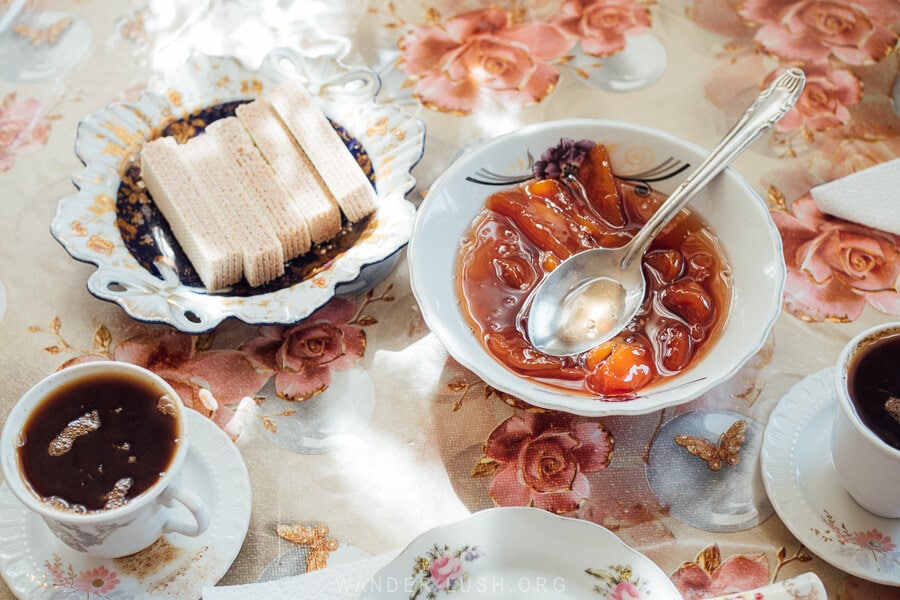
When we returned, the family had laid out coffee, biscuits, homemade muraba jams and sweets on the table. We couldn’t communicate with the Armenian family, and they absolutely refused to accept any payment. It was one of the most touching acts of hospitality I’ve experienced in Georgia.
Tetritskaro
Leaving Samshvilde, the road carries you north through Tetritskaro, a small town with an unexpectedly nostalgic, Soviet-era feel. If you enjoy retro architecture and forgotten art, it’s worth slowing down for a wander.


Broad streets are lined with fading mosaics and friezes, vintage cars sit rusting in yards, and an abandoned medical laboratory adds to the time-capsule atmosphere.
Two large mosaics stand right beside the highway as you enter town – one depicting pastoral farming scenes and grazing deer, the other once framing a map of Georgia and fruit pickers (probably a sign for the local House of Culture?), now partially destroyed.

Along the southern edge of town, the Baku–Tbilisi–Kars Railway slices across the landscape. It’s an impressive piece of infrastructure and I’m still quietly hoping that passenger services finally launch this year.
On a previous trip, we spent the night in Tetritskaro at the cosy Family Hotel Artist’s House, which makes for a lovely base if you want to break up the drive at this point.
Asureti
Just twenty minutes up the road from Samshvilde, Asureti is a perfectly timed lunch stop.
When you arrive in town, head straight for Bahnhof Station, a German-style beer hall and garden set inside a restored railway station. It’s exactly the sort of place you hope to stumble across on a road trip: long wooden tables, decorative steins lining the shelves, shady outdoor seating, and the smell of schnitzel rising from the kitchen. The menu is proudly Bavarian – proper pretzels and cold beer on tap – and I must say the food is very solid.


Like nearby Bolnisi, Asureti has deep German roots. The village was originally founded around the same time by Swabian settlers and was known as Elisabethtal. Winegrowing shaped life here for generations, and the settlement grew into one of the most prosperous German colonies in the South Caucasus before most of the community was deported during the Stalin era.
After lunch, take a short walk around Asureti. The old plan of the settlement is still clearly visible in the neat lanes and half-timbered houses that feel more Baden-Württemberg than Georgia. At the centre stands the Asureti Lutheran Church, a striking kirche built in 1871 and carefully restored in 2017.

The church is no longer active, but stepping inside is still a powerful experience. There is a small photo exhibition on the main floor, showing archival images of old Elisabethtal. Climbing the narrow stairs to the top of the bell tower rewards you with a view down main street.
Knowing that seventy-two German families once called this place home – and that their lives here ended so abruptly – gives the whole village a bittersweet atmosphere. In a strange historical footnote, even Joseph Stalin had a personal connection: his wife, Nadezhda Alliluyeva, was reportedly descended from settlers from this village.


On a previous trip to Asureti, we were lingering outside one of the half-timbered houses when a couple emerged from the gate and waved us over. Leri and Liana insisted we come inside for a look around. They showed us their home, and pointed out objects left behind by the original German owners – a baby’s cradle, a waffle press, delicate glass light fittings.
With their daughter Nino translating, we learned that Leri was born in this house in 1945 after his parents moved here from Racha. Later, Nino even emailed us a bundle of archival photographs and hand-drawn mud maps of the village.

If you have time for a light urbex, there’s an excellent side quest just outside Asureti. A narrow unpaved road behind Bahnhof Station winds six kilometres southeast to the Wine Cellar of the Kolkhoz ‘Success’, the remains of an old Soviet wine factory. Allow at least 60-90 minutes total for the detour.


Established in 1931, Asureti’s old wine cellar now stands completely abandoned, but the bones of the operation are still clearly visible. Walking through, you can almost trace the production line – barn doors open onto a mezzanine level where trucks once reversed in to unload their grapes through holes in the floor.
Below, channels and spouts – each carefully labelled with tank numbers and volumes – carried the juice onward. Beneath the stone building that lies a vast cellar that must have stored barrels or bottles, while a few crumbling offices sit at the back.
Watch your step inside, and keep an eye out for snakes in the tall grass.
Didgori Battle Memorial & Manglisi Sioni
Leaving Asureti, point your car northwest and follow the road as it climbs gently into the hills.
Not far along, you’ll pass signs for Birtvisi Fortress, another dramatic canyon-fortress complex hemmed in by rugged limestone cliffs and sheer rock walls. It was once a favourite wild hiking spot, but in 2025, it was developed into a tourist site and it now carries a steep entrance fee. After the quiet magic of Samshvilde earlier in the day, it’s honestly not worth the stop.
From there, the road unfurls into one of the most beautiful stretches of driving in Georgia: a 30-kilometre ribbon of smooth tarmac that twists through the undulating hills of the Didgori Valley. It bends and curves like it was drawn by hand, rising and dipping with the landscape, each turn revealing another sweep of pasture and sky.
These hills carry enormous historical weight. In 1121, they were the stage for the Battle of Didgori, when King David the Builder defeated the much larger Seljuk army in a victory that liberated Tbilisi and unified Georgia, ushering in the country’s short-lived Golden Age.


You have the option to make a quick stop at Manglisi Sioni Cathedral, which sits near the mouth of the road. Officially known as Manglisi Holy Dormition, the church dates back to the 4th century, making it another of the oldest Orthodox churches in Georgia. The structure you see today was largely developed between the 6th and 7th centuries, and later modified in the 1100s.
Architecturally, its unusual tetraconch plan features four apses embedded in an octagonal form. The church sits in deep shade beneath tall, weeping trees, its stone darkened with age. The carvings and the warm colour of the rock remind me of the cathedrals just over the border in Gyumri.

Climb the road and aim to reach the Didgori Battle Memorial around sunset if you can. I have been here several times now and I think it is most atmospheric at dusk.
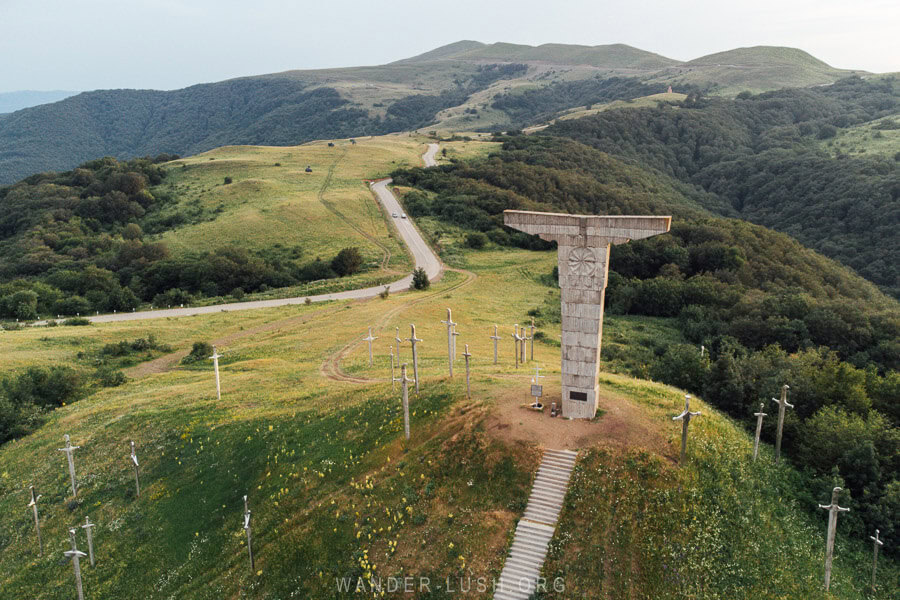
The giant memorial complex is spread across several low hills and includes an amphitheatre, a small church, and a series of monumental sculptures. The main part of the memorial is a vast stone plinth encircled by towering metal sword-crosses that seem to have fallen from heaven.
→ See more photos plus my tips for visiting the Didgori Battle Memorial.

A second monument, known as the Trumpeter Warrior, stands a little further along at the end of a short gravel road on a precipitous cliff edge. If you want to see both, it’s better to visit this one first while there’s still daylight, as it’s not somewhere you’d want to be navigating after dark.

When you’re ready to finish, the drive to Tbilisi is an easy hour or so. Exit Didgori towards Saskhori, then continue via Mtskheta to approach the city from the north, neatly completing the loop.
Visiting Kvemo Kartli without a car
If you don’t want to self-drive, you can hire a private car and driver through GoTrip to follow a similar route from Tbilisi. Here is an example day trip itinerary.
If you want to visit with a guide, this day trip itinerary with Friendly.ge visits several spots in Kvemo Kartli, including Asureti, Didgori, and Tsalka (Dashbashi) Canyon. Use the code wanderlush for a 10% discount.
If you’re on a budget, marshrutkas to Bolnisi leave from the highway in front of Tbilisi’s Samgori Mall (around 6 GEL; late-morning departures). Once in Bolnisi, you can organise a driver/onward transport to the churches, Dmanisi and beyond through your accommodation.


