Why Expats Are Moving to Mexico in Record Numbers Right Now – thetraveler.org
12 min readMexico is experiencing an unprecedented influx of foreign residents, particularly from higher income economies such as the United States and Canada. Recent estimates suggest that well over 1 million foreign-born residents now live in Mexico, with Americans representing the single largest migrant group and accounting for a clear majority of registered foreign residents. Multiple data points indicate that inflows have accelerated since the pandemic period, driven by a combination of structural economic shifts, remote work, lifestyle reassessment, and regional dynamics that have made Mexico one of the most attractive relocation destinations globally.
Scale and Momentum of the Current Expat Influx
Although Mexico’s foreign-born share of the total population remains below 2 percent, the absolute number of expatriates has risen sharply in the last decade and especially since 2020. Mexico’s 2020 census counted roughly 1.2 million foreign-born residents, and more recent compilations of administrative and consular data suggest that the real number, including long-staying visitors and under-registered residents, is significantly higher. Various demographic analyses now converge on estimates of more than 1.5 million US-born citizens alone living in Mexico as of the early 2020s, indicating that Americans are not only the largest foreign community but a rapidly growing one.
Administrative indicators confirm that recent inflows are outpacing historical patterns. Mexican interior ministry statistics and independent analyses show that applications for temporary and permanent resident cards from citizens of developed countries, especially the United States and Canada, more than doubled between 2020 and 2022. One review of government data, for example, found that residence procedures for Canadians increased from the low thousands in 2020 to several times that volume by 2022. By 2024, some consular and relocation advisory sources were reporting year-on-year increases in US citizens formalizing residency of well above 50 percent in key states.
Trends in major urban centers further illustrate this surge. Mexico City, Jalisco (home to Guadalajara and Lake Chapala) and Quintana Roo (Cancun and the Riviera Maya region) have emerged as the primary recipients of new foreign residents. Between 2023 and 2024, these three entities together accounted for the majority of new residence cards issued to US citizens. Even allowing for incomplete or delayed reporting, the directional signal is clear: Mexico has shifted from a niche retirement haven to a major global hub for a wide spectrum of expatriates, including families, professionals, and remote workers.
This momentum is also visible in global rankings of American expatriate destinations. Recent syntheses of US and foreign data suggest that Mexico now hosts roughly one quarter of all Americans living abroad, more than double the estimated American population in Canada and well ahead of any single European country. This concentration underscores how uniquely attractive Mexico has become relative to other destinations with similar levels of development or proximity.
Economic and Currency Fundamentals Attracting Foreign Earners
One of the most powerful drivers behind record expat arrivals in Mexico is the structural gap between incomes earned in hard currencies and local price levels. Professionals, retirees, and remote workers who receive income in US dollars, Canadian dollars, or euros can often achieve a substantially higher standard of living in Mexico than in their origin cities. Surveys and comparative cost-of-living analyses consistently show that everyday expenses in many Mexican cities are markedly lower than in major metropolitan areas in North America or Western Europe, even as Mexico offers comparable access to services, connectivity, and consumer goods in urban cores.
The purchasing power differential has widened in recent years due to inflation dynamics and housing pressures in expats’ home countries. In the United States and Canada, rapid increases in housing costs, healthcare, and urban living expenses since the late 2010s have eroded the real value of middle-class incomes. By contrast, while Mexico has experienced its own inflationary pressures, median rents and service costs in many regions remain significantly below levels seen in major US metropolitan areas. For expats earning abroad, this creates a strong arbitrage incentive to relocate to Mexican cities and towns where their income stretches further in absolute and relative terms.
Currency movements also shape relocation decisions. The Mexican peso has at times appreciated against the US dollar, but in most of the post-2020 period it has traded at levels that still favor foreign earners, particularly those coming from very high-cost markets such as San Francisco, New York, Vancouver, or London. Even moderate fluctuations in the exchange rate have not eliminated the large cost gap for housing, transport, and locally sourced services. This economic environment encourages not only long-term retirees but also mid-career professionals and younger remote workers to consider Mexico a rational base of operations rather than a purely lifestyle-driven choice.
From a macroeconomic standpoint, Mexico’s integration into North American supply chains and steady growth in export-oriented industries further enhance its attractiveness. Stable access to modern financial services, a reasonably deep consumer market, and an expanding middle class mean that expats can often combine a lower personal cost structure with opportunities to invest, run location-independent businesses, or collaborate with local firms. This combination of affordability and economic connectivity is a core reason why current expat inflows are not limited to leisure-oriented retirees but encompass a broader range of income-generating profiles.
Remote Work, Digital Nomadism, and Hybrid Location Strategies
The rapid normalization of remote work since 2020 has fundamentally altered global relocation patterns, and Mexico has been one of the clearest beneficiaries. As employers across North America and Europe accepted fully remote or hybrid arrangements, a growing share of workers gained the flexibility to perform their roles from locations outside their home country. Mexico’s geographic proximity, robust telecommunications infrastructure in major cities, and historically flexible entry regime for visitors staying up to several months positioned it as a natural choice for remote professionals seeking a lower cost base without severing ties to their home labor market.
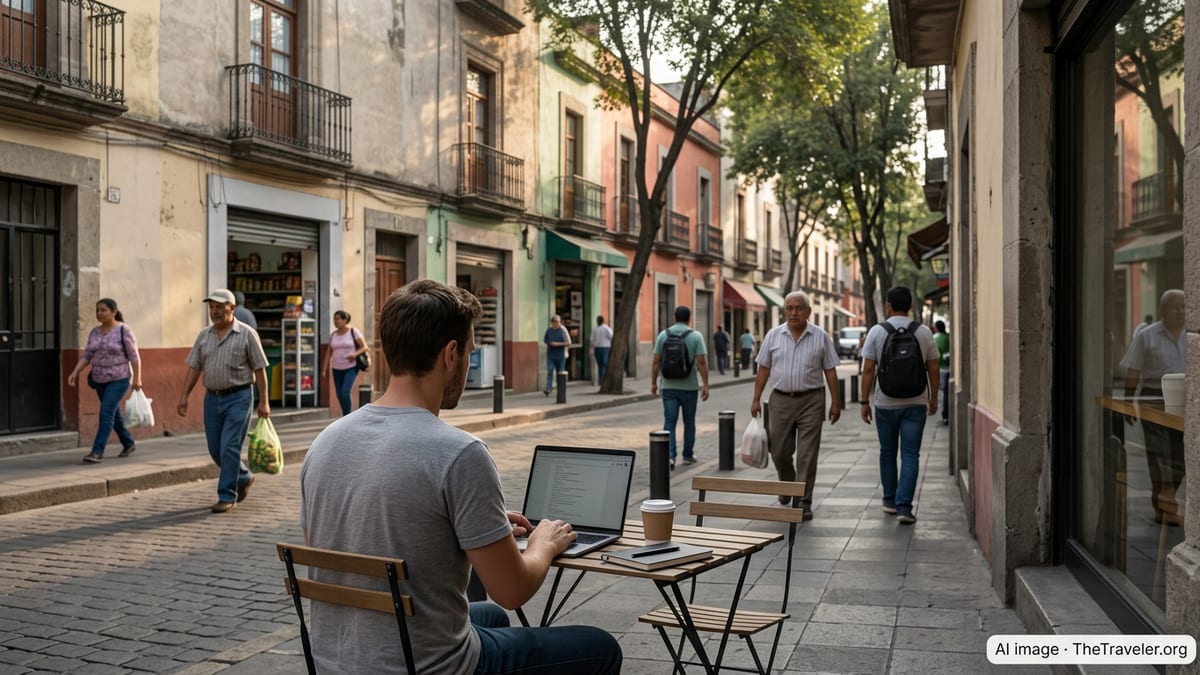
Mexico City in particular has become emblematic of this shift. Since 2020, local housing markets and civic debates have documented a substantial increase in foreign remote workers and so-called digital nomads settling, at least temporarily, in central neighborhoods. Protests and policy discussions in 2024 and 2025 have specifically referenced the influx of Americans working remotely from the capital and the perceived impact on rents and local services. Similar, though often less publicized, patterns can be observed in secondary cities such as Guadalajara and Monterrey, as well as in coastal hubs that blend tourism infrastructure with longer-stay accommodation.
Beyond pure digital nomadism, many expats are pursuing hybrid location strategies that combine periods in Mexico with regular travel back to their home countries. Direct flight connections between Mexican cities and major US and Canadian hubs make it feasible for professionals to attend in-person meetings or family events while maintaining a primary base in Mexico. Remote and hybrid arrangements have effectively decoupled place of residence from place of employment, and Mexico’s time zones aligned with North American business hours give it a structural advantage over more distant or time-shifted destinations.
Companies themselves are also evolving. Some North American and European firms now explicitly allow employees to work from Mexico as part of distributed workforce models, as long as individuals manage their own residency and tax compliance. This policy evolution reduces the career risk associated with relocation and helps normalize Mexico as a mainstream base for knowledge workers rather than a marginal or “gap year” destination. The record numbers of expats moving today therefore reflect not only individual preferences but also systemic shifts in how and where professional work is performed.
Demographic Shifts: Beyond Retirees to Families and Young Professionals
Historically, the stereotypical foreign resident in Mexico was a retiree from the United States or Canada settling in coastal towns or lake regions. While this demographic remains important, recent data and on-the-ground observation indicate a clear diversification of the expat population. Studies drawing on the Mexican National Population Council’s migration yearbooks highlight that a substantial share of US-born residents in Mexico are under 20 years old, particularly in northern border states and certain interior regions. This pattern suggests significant numbers of binational families and return-migrant households who choose to establish long-term residence in Mexico.
At the same time, younger adult expats are arriving in greater numbers than in previous decades. Remote workers in their 20s and 30s are drawn by the interplay of lower living costs, urban amenities, and the possibility of building careers that are less geographically anchored. Some are long-term digital nomads who may ultimately move on to other destinations, but many are using Mexico as a base for several years while they consolidate savings, launch businesses, or pursue creative and professional projects that benefit from cross-border positioning.
Middle-aged professionals and families are also increasingly represented among the new arrivals. For this group, the decision to relocate tends to be driven by a combination of financial pressure in home housing markets, the desire for a perceived slower pace of life, and the feasibility of remote schooling or international education solutions. Because the decision calculus is more complex for families, the growing number of such moves is a strong indicator that Mexico is considered a viable long-term living environment rather than simply a short-term arbitrage.
These demographic shifts matter for policy and planning because they change the types of services and infrastructure that expats demand. Instead of primarily seeking retirement communities, today’s foreign residents are integrating into urban neighborhoods, enrolling children in local or bilingual schools, and participating in local labor and consumer markets in more varied ways. The record levels of immigration are therefore reshaping local demographics and economic patterns in a more multidimensional manner than earlier waves of retirement-focused migration.
Urban Hotspots, Gentrification Pressures, and Policy Responses
The concentration of expats in specific urban neighborhoods has produced visible local effects, particularly in Mexico City. Since 2022, there has been mounting public debate about gentrification linked to foreign residents and digital nomads. In 2024 and 2025, protests in central districts highlighted concerns that an influx of higher-income foreigners paying in dollars or euros was contributing to rapid rent increases and the conversion of long-term housing stock into short-term rentals. Demonstrators and neighborhood groups have argued that some long-time residents are being priced out or pushed to peripheral areas.
Municipal and federal authorities have begun to respond. In 2025, Mexico City’s government announced preliminary plans to regulate rent increases more tightly and to promote lists of “reasonable rental” offers as part of a broader strategy to address affordability. Policymakers are also examining the links between international short-stay platforms, tourism promotion initiatives, and residential displacement. These discussions explicitly reference the role of foreign residents and remote workers, indicating that the scale of recent inflows is sufficient to shape urban policy.
Other regions with high expat concentrations, such as parts of Jalisco and Quintana Roo, face similar though less formalized tensions. Local authorities are under pressure to balance the economic benefits of foreign residents, including spending and investment, against concerns about housing access and cultural displacement for local populations. The fact that expat arrivals are now large enough to trigger such debates underscores how swiftly migration volumes have grown compared with pre-pandemic baselines.
For potential expats evaluating relocation, these dynamics are important for two reasons. First, they signal that local political and regulatory environments may evolve, especially around rental rules and urban development. Second, they highlight that some neighborhoods are in the midst of rapid transition, with potential for both opportunity and friction. Record numbers of foreign residents are not merely joining existing communities but actively transforming them, which can affect long-term livability and integration prospects.
Regional and Geopolitical Context Favoring Mexico
Mexico’s rise as a top expat destination is also shaped by broader regional and geopolitical dynamics. Compared with many other countries that attract foreign residents, Mexico offers a relatively short travel time from major North American cities, limited time zone differences, and dense transport links. For US and Canadian citizens in particular, the psychological and logistical barrier to relocation is much lower than for moves to Europe or Asia. This proximity allows expats to maintain closer family ties and professional networks at home while residing abroad for extended periods.
Shifts in other destinations’ policies further enhance Mexico’s comparative position. Over the past decade, several European and Asian countries have tightened immigration or property purchase rules, raised minimum income thresholds for residency, or increased bureaucratic requirements for long-stay foreigners. While Mexico has its own regulatory framework and enforcement practices, the relative accessibility of establishing legal residence for those who meet income or asset criteria is a key factor behind the current inflow. Some expats explicitly cite the complexity or unpredictability of residency processes elsewhere as a reason for preferring Mexico.
Regional economic integration and nearshoring trends also play a role. As manufacturing and service supply chains reorient toward North America, Mexico’s importance as a production and service hub has grown. International professionals relocating to work with or advise firms engaged in nearshoring projects often choose to base themselves directly in Mexico rather than commuting from abroad. Even for remote workers not directly involved in these sectors, the perception of Mexico as an economically dynamic and strategically important country contributes to its image as a credible long-term base.
Finally, survey evidence indicates that many North Americans evaluating relocation see Mexico as offering a more favorable balance between distance and familiarity compared with other options. Shared media markets, existing migrant communities, and long-standing tourism flows mean that potential movers often feel they understand the country better than more distant alternatives. This familiarity reduces perceived risk and encourages higher relocation volumes, magnifying the effect of the structural drivers described above.
The Takeaway
The record number of expats moving to Mexico reflects a convergence of structural factors rather than a passing trend. Income and price differentials between Mexico and high-cost origin countries, the normalization of remote work, and the country’s proximity to major North American markets have combined to create a powerful incentive for foreign residents to establish medium- and long-term bases there. Administrative statistics on residence permits, estimates of the US-born population, and on-the-ground urban dynamics all point to a sustained upward trajectory in foreign resident numbers since at least 2020.
At the same time, the consequences of this influx are increasingly visible in local debates over housing and gentrification, especially in key urban hubs. Policy responses now under discussion in Mexico City and other regions indicate that authorities recognize both the opportunities and pressures associated with large-scale expat settlement. Potential movers must therefore evaluate not only the personal financial and professional benefits but also the evolving regulatory and social landscape in the neighborhoods they are considering.
For relocation decision makers, the central conclusion is that Mexico has transitioned from a niche retirement choice to a primary global destination for diverse expat profiles. The underlying drivers behind this shift are structural, anchored in economic fundamentals and changes in work organization, which suggests that elevated inflows are likely to persist. While individual circumstances will determine whether a move is appropriate, the macro-level trend is clear: Mexico has become one of the world’s most significant magnets for foreign residents, and this status is unlikely to reverse quickly.
FAQ
Q1. Are more expats moving to Mexico now than in previous decades?
Yes. Multiple data sources indicate that the number of foreign residents, especially from the United States and Canada, has increased significantly since around 2020, outpacing historical growth trends.
Q2. Which nationalities make up the largest expat groups in Mexico today?
US citizens represent the single largest foreign community by a wide margin, followed by other North Americans and smaller but growing groups from Europe, South America, and Asia.
Q3. Are these new arrivals mostly retirees?
No. Retirees remain important, but recent inflows increasingly include remote workers, young professionals, families, and binational households with children who hold foreign citizenship.
Q4. Why is Mexico particularly attractive for remote workers?
Time zones aligned with North American business hours, relatively strong connectivity in major cities, and lower living costs make Mexico a practical base for remote and hybrid professionals.
Q5. Are certain regions receiving more expats than others?
Yes. Mexico City, Jalisco, Quintana Roo, northern border states, and established coastal and lake regions host especially high concentrations of foreign residents.
Q6. How important is the cost-of-living gap in driving expat moves?
It is a central factor. People earning in stronger currencies often find that housing and everyday expenses are substantially more affordable in Mexico than in major cities in their home countries.
Q7. Is the current expat influx causing gentrification in Mexican cities?
In some neighborhoods, particularly in Mexico City, the arrival of higher-income foreign residents and remote workers has been linked to rising rents and local concerns about displacement.
Q8. Are Mexican authorities changing policies in response to rising expat numbers?
Yes. Mexico City, for example, has begun discussing rent regulation and related housing measures that explicitly reference the impact of tourism and foreign residents on affordability.
Q9. Is Mexico likely to remain a top expat destination in the coming years?
Given structural drivers such as remote work, regional integration, and cost differentials, Mexico is likely to remain one of the leading global destinations for foreign residents.
Q10. What types of expats are best positioned to benefit from relocating to Mexico?
Those with stable income in foreign currency, flexibility to work remotely or retire abroad, and willingness to adapt to a different regulatory and cultural environment are generally best positioned to benefit.


