Visit Kakheti: The Best Things to Do in Georgia’s Wine Region With a 3-Day Kakheti Itinerary
37 min readThe most comprehensive guide to visiting Kakheti currently available online. Here is absolutely everything you need to know to sip, savour and sightsee your way around Georgia’s premier wine region, including the best Kakheti wineries, monasteries, and things to do in Sighnaghi, Telavi, and beyond.
Whether you’re an aspiring sommelier or an unapologetic beer drinker, raising a toast in Kakheti – Georgia’s main wine region – is an essential part of any good Caucasus itinerary.
In Georgia, viniculture is as old as the hills. The 8000-year-old practice of making wine in clay vessels called qvevri is recognised by UNESCO, and unlike any other wine culture you’ve experienced before.

Kakheti is one of the most popular places to visit in Georgia, and for good reason. It’s not the country’s only wine region, but it is the most productive. The sheer number of commercial wineries, family marani cellars and wine-producing monasteries makes the Kakheti Wine Route the best place to sample the width and breadth of Georgia’s wine industry.
I have visited Kakheti more times than I can count. This guide brings together all my favourite parts of the wine region, organised into an efficient 1-3 day itinerary.
As well as vineyards and churches, it covers Kakheti’s most charming cities and towns, Soviet-era throwbacks, and plenty of hidden gems.
Please note: This post contains affiliate links, meaning I may earn a commission if you make a purchase by clicking a link (at no extra cost to you). Learn more.
Only have time for a Kakheti day trip? Eat This! Tours is my preferred provider for wine tours in Kakheti. They offer a number of excellent pre-designed itineraries that focus on small family wineries and authentic experiences. Many of their local guides are trained sommeliers – so if you want an in-depth wine experience, this is it. Browse day trips and multi-day tours here and use the coupon code wanderlush to get 5% off.


Briefly about Kakheti wine region
Kakheti is Georgia’s biggest region by area, taking in the entire eastern part of the country. The landscape and climate varies dramatically from the high mountains of Tusheti in the north to the semi-desert landscapes of Udabno and Vashlovani in the south.
In between, the Alazani River and its wide valley cut through from north to south, carving out dozens of different microclimates that provide the perfect conditions for cultivating grapes.
Georgia has more than 500 endemic grape varieties in total, many of which grow (or once grew) in fertile Kakheti. Today, it remains Georgia’s most productive wine region, responsible for around 70% of the nation’s annual harvest.
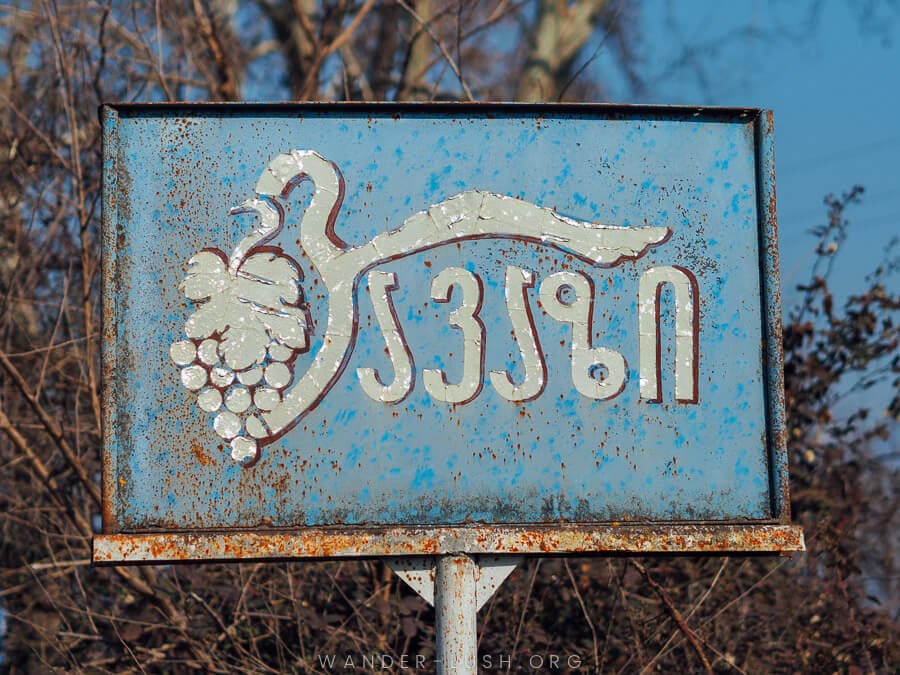
Archaeological evidence dates Georgia’s winemaking traditions back to the 6th millennium BC, predating the earliest wine production in France by more than 5,000 years. Wineries in Kakheti continue to live out this legacy.
These vary from tiny family operations that stick to time-honoured natural winemaking methods, all the way through to large commercial wineries that employ a mix of qvevri and ‘European’ techniques.


Aside from vineyards, Kakheti is known for its medieval monasteries and hilltop churches, many of which date back to the 5th or 6th century when Kakheti was its own self-governed kingdom. Wine cellars feature prominently in some of the oldest and most revered, including Alaverdi and the cave monasteries of David Gareja in southern Kakheti. Wine and religion are closely intertwined, with many vintages bottled by monks.
Winemaking, toasting and drinking are all tied inextricably to history, folklore, and religion. When you visit Kakheti, not only do you get to taste Georgian wine, you also get to immerse yourself completely in these cultural elements. This makes Kakheti a must-visit in my books – even for non-drinkers!
Some travellers only have time for a quick day trip from Tbilisi to Kakheti. If your Georgia itinerary allows, I highly recommend a longer sojourn in wine country. Three days is the perfect amount of time for the highlights.
Planning to visit Kakheti? Don’t miss my other guides for the region:


Top 10 things to do in Kakheti
1. Drink qvevri wine at a family Marani
The most intimate and memorable wine experiences usually happen at family run cellars, where production is small-scale and knowledge is passed down from generation to generation. I have included some of my favourite maranis in the Kakheti itinerary below. Here is an extended list.
→ Check out my Tbilisi Wine Guide for the best wine tastings, bars & bottle shops in the capital.
2. Tour the ‘wine tunnel’ at Khareba
On the opposite side of the spectrum are Kakheti’s commercial wineries. These are much slicker operations (and thus more touristy and expensive as a result), but that doesn’t mean you should necessarily skip them. Khareba is my favourite: It features a gigantic, cave-like ‘wine tunnel’ cut from a rocky slope in the foothills of the Greater Caucasus.
3. Climb the old walls in Sighnaghi
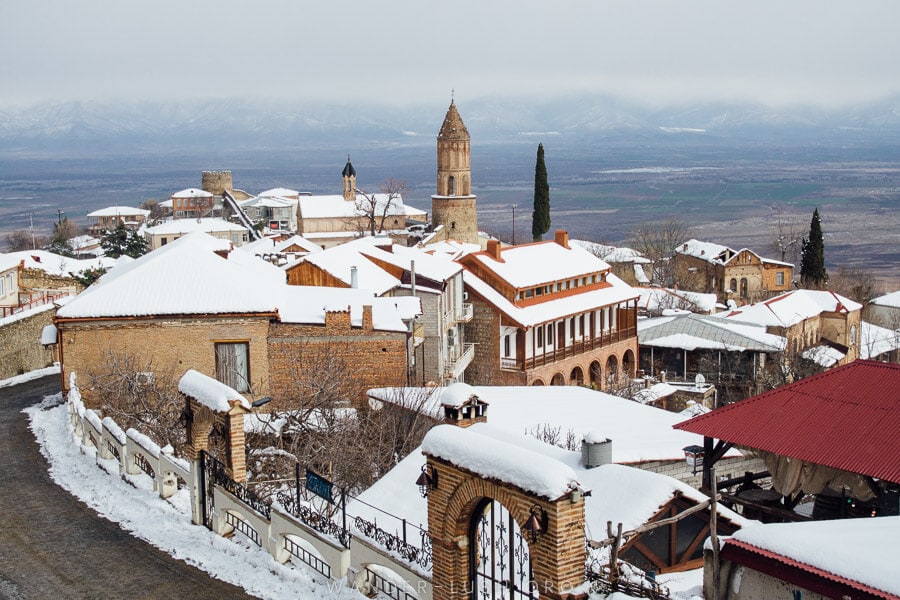
With its cobble streets and carved balconies, fortified Sighnaghi is one of the prettiest little towns in Georgia. Climbing Sighnaghi’s City Walls for panoramic views of the Alazani Valley is a highlight of any visit to Kakheti.
4. Visit the magnificent monasteries of Alaverdi, Ikalto & Dzveli Shuamta
This trio of monasteries are among Georgia’s most important. Each one has a long history, and a spectacular location.
5. And the hilltop churches of Gremi & Nekresi
Perched way up in the foothills along the northern side of the valley, these two landmarks cut an impressive figure when viewed from below and command epic views from the top.

6. Spend a night on the vineyard
Many commercial and family vineyards in Kakheti provide guest accommodation, so you can rest your head amongst the grapes. A few of the region’s heritage wine estates, including Vazisubani and Tsinandali, have been transformed into five-star hotels. It’s worth the splurge!
7. Walk the grounds of Bodbe St. Nino’s Convent
One of my favourite religious complexes in all of Georgia, Bodbe Convent is located a short walk from Sighnaghi. The valley views and the artfully manicured gardens are what sets it apart.
8. Get lost in the Telavi Bazaar
Kakheti’s biggest city is home to a roaring produce market that is great fun to explore.

9. Search for Soviet relics
When Georgia was part of the USSR, Kakheti became the site of industrial-level wine production. Factories such as the Red Cellar were built, and entire towns and small cities, including Gurjaani, were raised to accommodate workers and their families. If you are interested in Soviet history and architecture from this period, you will find lots of interesting mosaics and monuments around the place.
10. Taste Kakhetian specialty foods
Kakhetian cuisine is known for being simple yet hardy, and features plenty of mtsvadi (BBQ) – sometimes skewered on grape vines – and fresh, vibrant vegetable dishes. Snacks such as churchkhela (nuts dipped in grape juice roux) and tklapi (fruit leather) are synonymous with Kakheti. Fruits, preserves and other grape-related specialities are often paired with artisanal cheese for boards that accompany wine tastings.
Kakheti travel guide
Here are a few practical tips for planning a visit to Kakheti.
Best time to visit Kakheti
I have been lucky enough to visit Kakheti during every season.
In summer, the vines are heavy with beautiful grapes – but it’s blistering hot, and the sky can be very hazy. It gets crowded in Sighnaghi and at some wineries, particularly on summer weekends.
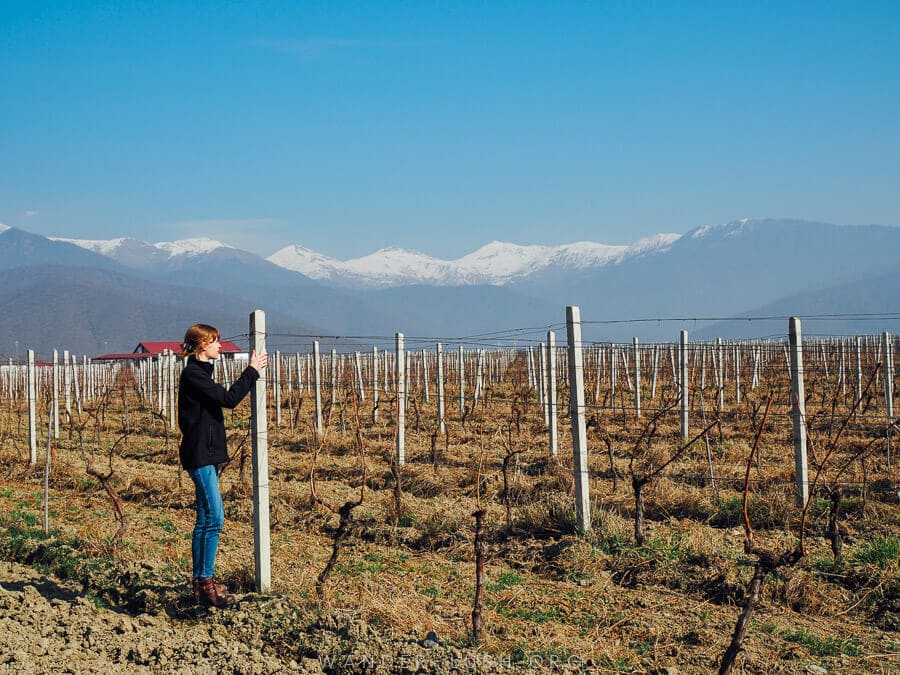
Spring in Kakheti (especially late April/May) is usually very pleasant, with milder temperatures and peach blossoms aplenty. The grape vines are budding, wineries are opening up for the season, and the landscape is nice and green. It’s much less crowded around this time compared with summer.
Winter in Kakheti is a different kind of magic. Tourists are scarce, you get crystal-clear views of the Greater Caucasus, and if you’re lucky, you’ll get to see Sighnaghi beneath a blanket of snow. On the flip side, some wineries might not be operating.
Should you visit Kakheti for the wine harvest?
The most atmospheric time of year in Kakheti is fall when the Rtveli wine vintage takes place. This usually occurs between late September and early October – but the exact dates vary from year to year, and from vineyard to vineyard.
Winemakers only have a very short window to harvest their grapes (2-3 days max). This is the busiest weekend of the year, and it’s all hands on deck to get the job done. Many vineyards close to tourists as a result. Some are open for Rtveli experiences, but only if you book a special package. See your options here in my Rtveli Event Guide.
The ideal option is to join a family on their private vineyard and help out with picking and even pressing the grapes the old-fashioned way in a wooden trough.

The timing of the harvest is tricky to predict as it changes from year to year depending on various factors including the weather. Sometimes the final dates are only decided a week or two in advance.
Winemaking is a year-round pursuit, and there’s something interesting to observe on the vineyard no matter the season. In spring, you can crack a qvevri to taste the new season wines, and in winter, you can see how the vines are pruned.


How to get to Kakheti from Tbilisi
Kakheti is a quick trip from Tbilisi. Travelling by car, it takes 1.5-2 hours to reach Sighnaghi from the city, and just under two hours to reach Telavi. Travel times are coming down all the time as the Kakheti Highway undergoes improvements.
Since there are places to stop en route (see Day One below), my preferred way to travel to Sighnaghi is with a private transfer booked through GoTrip. If you’re on a budget, marshrutka vans or shared taxis are perfectly acceptable.
→ See my Tbilisi to Sighnaghi transport guide for bus schedules, fares, and detailed information about getting to and from Kakheti.
How to move around Kakheti
The Alazani Valley is a sprawling area, and the points of interest mentioned here are quite spread out. It is therefore ideal to visit Kakheti with a car.
While self-driving gives you the most flexibility, note that Georgia has a relatively strict policy on drink driving (0.03 BAC compared to 0.08 in the United States, for example). Free pouring is the philosophy at wineries, so you will need a designated driver.
If you want to participate in tastings, the most convenient option is to hire a private driver for the day. This can be organised through your guesthouse once you arrive, and should cost around 70-100 GEL per person for a full day depending on the route and how many people you have (you can save by pairing up with other travellers).
Normally it will either be someone from the family, a relative or a friend behind the wheel. There is some flexibility to choose your stops, but normally the driver will have an agreement with a couple of wineries and take you on a predetermined route.
If you want more flexibility to choose your start time and visit wineries and monasteries that are off the stock-standard trail, then you’re better off finding a driver independently. I recommend hiring a car through GoTrip for the day. You can stop as often as you like, wherever you like, without the set price going up.
Taxi apps such as Bolt work in larger cities such as Telavi, but the cohort of drivers is quite small.
→ Read my review of GoTrip and start building your personalised Kakheti road trip itinerary.

Where to stay in Kakheti
Sighnaghi and Telavi are the most popular places to base a visit to the wine region. Both have a good range of accommodations at different price points, plenty of restaurants, and conveniences such as supermarkets.
Telavi is my personal preference. This largest city has more restaurants and wine bars, and since there is a large bus station in Telavi, better transport connections too. Moreover, Telavi is better positioned within the valley for sightseeing. Sighnaghi sits on top of a hill, meaning you have to travel at least 20 minutes before you reach the closest vineyards. Telavi is surrounded by vineyards, and is in closer proximity to the area’s must-see monasteries.
If you want the romance of the walled town and you don’t mind staying somewhere quite touristy, then Sighnaghi is a great choice. If you want something with a more local vibe, consider Telavi.
Another option is to stay on a vineyard or at a heritage wine chateau somewhere between Sighnaghi and Telavi. I highly recommend you spend at least one night on the vineyard if you have time. The 5-star Radisson Tsinandali is a bit of a splurge, but absolutely worth it.


→ My detailed guide to where to stay in Kakheti includes a breakdown of the different areas and accommodation options for every budget.
Here are quick links to my favourite hotels in Kakheti:
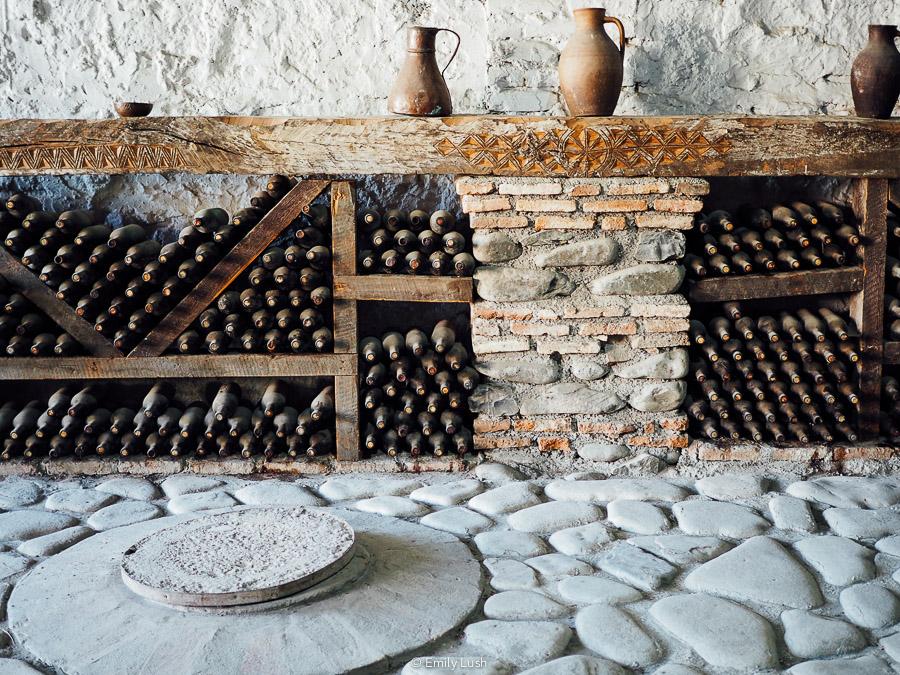
Tips for visiting vineyards for a Kakheti wine tasting
Kakheti’s winery offering are quite diverse, and the experience differs depending on the size and type of operation.
Larger commercial wineries (Khareba, Kindzmarauli, Shumi, etc.) are equipped for tourism and able to accept walk-ins and groups without an advance booking. They typically charge a fee (30-50 GEL) for a tour of the facilities and a tasting of 3-4 wines. Though more touristy and less personal, it’s still a fun experience. On a handful of occasions, I have visited mid-sized wineries where the tasting was complimentary, but the expectation to buy a bottle at the end was quite intense.
Smaller family wineries are less formal and less likely to take walk-ins. You should therefore give them at least 1-2 days notice if you plan to visit. English might not be spoken, and without a guide to interpret, it can be tricker to understand what’s going on. But the language of wine usually wins in the end, and the experience is more rewarding.

What to wear & bring with you
When you’re out winery-hopping, it’s essential to bring drinking water and snacks with you as there won’t always be time to stop. If you’re going to be outside in the vineyards, sitting on an outdoor terrace or just walking through monastery grounds, sun protection gear is necessary no matter the season. A light jacket or scarf also comes in handy as some cellars (especially Khareba) are quite chilly inside.
The church dress code is strictly enforced in rural Kakheti, so remember to wear long trousers, cover your shoulders, and have a lightweight scarf to cover your hair (ladies). Wrap-around skirts and headscarves are available at the entrance to every church/monastery if you need to borrow one.
→ Check my Georgia packing list for more recommendations on what to wear in Tbilisi and Georgia.

Things to do in Sighnaghi, Telavi & beyond: Suggested Kakheti itinerary
Three full days in Kakheti is the ideal amount of time for a slower-paced exploration of the wine route. You could easily condense this itinerary into one or two days, moving at a faster pace and sacrificing some stops.
My Kakheti itinerary starts in Sighnaghi, which is easy to access from Tbilisi, and ends in Telavi, a more convenient transport hub with onward connections to other parts of Kakheti beyond the wine region, including Tusheti, Pankisi Valley, and Lagodekhi National Park.
Day 1: Sighnaghi + stops on the Kakheti Highway – Overnight in Sighnaghi
Day 2: Gurjaani + eastern Alazani wineries & monasteries – Overnight in Telavi or Tsinandali
Day 3: Telavi + western Alazani wineries & monasteries – Overnight in Telavi
Day 4: Return to Tbilisi via the Gombori Pass
This itinerary is designed as a loop, so you don’t have to backtrack too much or repeat the same roads. You can easily reverse it to start in Telavi and finish in Sighnaghi, entering Kakheti via the Gombori Pass.
It’s not possible to fit in everything I’ve mentioned here, so I’ve used this key to help you be more selective:
*** – Don’t skip it
** – Worth seeing
* – Only if you have time
Day 1: Sighnaghi
If you’re coming from Tbilisi via the Kakheti Highway (recommended if you’re spending your first night in Sighnaghi), then you can start your wine adventure as soon as you enter the region.
Ninotsminda, Sagarejo & Manavi
Most wineries along the Kakheti Highway are very commercial, but there are a couple of good ones before you reach Sighnaghi, including Giuaani Winery in Manavi village. This family winery has particularly lovely grounds and friendly, knowledgeable staff. Tour and tasting packages start from 35 GEL per person – see the full program here. The restaurant here is also very good.
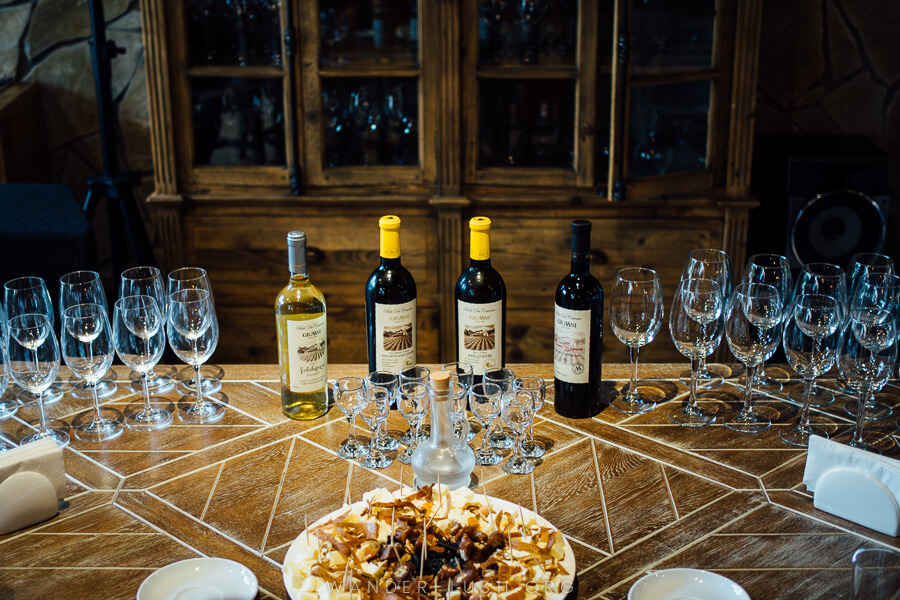
I also recommend making a short detour to Ninotsminda Cathedral in the town of Sagarejo. The complex comprises the ruins of an impressive cathedral (partially eroded frescoes still intact), and a tiny chapel with a wood-burning stove in the corner.

If you’re into Soviet history, you might also want to stop at the abandoned wine factory in Sagarejo. The building is boarded up, but there are some lovely relief sculptures that you can see on the front facade.

Nukriani
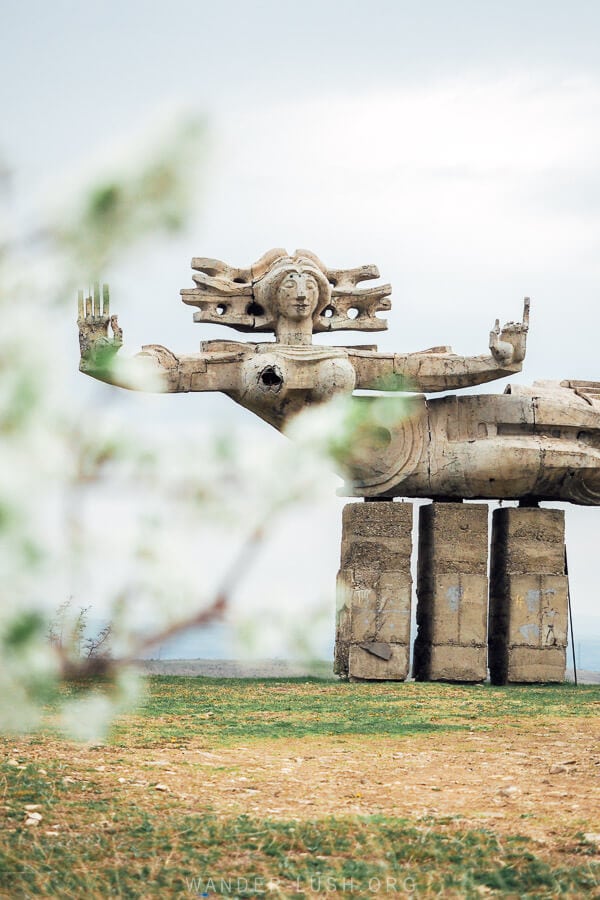
Nukriani village is located just after the turn-off for Sighnaghi. Once you pass through the Gate of Kiziqi, you will see a wooded picnic area on the side of the road. Stop here for a quick walk out to the plateau to view the incredible sculpture Peace by Nugzar Manjaparashvili. The very-Soviet 1970s artwork might be a bit worse for wear, but it is still one of the most impressive sculptures I have ever seen in my life.

Nearby, the popular Dergi Restaurant, run by Georgian celebrity chef Levan Kobiashvili, is perfect for a bite to eat before you arrive in Sighnaghi proper. This place is famous for its khinkali dumplings and I can confirm that they are very good!


If it’s the right season (late spring/early summer), you could also consider stopping off at the Nukriani Lavender Farm to frolic in the fields. Back towards Tbilisi, the Sartichala sunflower fields are home to another famous Kakhetian crop: sunflowers used for making cold-pressed Kakhetian oil.
Sighnaghi
Check into your accommodation and spend the rest of your first day in Kakheti sightseeing in Sighnaghi town. There is plenty to do within walking distance of the centre.

*** Climb the tower at St. Stephen’s for a view of Sighnaghi
From its hilltop perch, Sighnaghi overlooks the patchwork fields of the Alazani Valley, and the snowy peaks of the Greater Caucasus. The best vantages reveal the valley landscape and mountains with Sighnaghi’s red rooftops and bell tower in the foreground.
Popular viewpoints in the centre of Sighnaghi include:
- The terrace behind the National Museum
- The Tea Lounge at Bodbe Hotel (pictured below)
- The fork in the road at Lolashvili Street
- The terraced restaurants at the top of Lolashvili Street
- The road to Bodbe Monastery
- The tower adjacent to St. Stephen Church (also see below)

The best views of all (in my opinion) are from this lesser-visited bastion (part of the Sighnaghi City Wall – more below) in the upper part of town. With some careful footwork, you can manoeuvre onto the roof for a photo.
To find the tower, follow the street up to Burji, then take the narrow iron staircase in front of the restaurant. Enter through the church gate, and move to the back of the complex to access the tower and roof. Entrance is only during church opening hours (from approximately 9am until sunset), and costs 1 GEL.

** See the Pirosmani paintings at the Sighnaghi National Museum
Founded in 1947, Sighnaghi’s local museum is worth a walk through if only to view the large collection of paintings by Niko Pirosmani. Georgia’s national artist was born in the village of Mirzaani near Sighnaghi, and many of his works are inspired by the landscapes around Kakheti, and traditions and themes related to wine country.

There are about a dozen Pirosmani canvases hanging in the gallery, including a panoramic scene from the Rtveli wine harvest. More of Nikala’s works can be seen at various galleries in Tbilisi.
An archaeological exhibition on the ground floor of the Sighnaghi Museum showcases ethnographic objects and coins, and is also worth a quick look. Before you leave the museum, walk out to the east-facing terrace at the back of the building for another breathtaking view of the town.
The museum is open from 10am-5.30pm Tuesday to Sunday (closed on Mondays). Entrance costs 30 GEL.

** WWII Memorial
Directly outside the museum, a huge Soviet-style WWII Memorial depicts battle scenes and winemaking traditions side by side, with vignettes of Sighnaghi town and inscriptions of the names of soldiers from the Sighnaghi Municipality who lost their lives in the Great Patriotic War.
Find it inside the park.

*** Bodbe Convent & St. Nino’s Spring
Bodbe Convent is a 3-kilometre walk or a 10-minute taxi ride from the museum. There are often big tour buses on the narrow road, which means it’s not so pleasant for pedestrians. But if you do go on foot, you will be treated to spectacular views of Sighnaghi’s red rooftops and city walls along the way.
Founded in the 9th century, Bodbe probably has the best-kept grounds of any monastery I’ve visited in Georgia. When I mentioned this to a Georgian friend, she told me the reason: It’s nuns, not monks, who live here and are responsible for tending the gardens. A woman’s touch!


Once you’ve admired the chapel where Georgia’s beloved St. Nino is interred, seen the new church and admired the meticulously tended flower beds, follow the steps down to St. Nino’s Spring, where believers kick off their boots to bathe in the holy water. It takes around 20 minutes to reach the spring and stone chapel on foot, walking along a beautifully forested pilgrim’s path.
The Monastery of St. Nino is open daily from 10am until 6.30pm.


* Craft beer tasting at Lost Ridge
Located close to Bodbe Monastery in Qedeli, Lost Ridge is a horse ranch and boutique inn with an onsite restaurant and craft brewery. The property is set high on the ridge overlooking the valley, and incorporates the ruins of several brick houses that were abandoned in the 1990s.
If you’re into beer, I highly recommend stopping off for a short tour of Lost Ridge’s micro brewery and a tasting. Bottled under the name Svia, the beer here is brewed with seasonal Georgian fruits and local botanicals.


The kitchen at Lost Ridge serves delicious rustic meals made from garden-fresh ingredients. There is no menu as such, but rather the talented ladies here whip up creative meals using whatever produce is available and in season. If you’re looking for an early dinner option rather than eating back in town, it’s really lovely to eat under the Linden tree overlooking the valley.
And finally, if horse riding is on your agenda for Georgia, Lost Ridge is one of the best (i.e. most ethical/professional) places in the country for that, too. Short and full-day rides around the valley accompanied by English-speaking guides can be arranged.
Lost Ridge is open every day. Advance bookings for all of the above are essential.


*** Photograph the Sighnaghi City Gate
Sighnaghi town is filled with cute brick houses, wooden balconies, and intriguing statues.
As you wander back through the town, a good place to aim for is the City Gate – one of six arched openings in the 4.5-kilometre-long Sighnaghi Wall. There are various places where you can climb onto the ramparts for a view, but I recommend saving this for sunset (more below).
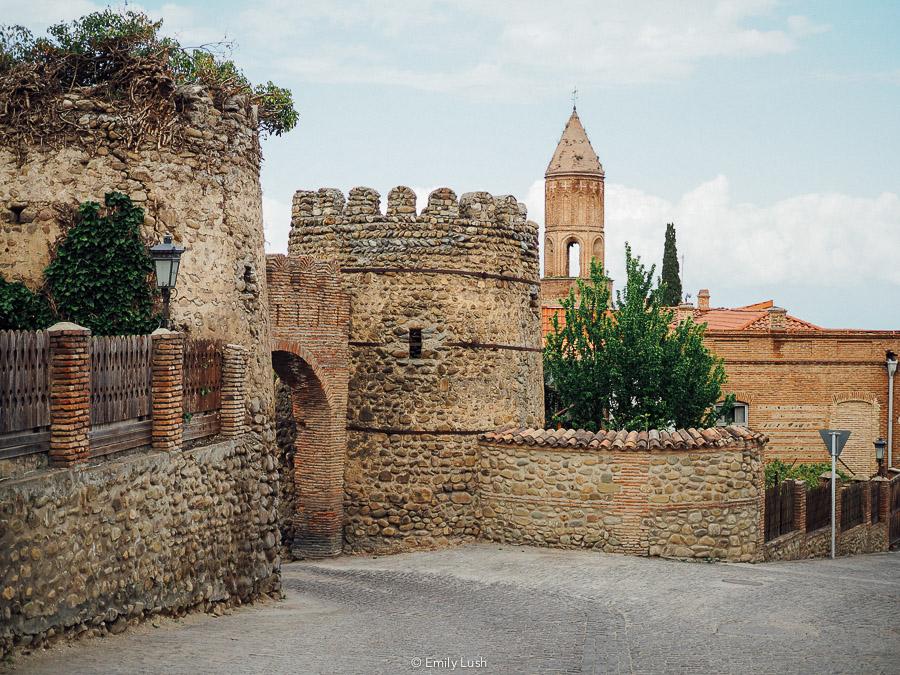
On the cobbled streets around the gate, you’ll find little shops selling chunky wool socks and other cute Georgian souvenirs. The knitting ladies sit out front clicking their needles, and are more than happy to pose for a photo.

*** Walk the Sighnaghi City Walls at sunset
Sighnaghi is encased by stone walls that were erected to fortify the trading town. You can safely climb up onto the wall at this point and teeter along the top for views of the low-lying town of Tsnori and the valley basin.
Sunset is the perfect time to walk the Sighnaghi Walls. There are far fewer people around, and the golden light illuminating the brickwork is gorgeous.

*** Wine degustation at Kerovani
There are several small and medium-sized cellars in the centre of Sighnaghi that offer sit-down qvevri wine tastings, and wine by the glass. My pick of the bunch is Kerovani.
Call ahead to book in a short tour of the cellar with winemaker Archil Natsvlishvili.. After the walk-around, you can sit on the family’s balcony and order a three-wine degustation or wine by the glass. The Simonaseuli, a rich, full-bodied red wine made from a rare grape, is my pick.


*** Dinner at Pheasant’s Tears
If you haven’t eaten yet, start with lunch at Pheasant’s Tears, a longstanding restaurant in the centre of Sighnaghi operated by John Wurdeman of the homonymous natural wine label. Plates here are rustic and rootsy, artfully prepared from local and seasonal produce, and accompanied with wine by the glass or bottle.
Both the large dining room and terrace fill up fast (especially on weekends), so I recommend making a reservation.


Extend your time in Sighnaghi: If you have the time, there is a lot more to see in the vicinity of Sighnaghi and to the south, including Tsnori, the Bodbiskhevi Sunday Bazar, the Arboshiki WWII Memorial, and Machkhaani village. Find a shortlist of my favourite off-beat locations in this Alternative Sighnaghi Guide.
Day 2: Gurjaani + Eastern Alazani Valley
On the second day of your Kakheti adventure, leave the hilltop town of Sighnaghi behind, and delve into the Alazani Valley.
I suggest you start by crossing the river to visit the iconic wineries and monasteries on the eastern side of the river. On the way down from Sighnaghi, you will pass through the small city of Gurjaani. If Soviet-era monuments and quirky museums are your thing, it’s worth stopping here for an hour or two.
At the end of the day, cross back to the western side of the valley and spend the night in either Telavi city (which you can then explore the following morning on Day 3), or at the Tsinandali Estate just outside Telavi.
Gurjaani
Gurjaani is a small city 40 minutes from Sighnaghi on the Alazani River Plain. Though not an essential stop, it’s a great place to spend an hour before the wineries further down the valley open their doors.
During Soviet times, Gurjaani was a busy industrial town with a wine factory, canning facility and brick-making plant. It was – and still is – home to the single biggest wine factory in Georgia.
Reminders of the Soviet period live on in the many memorials and mosaics around town, while the nearby Akhtala volcanic mud baths still attract visitors for balneotherapy treatments. There are several epic street art murals in Gurjaani, too.

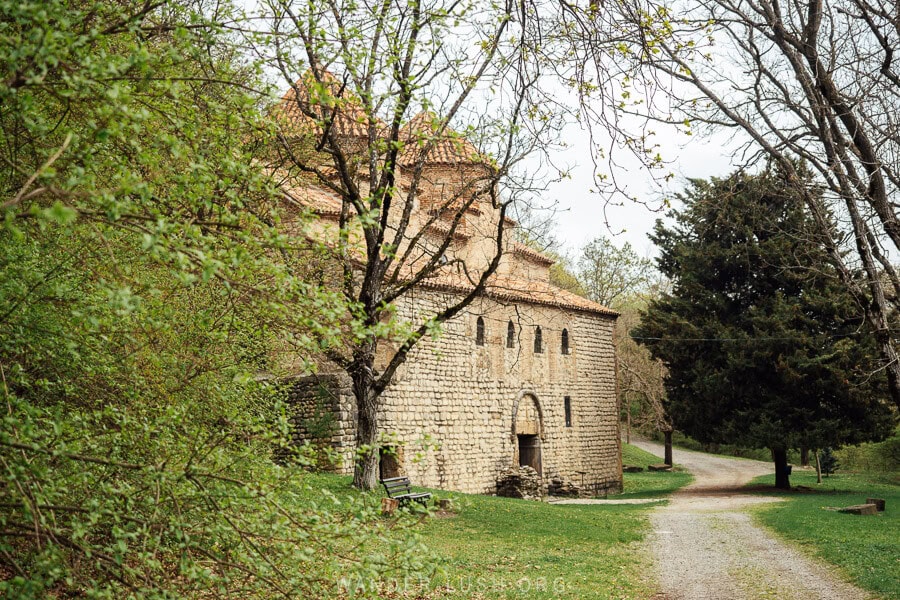
** Gurjaani Kvelatsminda
Built in the 8th or 9th century, this is the only church in Georgia with a double-dome design. It was restored in 2010 after being ransacked by Persian and Dagestani invaders in the 17th century then lying abandoned for many decades.
The church is nestled in a forest back from the road and reached via a very pleasant shaded path. The walk is a lovely way to start your morning. At the entrance you’ll find a church shop selling handicrafts and local honey.
** Gurjaani bus stop mosaic
The wrap-around mosaic that decorates a shopping complex and bus station in Gurjaani is one of the finest in the wine region. It depicts typical wine harvest scenes, folk instruments, and dance.
The mosaic was completed in 1985 and is the work of Leonardo Shengeli and Enriko Kopadze. Unfortunately, the left-hand panel is now obscured by another building, but the front part of the mosaic is fully visible and in good condition.
If you skipped your morning coffee, there is a small coffee shop on the far right.

* Soldier’s Father Monument, the Memorial of Glory & Museum
Another 1970s throwback, the Gurjaani Glory Memorial Museum is a huge outdoor amphitheatre-cum-war memorial with a detailed Soviet-style frieze, an indoor exhibition hall, and an ‘Eternity Wall’ that bears the names of the 4,000 Gurjaani locals who lost their lives in WWII.


A larger-than-life sculpture by Merab Berdzenishvili titled Statue of Soldier’s Father overlooks the hilltop complex.
If you’re lucky enough to find the museum open (officially from 10am-6pm Tuesday to Sunday), then it is worth paying the 3 GEL entry fee to see the exhibition of canvases, old canvases and war memorabilia inside.


Velistsikhe/Vazisubani
Another 15 minutes up the road from Gurjaani, villages Velistsikhe and Vazisubani are located before the turn-off to cross the river valley into Kvareli.
** Numisi Cellar Museum
Numisi offers tours and wine tastings in their heritage cellar, which doubles as a museum. An old limestone wine press, a collection of clay qvevri and pitchers, wine-making equipment and other curiosities are on display. Host Nunu is quite a character!
Bookings are recommended.


** Vakho Oqruashvili Wine Cellar
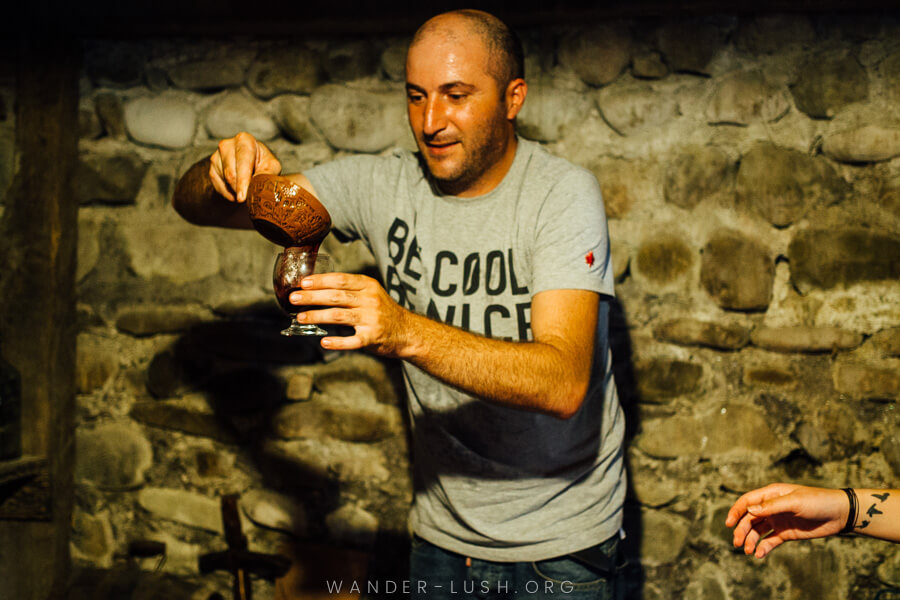
One of my favourite small cellars in Kakheti, Vakho’s winery offers tastings of qvevri wine and sit-down meals on the family’s home veranda. You can see how the grapes are funnelled from the garden into the cellar, and Vakho will serve you new-season wine straight from the qvevri in clay drinking bowls.
Bookings are essential.
* Chateau Zegaani
Built in 1820 in the Mukuzani micro-region, the Chateau Zegaani heritage estate produces all-natural wines. Tours of the vineyards and wine tastings are available with advance notice. The main house – a sprawling stone number with a Hogwarts-style dining room – is extremely impressive.
* Vazisubani Estate
Set in a restored 19th century palace, the former residence of Sulkhan Chavchavdze, Vazisubani Estate houses boutique suites alongside a farm-to-table restaurant, cellar and outdoor pool. Wine tours and pairings are available year-round and in summer, the property is known for hosting lavish lunches in the vineyard. We recently stayed here for a night and really enjoyed the experience.


Extend your time in Gurjaani: There is plenty more to do in Gurjaani Municipality, particularly if you’re interested in Soviet-era city planning, architecture and mosaics. The Akhtala Mud Baths were recently renovated and a treatment here could be a fun experience! For more things to do in Gurjaani, see my full guide.
Kvareli
Kvareli is a larger town on the opposite side of the river, 30 minutes by car from Gurjaani. Crossing the valley via the perfectly straight, tree-lined road is magical. As you head for the foothills of the Caucasus mountains, you get incredible views of the range on the horizon.

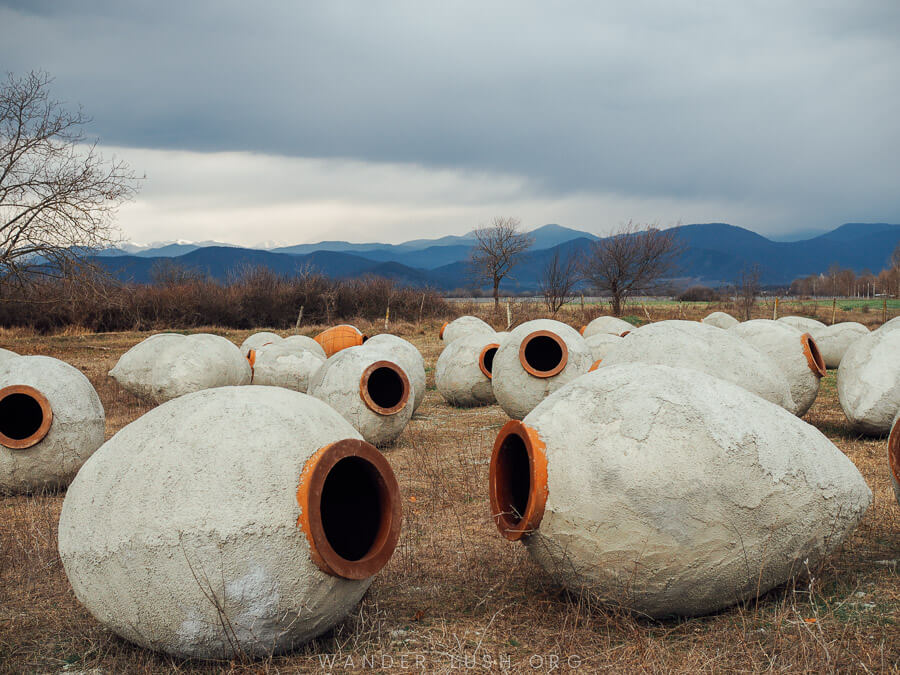
There are vast vineyards all through the river basin where you can stop for an up-close look at the vines. You might even see a qvevri farm!
*** Winery Khareba (Kvareli Wine Cave)
Located in Kvareli, Khareba is one of the largest commercial cellars in Kakheti. Yes, it’s touristy and usually busy – but the scale is awesome, and the guides are very professional. I always bring friends and family here when they are visiting me in Georgia.
The wine cellar here isn’t exactly underground, but rather it’s hewn vertically from the rocky Caucasus mountainside. Interconnecting tunnels total 7.7 kilometres in length, and store more than 25,000 bottles of wine. Temperatures sit at 12-14 Celsius year-round, making it the perfect natural fridge.
I was once told that the tunnels were originally intended to serve as a bomb shelter, but since the Cold War finished before construction did, they were co-opted for storing the community’s wine instead. But I’m not sure if that’s true! I do know that the same machinery used for carving out the Tbilisi Metro network was deployed here, so the tunnels have identical dimensions.
Reservations are not required at Khareba and walk-ins are welcome, but I recommend calling ahead to confirm opening hours outside of summer season. Normally it’s 10am-8pm. Tour and tasting packages start from 35 GEL or 10 GEL for non-drinkers.


** Kindzmarauli
Also in Kvareli, Kindzmarauli is another large commercial winery that runs a very slick operation. Small group tours start with a walk through the wine-making and bottling process, and finish with a sit-down tasting of 3-5 wines. The grounds of the winery back onto Kvareli Fortress, and parts of the walls are visible from inside.
The cellar is open from 8am on weekdays, and tastings start from 20 GEL per person. They also have a new restaurant where you can enjoy an outdoor lunch. Bookings for the wine tasting are not essential, but consider calling ahead to confirm.

* Kvareli architecture & museums
Beyond the two big wineries that dominate the centre, Kvareli is a pretty little town with some very interesting architecture, including an abandoned Kino Cinema and a cool Public Service Hall.
The Ilia Chavchavadze State Museum, pictured below, is dedicated to the journalist and public figure, who was born in Kvareli in 1837. The building was designed by the legendary Georgian architect Viktor Jorbenadze, who also designed the Wedding Palace and a few other Brutalist icons in Tbilisi.
Nearby, there is a second house museum for dramatist Kote Marjanishvili.

The Kvareli Money Museum is a bit of a hidden gem in Kakheti. Managed by the Bank of Georgia, it catalogues the history of the country’s currency and banking system, with various numismatic exhibits and collections of old banknotes. If you’re wondering why the museum is located in this town, it’s because Ilia Chavchavadze was instrumental in initiating the first bank in Tbilisi.
Didactics are in English, and entrance is free.


* Dolochopi Basilica
If you’re in the mood for an adventure, the ruins of Dolochopi Basilica – Georgia’s oldest known site of Christian worship – are located near Kvareli. The site is not developed for tourism, and getting there involves crossing a big river by foot. You can only visit when the river is dry. Don’t attempt this in spring, it’s too dangerous.
The visible ruins here date to the 5th century, and constitute the largest basilica of its kind in all of Georgia. It is built atop an earlier church that has been carbon dated to AD 387. Amongst the crumbling walls, you will find underground crypts that have not yet been excavated.

* Wine Yard N1
A 20-minute drive further down the valley, Wine Yard N1 in Akhalsopeli offers wine tastings (from 50 GEL) and meals, and is a nice alternative to the larger commercial wineries listed above. During the Rtveli, they welcome guests to participate in the harvest. Tell Tika I sent you!
Eniseli & Shilda
15 minutes further north from Kvareli, this area is home to several must-visit monasteries, and one of the best restaurants in Kakheti.
*** Nekresi Monastery
Perched perilously high on a forested slope, parts of this monastery date back to the 4th century. To reach the basilica, you need to take a chartered marshrutka up the hill.
Hunt around for the cellar room where you can see a set of qvevri jars embedded in the stone floor. The views from the top are spectacular. Try to spot the ruins of the ancient Sun Temple in the field below.


** Nekresi Estate
With a menu designed by legendary chef Tekuna Gachechiladze, the restaurant at Nekresi Estate is definitely one of my stand-outs in Kakheti. I have eaten here several times in the past few months, and I’m never disappointed.
The restaurant (and its adjoining hotel-pool complex) are located right on the road to Nekresi Monastery, making this a convenient place to stop and refuel between monasteries – either with a sit-down lunch, or with a cup of coffee and a seasonal dessert (the baked quince is my favourite).


* Ikano Estate
Also located close to Nekresi, the Ikano Estate is a polished winery. Staff are extremely professional and gracious when guiding you around the vineyards. Both qvevri and European-style wines are produced, hence the combination of clay jars and oak barrels.
There are tasting rooms in the cellar, but I prefer to sit upstairs in the breezy restaurant or on the balcony overlooking the vineyards. The wine is excellent (especially the Saperavi) and the tasting plates with local goat’s cheese and figs are exquisite.
Bookings are essential.

*** Gremi Archangels’ Complex
In the 16th and 17th centuries, Gremi served as the capital of the Kingdom of Kakheti. A once-thriving Silk Road trading town, Gremi eventually met its demise at the hands of invading forces. The turquoise-crested Church of the Archangels and a three-story palace are the only parts of the complex that survived.
Inside, the palace bell tower serves as a museum, displaying a number of artefacts unearthed during digs in the area, and a set of portraits of the old Kakhetian kings. For a few extra GEL, you can climb the bell tower for panoramic views of the valley.
The museum and bell tower are open from 10am to 5pm Tuesday to Sunday (closed Mondays). Entrance costs 10 GEL.


* TEMI-Community
This social enterprise winery/garden produces natural wines and organic fruit and veg. Tours and tastings are available, with proceeds going to help TEMI‘s work in the community. The property hosts groups for the Rtveli and can also organise cooking classes, lunches and folk music performances.
Day 3: Telavi + Western Alazani Valley
The city of Telavi is located just 60 kilometres from Sighnaghi but it has a very different vibe.
If you spent your second night in Telavi, get out early for a wander around the city. If you’re waking up in Tsinandali, do the opposite – enjoy the buffet breakfast, and save Telavi for the evening or the early morning of Day 4 before you leave.
The northern part of the Alazani Valley around Telavi is probably my favourite part of the region, so save plenty of time for a slow-paced exploration of the wineries and monasteries here.
Returning to Telavi at the end of the day puts you in a good position to return to Tbilisi the next morning, or to continue the journey north.
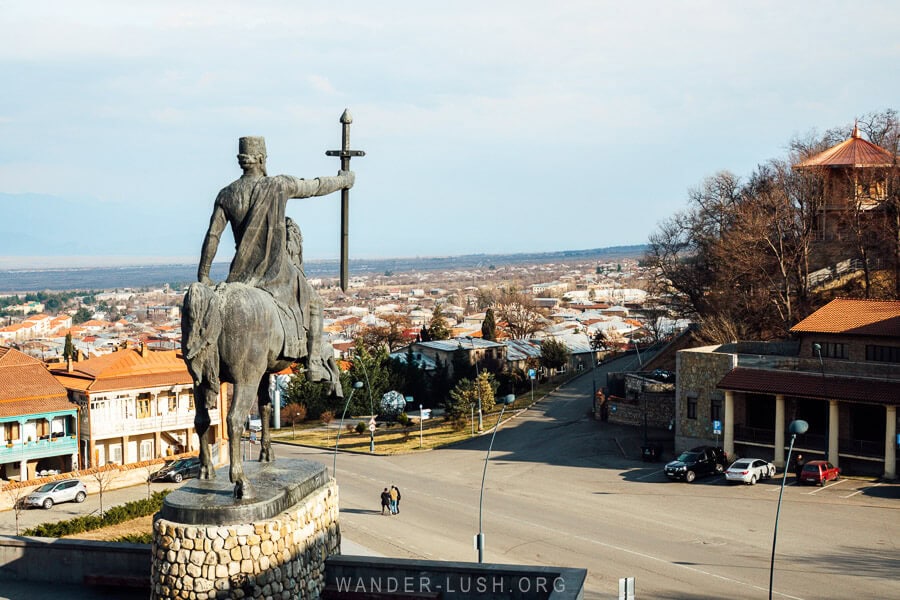


Telavi
*** Telavi Bazaar
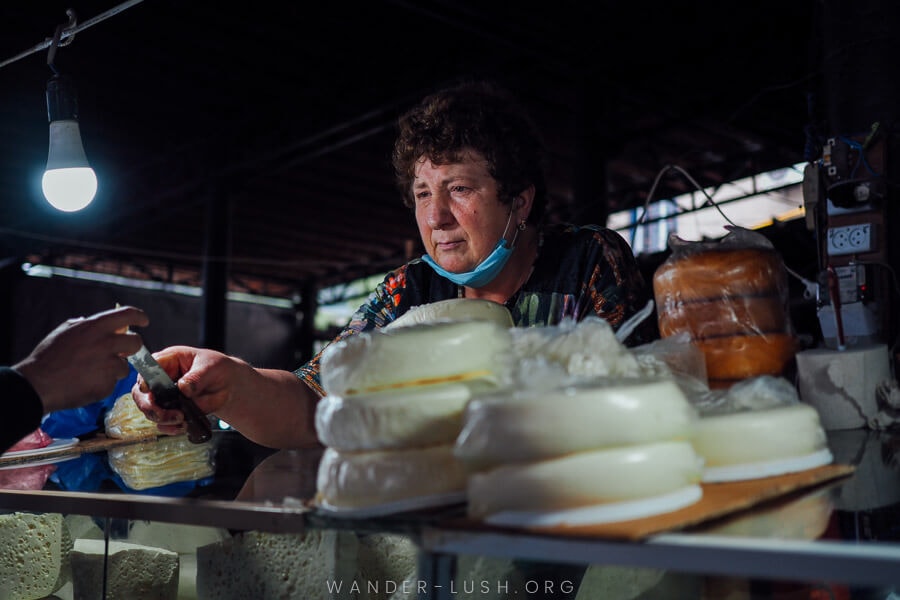
Set under a domed roof and open on all sides, Telavi’s local bazaar is a cacophony of colour, chaos and commerce. Visit in the mid-morning to see the market at its liveliest, keeping your eyes peeled for churchkhela, cheese, and other local specialties.
*** Batonis Tsikhe & Telavi Historical Museum
Telavi is built across a hillside, with the higher part of the city dominated by Batonis Tsikhe. The ‘Master Fortress’ or ‘Prince’s Fortress’ was reconstructed in the 17th century and comprises ramparts, towers, and an inner compound with a royal palace and bathhouses.
The modern museum within the fortress grounds is one of the best in Georgia, with a beautiful collection of paintings and ethnographic objects from the region. The ticket price also includes entrance to the restored palace where King Erekle II was both born, and died.
The Historical Museum is open from 10am-5pm Tuesday-Sunday (closed Mondays). Entrance costs 5 GEL.

*** Cholokashvili Street
Every house in Telavi is a work of art, especially the balconied facades on Cholokashvili Street. This is one of the oldest cobbled streets in Telavi, and is known for its heritage homes. Stop in at Kera ceramic studio to pick up a souvenir.

*** Odlisi Cheese Bar
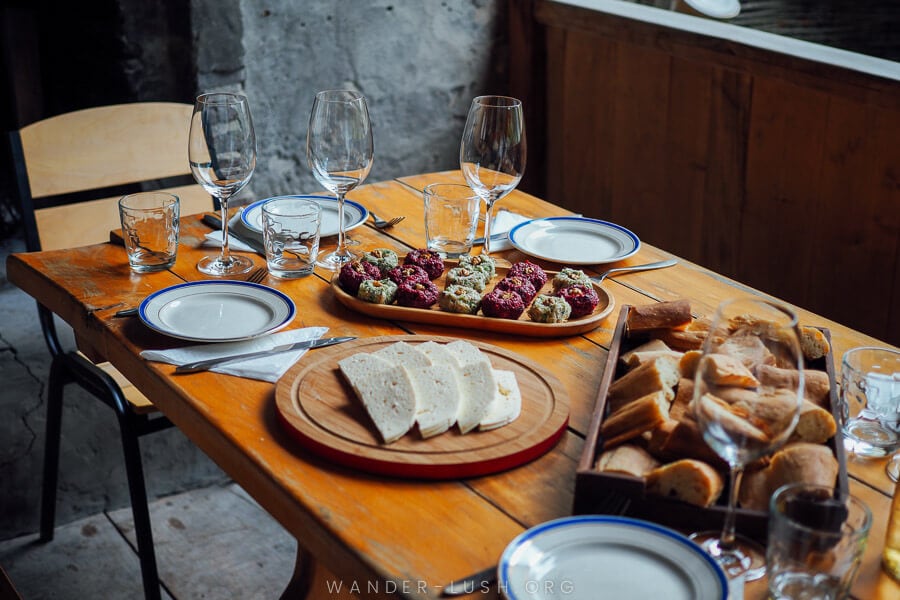
Located on Cholokashvili Street, Odlisi offers one of the most memorable foodie experiences in all of Georgia. This cheese atelier and bar is run by a beautiful family (Rati, Maka, and their three daughters) who produce around 30 different cheeses from their Swiss village cows!
Cheese degustations are available by appointment, and make for a rather special lunch. Maka has an incredible flare for design, and the table spreads she puts on are pure magic.
Message them a few days in advance to reserve a table.


→ Read my full guide for more things to do in Telavi plus restaurant and wine bar recommendations.
North of Telavi
** Dzveli Shuamta’s Monastery
I missed this monastery on my first visit to Kakheti, but having visited a couple of times now, it’s a firm favourite. There are two Shuamta monasteries, an old one, and a new one. Dzveli Shuamta (the older of the pair) is the more picturesque.
It sits even deeper in the forest, and can be reached via a two-kilometre walking path or by road. The top of the monastery mirrors the peaks of the Greater Caucasus behind. Akhali Shuamta – New Shuamta Monastery – is located closer to the highway. Both are open to visitors from 9am daily.
Note: If you’re short on time on day 3, you could visit Shuamta Monastery on the last morning on the way back to Tbilisi from Telavi.

*** Alaverdi Monastery
Before monastery fatigue inevitably sets in, pay a visit to Alaverdi – the biggest church in Kakheti, and the second-tallest in Georgia after Sameba Cathedral in Tbilisi. It is impressive in the truest sense of the word and shouldn’t be skipped.
Sitting smack bang in the middle of the plain, surrounded by vines and fields, Alaverdi was built in the 11th century. It is hemmed in by tall defensive walls, and also includes a small vineyard of rare grape varieties, an apiary, and a small cemetery.
The grounds and cathedral are open from 10am until 4pm daily (from 9am on Sundays). The dress-code is strictly enforced: women should borrow an apron skirt and a scarf from the gift shop before entering.

** Ikalto Monastery & Academy
This complex dates back to the 6th century, making it one of the oldest monasteries in Kakheti. Similar to Gelati near Kutaisi, it was a centre of education and learning. Highlights of the compact grounds include the Church of Transfiguration, and the crumbling ruins of an old academy where Shota Rustaveli (Georgia’s national poet) studied in the 12th century. The grounds are scattered with antique qvevri.

** Zaza’s qvevri workshop
Zaza Kbilashvili is a master qvevri builder whose workshop is located off the main road between Telavi and Ikalto. During a short tour, you get to see how the wvevri-building process unfolds, from raw clay to fired vessel.
There are very few Qvevri masters still working in Georgia so seeing this process up close is a true honour. Zaza also has a small cellar where he makes his own wine and brandy.
Advance bookings are essential, and Zaza speaks limited English, so it’s best to go with a guide. Eat This! Tours sometimes include a visit to Zaza’s place as part of their Telavi itinerary – be sure to request it when you make your booking.

* Akido Winery
If you have time for a wine tasting at this point in the day, Akido is a wonderful choice. Not only do they have an authentic dirt-floor cellar that backs right onto the vineyard, they also have a beautifully restored Kakhetian house on the property that is set up like a mini museum. Wine tastings are hosted on the veranda.
Advance bookings are essential.
If you’ve run out of time, you can save today’s wine tastings for the vineyards south of Telavi.
South of Telavi
*** Tsinandali Estate & Chavchavadze House Museum
The house and estate of Georgian poet/militaryman/aristocrat Alexander Chavchavadze is a must-visit near Telavi. Sign up for a guided tour of the house and its restored rooms for a taste of how the other half lived in 19th century Georgia.
The first bottle of Kakhetian qvevri wine – a saperavi – was corked here in the ‘European style’, marking the beginning of commercial winemaking in Georgia. The museum displays Chavchavadze’s personal collection of ephemera, while the enoteca houses vintage bottles. The latter is the highlight of the whole experience, but easy to miss – walk up to the Radisson Hotel and staff will point you in the right direction.
The restored estate grounds feature a sprawling garden. Hidden somewhere in the undergrowth is a statue of Lenin’s head.
Tsinandali Estate is open daily from 10am until 6pm Tuesday to Sunday (closed Mondays). A visit to the House Museum of Alexander Chavchavadze and enoteca costs 10 GEL.

** Wineries in Shalauri & Kisishevi
If you have time to squeeze a couple more wineries in, Shalauri village 20 minutes outside Telavi has a number of cellars where you can eat dinner and partake in one final tasting.
Togonidze’s Wine Cellar is run by an artist-winemaker couple who have decorated their home with beautiful hand-painted details. They offer home-cooked meals, wine tastings, and onsite accommodation.
Shalauri Wine Cellar is a medium-sized boutique winery that produces qvevri wines exclusively. Tastings are available for 40-70 GEL.

Mosmieri Kakheti Wine Centre (pictured below) in Kisishevi, between Tsinandali and Telavi, is a commercial winery and chateau that offers formal wine degustations and meals on an outdoor terrace. I really enjoyed the food here on my last visit and would recommend eating dinner here before returning to Telavi for the night.


Day 4: Back to Tbilisi via the Gombori Pass
The quickest way back to Tbilisi from Telavi is via the incredibly pretty (and very windy!) Gombori Pass, one of Georgia’s most scenic roads.

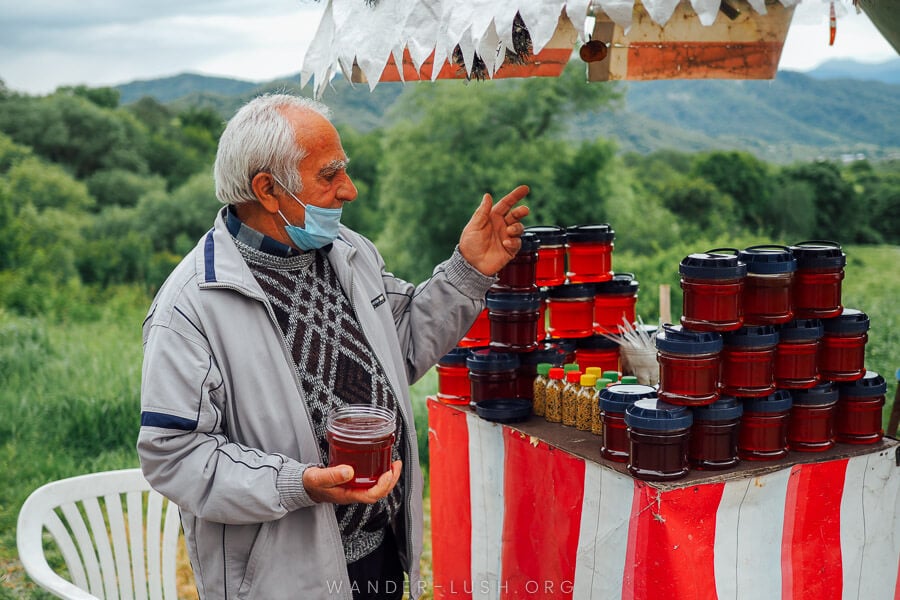
Along the verdant Gombori Pass, you will see vendors selling honey. There is a cafe at the highest point of the road, and a marked lookout point where it’s safe to pull over for a photo.
Ujarma Fortress lies at roughly the halfway point and is a good place to break the journey after crossing the pass. The complex dates to the 3rd century and has been partially restored, with walkways and lookout points added to the stone ruins.
The complex is accessed via a short but steep path that opens up on the left-hand side of the highway. Entrance costs 10 GEL.

Kakheti Map

Less time in Kakheti? Recommended Kakheti day trips
If you only have a day to spend in Kakheti, I strongly recommend joining an organised day tour from Tbilisi or hiring a driver through GoTrip. You’ll only get to see a very small part of Kakheti, but a taste is better than nothing.
On my second visit to Georgia, I joined two friends on a full-day wine tour from Tbilisi. There wasn’t too much driving involved, and we got to see a good range of wineries plus Bodbe Convent. All in all, it was a great experience.
I have since travelled to Kakheti with a number of other tour providers. After extensive research, my preferred company for wine tours in Georgia is Eat This! Tours, a small international outfit based in Tbilisi that focuses on authentic experiences and small family wineries. Many of their guides are trained sommeliers. If you want an in-depth wine experience in Kakheti, these are the folks to travel with. Read more about my recent experience with Eat This! here.
Eat This! offers a range of pre-designed Kakheti itineraries, including day trips and 1-2 night trips. My top pick is definitely the Vines and Mountains 1-day tour that focuses on Telavi. Check prices and availability here, and mention wanderlush in the coupon code to get 5% off your booking.


If you’re OK with something more casual, here are a couple of recommended Kakheti day trips from Tbilisi offered by other companies I know and trust:
Option 1: Grand tour to Kakheti with Friendly.ge. This private tour offers a very comprehensive introduction to the region and is perfect if you only have one day for Kakheti. This company has terrific guides and designs special itineraries that are a cut above the rest. More information and bookings here (use the code WANDERLUSH to save 10%).
Option 2: Kakheti and Sighnaghi Private Tour with Friendly.ge. This alternative itinerary covers less ground, but includes the walled town of Sighnaghi plus a couple of unique foodie experiences. More information and bookings here (use the code WANDERLUSH to get 10% off).
Option 3: Kakheti Region Full-day Group Tour with Gamarjoba Tours. Perfect for budget travellers who want a taste of the major highlights. Gamarjoba guides are professional and very engaging – I love travelling with this company. More information and bookings here.
Another option is to hire a car and driver through GoTrip for the day. You won’t have a guide per se, but you will have greater flexibility to explore the region. One of the best things about GoTrip is that you can make as many stops as you like without the price increasing.
Here is a sample day trip itinerary that you can customise. To give you an idea of the price, a visit to Bodbe Convent plus a few of the region’s best wineries with pick-up and drop-off in Tbilisi included costs as little as 200 GEL for the whole car.

Other places to visit in Kakheti
David Gareja Cave Monastery & Udabno
David Gareja, the incredible cave monastery that straddles the border of Kakheti and Azerbaijan, is one of Georgia’s highlights. Some people choose to visit as a day trip from Kakheti, and many guesthouses offer this option.
It might look close on a map – but because of the way the road runs (almost all the way back to Tbilisi), it takes the same amount of time to get to David Gareja from Sighnaghi as it does from Tbilisi.
In my opinion, it’s much better to visit the monastery as a day trip from Tbilisi instead and save your time in Kakheti for other wine-related activities.
DedoplisTskaro
Located in the southern part of Kakheti close to the border with Azerbaijan, Dedoplistskaro (‘Queen’s Spring’) is home to some fantastic (and lesser-visited) wineries including Nasrashvili Family Winery.
One of my favourite craft studios, Pesvebi Art-Studio, is based here and offers studio visits and carpet-weaving masterclasses.
This town is the gateway to the incredible landscapes of Vashlovani National Park and the spectacular Big Shiraki abandoned Soviet airfield.
Read my Dedoplistskaro Travel Guide for more things to do and travel tips.
Alvani
The twin villages of Zemo and Kvemo Alvani are located at the foot of the mountains in the northern part of the Alazani Valley. This is the jumping-off point for Tusheti, Georgia’s most remote mountain region, and as the place where most Tush families spend their winters, it’s also a stronghold of Tushetian culture.
There are a few wineries to visit, including Papa Zurabo Cellar, plus felt craft producers and Kakheti’s only wool-spinning factory.
Onward travel from Kakheti
If you’re travelling on to western Georgia then you’ll first need to transit back through Tbilisi. You can quite easily make it to Gori or Kutaisi on the same day.
If you plan to continue on to Kazbegi via the Military Highway, you can take the ‘back road’ through Tianeti to join up with the Military Road at Zhinvali. This road is fully sealed and an excellent drive.
Another option is to head east further into Kakheti to visit Lagodekhi Nature Reserve. From there, you can continue onward into Azerbaijan via the border pass at Matsimi. (Note that the Azerbaijan land border is currently closed to inbound travellers and will not reopen before October 1, 2025.)
If it’s the right season (usually the pass is open from mid-June to early October), you can head north from Telavi into Tusheti National Park via Alvani and take in some of Georgia’s most magnificent mountain scenery. Stop off in Pankisi Valley along the way and spend a few nights at Nazy’s Guest House, one of the finest homestays in the country.
It’s possible to make any of these trips from Telavi (or from Sighnaghi via Telavi). Check marshrutka times locally, or ask at your hotel/guesthouse for assistance.
Georgia essentials
Here are the websites and services I personally use and recommend for Georgia. Check out my full list of travel resources for more tips.
FLIGHTS: Search for affordable flights to Tbilisi, Batumi or Kutaisi on Skyscanner.
TRAVEL INSURANCE: Insure your trip with HeyMondo, my preferred provider for single-trip and annual travel insurance (get 5% off when you book with my link).
SIM CARD: Magti is my preferred provider, with prices starting from 9 GEL/week for unlimited data. See this guide for all the details about buying a Georgian SIM card.
AIRPORT TRANSFERS: Most flights into Georgia arrive in the early hours. For ease, pre-book a private transfer from Tbilisi Airport to your hotel (from $19) or from Kutaisi Airport to Tbilisi (from $90) with my partners at GoTrip.ge.
ACCOMMODATION: Booking.com is the most widely used platform in Georgia. Use it to find family guesthouses, private apartments, hostels and hotels around the country.
CAR HIRE: Find a great deal on a rental car in Georgia – use the Local Rent website to book through a local agent (prices start from $20/day).
DAY TRIPS & CITY TOURS: Use Viator or Get Your Guide to browse a range of day trips and city tours. For off-beat programs, I recommend Friendly.ge (use the promocode wanderlush for 10% off). For in-depth day trips to Georgia’s wine regions, I recommend Eat This! Tours (use the promo code wanderlush for 5% off).
PRIVATE TRANSFERS: GoTrip.ge is a terrific service for booking a private professional driver and car for the day. Use it for A-to-B transfers, a customised round-trip itinerary, or a multi-day trip. You can stop wherever you like for as long as you like without the fixed price going up.
NEED SOME HELP?: Need feedback on your itinerary or personalised travel tips? I offer a one-on-one consultation call service for Tbilisi and Georgia. More information and bookings here.


